
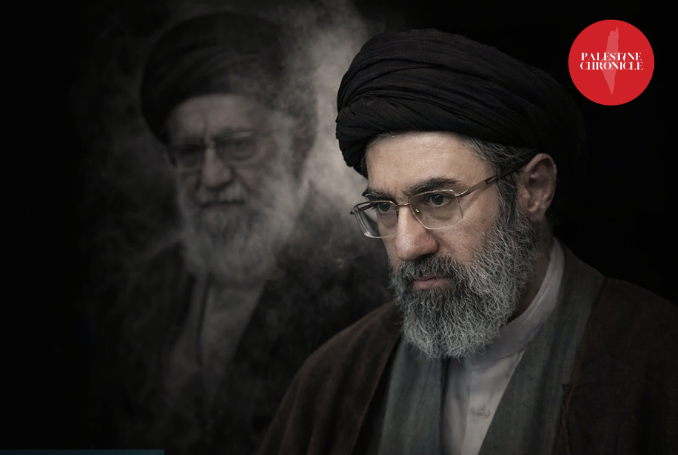
By Palestine Chronicle Editors
Misreading “diya” distorts Iran’s message, obscuring a deeper moral framework guiding its response, rhetoric, and future posture.
Key Takeaways
- Iran’s leadership often draws on layered religious and civilizational language that cannot be reduced to literal translation.
- The term ‘diya’ signals moral accountability and structured response, not transactional “price” or simple retaliation.
- Misinterpretation risks misunderstanding Iran’s strategic behavior during conflict and its long-term political posture.
On March 18, 2026, amid a rapidly escalating confrontation between Iran, Israel, and the United States, and in the immediate aftermath of the assassination of senior Iranian political and security figures—including Ali Larijani—Iran’s new spiritual leader, Mojtaba Khamenei, issued a condolence and political message that quickly circulated across regional media.
The timing of the statement is critical. It came during a moment of acute national trauma and transition, only days into intensified military exchanges and shortly after the killing of figures closely associated with Iran’s political and strategic establishment. It also followed his emergence into a more visible leadership role after the assassination of his father, marking one of his earliest defining public interventions at a moment of war and uncertainty.
In Arabic coverage dated around March 18, 2026, particularly by Al Mayadeen, citing Iranian sources, the statement appeared in its most striking form:
“لكل دم دية… دية دم يجب على القتلة المجرمين لهؤلاء الشهداء دفعها قريباً” — “For every blood there is diya… a blood-compensation that the criminal killers of these martyrs must soon pay.”
Yet in much of the English-language reporting—and even in some Arabic outlets such as Al Jazeera—the phrase was flattened into a far more limited rendering: “every drop of blood has a price.” (The Palestine Chronicle, too used the standard english rendering at the time.)
The difference between these formulations is not semantic. It is conceptual. And it is precisely this gap that makes understanding the term ‘diya’ essential to interpreting Iran’s discourse at this moment.
Why does language matter in moments of war?
Language is never neutral, particularly in moments of war. When senior Iranian leadership speaks—especially at a time of upheaval following the assassination of central figures—every word carries historical weight, moral framing, and political intent.
This is especially true in March 2026, where Iran is not only responding to external military pressure but also undergoing an internal moment of symbolic consolidation. In such contexts, language becomes a tool of both communication and positioning—directed simultaneously at domestic audiences, regional actors, and international observers. It signals not only what Iran intends to do, but how it understands what has been done to it.
This is why the phrase attributed to Iran’s new spiritual leader, “for every blood there is diya,” demands careful attention. Its widespread translation into English as “price” is not simply imprecise; it obscures the very framework through which Iran understands justice, accountability, and response.
What shapes Iran’s political language?
Iran is not merely a modern nation-state reacting in real time. It is the product of millennia of civilizational experience, shaped by Persian political traditions, Islamic jurisprudence, and a deeply embedded moral vocabulary.
Its language reflects this synthesis. Terms are rarely used casually; they are chosen because they resonate across legal, religious, and cultural registers simultaneously. In moments of crisis, such as the March 2026 escalation, this layered language becomes even more deliberate, serving as a bridge between past and present, law and politics, belief and strategy.
To interpret such language narrowly—through the lens of modern political shorthand—is to strip it of its meaning and, more importantly, to miss the signals it is intended to convey.
What does diya actually mean?
The term diya is a case in point. In Islamic jurisprudence, diya refers to a form of compensation for unjust killing or injury. Yet to describe it as a “price” is fundamentally misleading.
A price suggests equivalence, a transactional exchange in which a life can be measured and compensated materially. Diya, by contrast, belongs to a moral and legal system that does not commodify life. It operates within a broader framework that includes qisas (retaliation) and forgiveness, offering the victim’s family a range of responses rooted in justice, restraint, and reconciliation.
It is a form of accountability that acknowledges harm while preserving the moral weight of life itself, resisting its reduction to a simple metric of exchange. It reflects a worldview in which justice is not only punitive but also restorative, balancing the rights of individuals with the stability of the broader social order.
Is diya about compensation or accountability?
What diya signifies, therefore, is not valuation but responsibility. It acknowledges that harm creates a moral and social imbalance that must be addressed.
It is a form of accountability that can coexist with restraint, and in some cases, even transcend retaliation. Historically, it functioned as a mechanism to prevent cycles of vengeance, allowing societies to absorb loss without descending into perpetual violence.
In this sense, diya is not the opposite of justice, but one of its most structured expressions—one that recognizes that justice must be both firm and socially sustainable.
Why was the term used in this speech?
When this term is invoked in a contemporary political speech, it is not being used in a narrow legal sense. It is being mobilized rhetorically to signal that bloodshed—particularly unjust bloodshed—creates an obligation.
That obligation is not optional, nor is it purely emotional. It is structured, inevitable, and embedded within a moral universe that demands response. It signals that what has occurred is not an isolated act of violence, but a breach that must be addressed within a recognized framework of justice.
In the context of March 2026, this language also serves to unify domestic audiences, reinforcing the idea that the response to such events is not arbitrary, but anchored in deeply understood principles.
What went wrong in translation?
This is precisely where translation failures become consequential. Many English-language reports rendered the phrase as “every drop of blood has a price,” flattening the concept into a crude expression of retaliation.
Even some Arabic coverage, notably by Al Jazeera, opted for the more generic term thaman (price), rather than preserving the specific reference to diya. This is particularly striking given that diya is a shared concept across Arabic and Persian Islamic traditions, deeply embedded in both linguistic and cultural frameworks.
The result is not just a linguistic simplification, but a conceptual distortion that risks misrepresenting the intent behind the statement.
Why is the difference so important?
The shift from diya to “price” is not a minor linguistic adjustment. It alters the entire meaning of the statement.
What in its original form signals a structured moral accountability becomes, in translation, a simplified language of equivalence. One reflects a worldview grounded in ethical tradition; the other reduces it to a narrow, transactional reading that aligns more closely with external assumptions than internal meaning.
Such shifts matter because they shape how audiences interpret intent, legitimacy, and proportionality.
How does this shape Iran’s response to war?
Understanding this distinction is critical for interpreting Iran’s broader discourse and behavior, particularly in a context it frames as self-defense. When Iranian leaders respond to aggression, their rhetoric is not merely reactive.
It is framed within a narrative of historical continuity, moral duty, and collective memory. Concepts like diya situate contemporary events within that continuum, linking present actions to a deeper tradition of justice and resistance.
This does not make Iran’s response predictable in a conventional sense, but it does make it intelligible within its own framework.
What does this suggest about Iran’s future posture?
This also has implications for how Iran may act beyond the immediate moment of conflict. If its leadership is invoking concepts rooted in accountability rather than pure retaliation, this suggests a strategic posture that is both deliberate and internally coherent.
It does not imply restraint in the conventional sense, but it does indicate that responses are framed as fulfilling an obligation rather than pursuing escalation for its own sake. This distinction is essential for understanding how Iran calibrates its actions over time.
Why does leadership language matter now?
Moreover, the fact that such language is used at the highest levels—particularly by a new spiritual leader consolidating authority—underscores its importance. Leadership transitions in Iran are not merely political events; they are also moments of symbolic rearticulation.
The choice of words in such moments signals continuity, legitimacy, and alignment with foundational principles. It communicates not only intent, but identity, reinforcing the idea that the system remains anchored in its core values even in moments of crisis.
What does “for every blood there is diya” ultimately convey?
In this sense, the phrase is not just a statement. It is a declaration of framework. It communicates that the loss of life will not be absorbed silently, but neither is it reduced to a simple calculus of retaliation.
It affirms that there is an order—moral, legal, and historical—within which response will unfold. To miss this is to misunderstand not only the statement itself, but the broader logic of Iranian discourse.
(The Palestine Chronicle)
As a writer and editor, the obvious way to render this in English is:
“For every drop of blood there must be accountability”
Unfortunately, as you say, the Western media does not seek to reflect the sense accurately, let alone sympathetically