
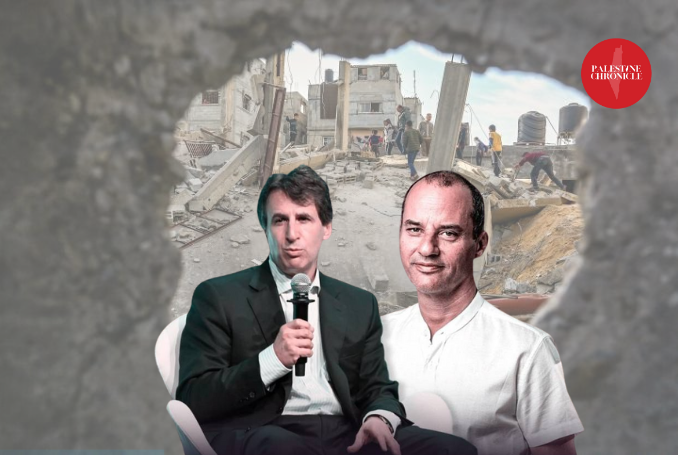
The White House’s Gaza ‘Board of Peace’ includes two multibillionaire businessmen, raising questions about investment priorities, reconstruction control, and political influence in postwar Gaza.
The White House’s announcement of the so-called “Board of Peace” for Gaza has drawn attention to the presence of powerful business figures whose personal fortunes run into the billions, underscoring the economic and political weight shaping Gaza’s postwar reconstruction.
Among the members named to the US-led body are American billionaire Marc Rowan and Israeli businessman Yakir Gabay, both of whom hold extensive global investments and are expected to play key roles in financing and structuring reconstruction efforts in the devastated enclave.
The board, unveiled on Friday as part of President Donald Trump’s 20-point plan for Gaza, includes senior US officials and international figures such as Secretary of State Marco Rubio, Special Envoy Steve Witkoff, Jared Kushner, former UK Prime Minister Tony Blair, World Bank President Ajay Banga, and US national security adviser Robert Gabriel.
Washington has presented the initiative as a mechanism to oversee Gaza’s transition from war to reconstruction. However, analysts note that the inclusion of major private capital figures suggests an emphasis on investment-driven rebuilding, following an Israeli war that has destroyed an estimated 85 percent of Gaza’s territory.
White House Unveils Gaza ‘Board of Peace’ — Who Will Control Gaza’s Next Phase?
Marc Rowan: Architect of Global Capital
Marc Rowan, an American billionaire investor and co-founder of Apollo Global Management, is among the most prominent financial figures on the board. Born in 1962, Rowan currently serves as Apollo’s chief executive officer and is widely regarded as one of the firm’s principal strategists.
Apollo Global Management is one of the world’s largest alternative investment firms, with assets under management estimated at $785 billion in 2025, according to Forbes. Under Rowan’s leadership since 2021, the firm has expanded its global footprint across private equity, credit markets, and large-scale acquisitions.
Rowan’s personal wealth is estimated at approximately $8.2 billion, based on Forbes’ 2026 rankings. He has also been active in philanthropic initiatives and is known for supporting organizations focused on combating antisemitism.
Observers say Rowan is likely to play a central role in designing complex financial structures aimed at attracting private global capital to Gaza, shifting reconstruction from emergency relief toward long-term investment in what is widely viewed as a high-risk environment.
Second Phase Opens with Bloodshed as Israel Kills Palestinians in Gaza
Yakir Gabay: Real Estate and Political Ties
Israeli businessman Yakir Gabay, who also holds Cypriot citizenship, is another key figure named to the board. Gabay is a major player in European real estate and is expected to focus on housing solutions and investment models for Gaza’s massive displacement crisis.
Gabay owns approximately 15 percent of Aroundtown, Europe’s largest commercial real estate company by assets under management. The firm’s portfolio is valued at around $30 billion and spans Germany, the Netherlands, and the United Kingdom, according to Forbes.
His personal fortune is estimated at $4.1 billion as of January 2026. Gabay began his career at Israel’s Securities Authority before moving into the private sector, later serving as chief executive of the underwriting arm of Bank Leumi. He entered the real estate market in the early 2000s, capitalizing on depressed property prices in Berlin before expanding across major European cities.
Gabay also comes from a family with deep institutional ties in Israel. His father, Meir Gabay, served as director-general of Israel’s Ministry of Justice and as civil service commissioner. His mother, Yemima Gabay, held a senior position in the public prosecution and headed the pardons department at Israel’s Ministry of Justice.
Civil Engineer, Ali Shaath, to Head Gaza Technocratic Committee – Who is He?
Reconstruction Through Capital
The inclusion of Rowan and Gabay on the Board of Peace has prompted scrutiny over how Gaza’s reconstruction will be shaped, particularly regarding investment conditions, ownership structures, and political oversight.
Critics argue that the heavy presence of private capital figures risks transforming reconstruction into a market-driven project, detached from Palestinian political self-determination, accountability for wartime destruction, and the ongoing reality of Israeli military control and restrictions.
The board’s work begins as Gaza remains under siege, with widespread destruction, mass displacement, and continued Israeli violations of the ceasefire, raising questions about whether reconstruction can proceed without addressing the underlying political and humanitarian conditions.
(QNN, PC)


” conflict of interest ” a little??
Gaza reconstruction plotting and double dealing will go hyper, especially if a nuke is spirited into Tel Aviv and detonated remotely.