By Andrew Meyer
The whole of UK policy on Palestine — at home and abroad — is only intelligible in racist, Islamophobic, and revisionist terms.
With grief and shock over the horrific attack on Bondi Beach still raw, influential figures in British politics wasted no time turning tragedy into political leverage. Almost immediately, the violence was seized upon as a pretext to revive a long-standing agenda – recasting the international movement against Israeli colonization and apartheid as an existential threat.
Bondi became the latest entry point in a familiar relay, where tragedy is converted into accusation, accusation into the criminalization of language, and language into guilt by association. Muslim presence is rendered suspect by default while the wider movement for Palestinian rights is disciplined as extremism by proximity. The question shifts accordingly – no longer concerning what happened in Sydney, or how violence might actually be prevented, but how far surveillance, restriction, and silencing can be expanded in the name of “safety.” Crucially, this grammar does not remain at the level of commentary. It travels through briefings, hearings, and police practice until it hardens into a domestic method.
Unsurprisingly, no one raced faster to operationalize this method than Dave Rich, Director of Policy at the Community Security Trust. Conceding in his recent Guardian op-ed that the world had “yet to discover the detailed motivations of the Bondi attackers,” he transformed this ignorance into indictment, stretching to implicate the global Palestine solidarity movement itself. The absurdity is worth quoting:
“Like it or not, it seems [the pro-Palestine movement] has generated and sustained a political culture in which violence is both conceivable and enacted. Shooting Jews celebrating Hanukkah is the most extreme manifestation of this hatred. But in sentiment, in the message it sends Jews, it is little different from the ‘Free Palestine’ graffiti scrawled on a Hanukkah menorah in north London…”
This is the hinge on which a wider operation turns, coming to bear significantly not only on the Palestine solidarity movement, but also on any political action which challenges the state’s position. The supposed violence endorsed or committed by such groups is not discovered, but produced, manufactured through strategically narrowed definitions that allow speech to be reclassified as crime. Once this maneuver is conceded, evidence becomes secondary. The state’s task is no longer to demonstrate harm, but to assert the authority to decide what words mean. From there, enforcement follows automatically.
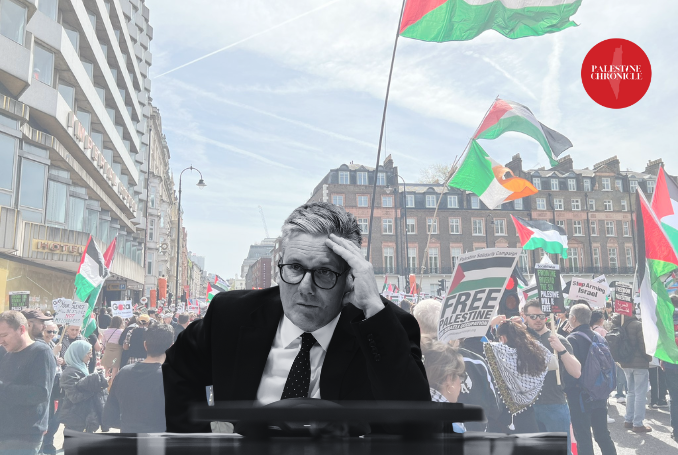
For Rich, Keir Starmer and others throughout the UK government, this logic now centers on phrases such as “globalise the intifada.” Downing Street has insisted “there is no other interpretation” of the phrase other than a call to attack Jewish communities worldwide. Once meaning is declared settled, inquiry becomes unnecessary, because only enforcement can follow.
This is a well-rehearsed semantic trap with devastating consequences. Language is ripped from its historical and political context, while disparate political currents across the Middle East–along with international movements to challenge injustice there–are collapsed into a single amorphous menace. This is not an analytical failure but calculated dehumanisation that strips people of history, antecedents, and political being until only a threat remains.
Edward Said captured this logic with unusual precision, arguing:
“[T]he main thing is to isolate your enemy from time, from causality, from prior action, and thereby to portray him or her as ontologically and gratuitously interested in wreaking havoc for its own sake. Thus, if you can show that…Moslems, Palestinian’s and Arabs, generally speaking, have no reality except that which…confirms their terrorist essence as…Moslems, Palestinians, and Arabs, you can go on to attack them and their ‘terrorist’ states generally, and avoid all questions about your own behavior or about your share in their present fate.”
With the proper level of Islamophobia in place, terms like intifada can be emptied of linguistic and political meaning and recast as symbols of terror. The prefabricated specter of Islamic terrorism erases the evidentiary burden and allows smearing of the pro-Palestine movement to appear as analysis. Rich and Starmer will bank on the likelihood that most of the public will not recognize the complexity these terms carry, nor distinguish between them — a public primed to hear Arabic never as meaning, only as peril. “Intifada” becomes “jihad,” becomes “sharia” in a single, sinister blur.
But these terms do not belong to the state, nor its police forces. Intifada has long been part of the Palestinian struggle, but it also carries meaning in broader Arabic usage. The Dictionary of Palestinian Political Terms, published by the Palestinian Academic Society for the Study of International Affairs (PASSIA), glosses “intifada” as a “civil uprising” while also noting its literal sense of “shaking off” — a reminder that no single English rendering can carry the term’s full political and cultural weight. Denijal Jegić shows that the word is derived from the verb which translates to “shudder,” “shiver,” or “tremble,” used to describe the shaking off of everything from dust to colonial oppression.
Meanings are contested, and multiple interpretations can be argued in good faith. What cannot be substantiated is the claim the intifada merely incites violence against Jews. That assertion is a calculated smear, sustained only through repetition rather than evidence. More troubling still is what this maneuver trains the public to accept – that Muslim presence itself constitutes risk. Once that training is complete, the move from op-ed to institution is seamless. “Threat” no longer needs to be demonstrated, only named and policed.
While many in the British public have long understood this Islamophobic foundation, the current rhetorical architecture matters profoundly in the current time of Israeli genocide. It reappears, almost intact, whenever state repression requires the disciplining of on-the-ground politics seeking to challenge its allies.
This dynamic was on full display during the Home Affairs Committee hearing on January 6, 2026, ostensibly convened to examine West Midlands Police’s decision to restrict Maccabi Tel Aviv supporters from traveling to Birmingham for a match against Aston Villa. The evidentiary question should have been straightforward: what behavior was anticipated, and from whom? Instead, the panel — filled with members of Conservative Friends of Israel, Labour Friends of Israel, the Board of Deputies of British Jews, and the wife of the government’s adviser on antisemitism — repeatedly drifted toward the more profitable morality play, instead asking if the police treated Israeli fans as a “problem” in themselves.
This displacement was remarkable given the facts. In the case of the Maccabi Tel Aviv fans, the question of “risk” should not be speculative, symbolic, nor difficult, as the record of the traveling fan base is not a matter of interpretation. The facts surrounding these supporters — especially those who travel to away matches — are crystal clear. Countless videos are widely available, showing thousands of the club’s supporters singing songs such as “We will win, we will win, let the Israeli army win, f— the Arabs” and “Why is school out in Gaza? There are no children left there.”
Just one month after the situation in Birmingham, the Union of European Football Associations handed down a €20,000 fine and a one-match ban for traveling fans after “racist and/or discriminatory behavior” during the team’s game against German side Stuttgart. A peer review commissioned by the police force summarized a Dutch police briefing describing the Tel Aviv contingent as “well organized,” “militaristic”, and “prepared to confront and fight officers,” alongside reports of attacks on Muslim taxi drivers, Palestinian flags being torn down and burned, and racist chanting. Regardless of what one thinks about the current situation in historic Palestine, the club’s fans are a documented threat to the communities they travel to.
However, with this reality unable to match the pre-fabricated mission of the committee, the question was necessarily muddied. The evidence session routinely drifted elsewhere, toward insinuations about why the police had engaged with Muslim communities ahead of its decision and whether those engagements represented “community reassurance” or capitulation. MP Joani Reid asked directly, without presenting a shred of evidence, “Why did you decide to consult with…four or five mosques, institutions, and organizations in the area that have well-documented…incidences [sic] of antisemitism and extremism?”
Mike O’Hara, the Assistant Chief Constable, noted that engagement with all local communities is a tactic for assessing risk regardless of the question at hand. But Reid’s Islamophobic reflex here is no mistake. It presents the assumption that Muslim presence in any chain of engagement is itself suspect, while Israeli far-right football politics can be handled as an unfortunate “perception problem” rather than what the facts show — an organized traveling cohort with a track record of targeting racialized locals and generating exactly the kind of public disorder the state claims, in every other context, to prevent.
In other words, the committee displaced the evidentiary question — from what Maccabi supporters do, to what Muslims in Birmingham and their allies in the Palestine solidarity movement supposedly are. This should be of no surprise, as a bad-faith discourse that insists there is “no other interpretation” of certain language will, with perfect consistency, insist there is no innocent interpretation of Muslim civic presence either.
Given this, it is no surprise that Reid circled back to the Bondi Beach and Manchester synagogue tragedies, as if these events have any bearing on the issue of banning football fans. Having collapsed everything into one undifferentiated threat, she could then perform the final reversal — the claim that Muslims are the beneficiaries of state indulgence, and Jews the abandoned minority. As she drowned in an inch of water, Reid could only offer that she finds it “hard to believe that this approach would have been taken had it been any other minority group.”
This is the level of conclusory statement we can expect when following the vacuous logic of Rich, Starmer, Reid, and the rest. What remains then is not a debate about a word, or even about a football match, but the steady installation of a governing reflex where Muslim life is rendered legible as threat, solidarity with Palestine as extremism, and immense state repression as “protection.”
The international community should understand the institutional motivations for this repression and not mistake these developments for a parochial culture war.
– Andrew Meyer is a researcher and writer based in Manchester, England. He holds a PhD in Politics from the University of California, Santa Cruz, and is a former policy analyst at the Rachel Corrie Foundation. He can be reached at ajmeyer@ucsc.edu. He contributed this article to the Palestine Chronicle.