

Around a clay oven in a Gaza displacement camp, stories of loss, memory and return transform survival into an act of belonging.
When we returned to the clay oven during the war, we did not know that we were returning to it as one returns to an old home forgotten in another time. The clay oven in the displacement camp was small, round-backed and black-mouthed, standing at the edge of the place as if it were waiting for someone. It was not beautiful in the way we usually understand beauty, but it carried something that resembled comfort. Whenever the fire was lit inside it, families began gathering around it, one after another, as if the smoke rising from its mouth were calling our names.
Umm Mohammad came carrying a bowl of dough. Umm Reem brought a tray of potatoes. Another woman carried a few eggplants to roast, while a small child arrived with a metal cup of water he wanted to warm for his baby sister. The clay oven was no longer simply a place for preparing food. It became a communal kitchen for the displaced, a gathering place, a café without chairs, a school without a blackboard, a clinic for memory, and a place where people separated by war could meet again.
Reem, nine years old, was always the first to arrive at the oven every evening. She would sit on a nearby stone and watch the fire with wide eyes, remaining silent until her mother began turning the bread. One evening she asked me, “Does the fire know the way to our home?”
I did not know what to say. I looked at her mother, who smiled sadly and said, “Of course it does.”
Reem turned back toward the fire and asked, “Even if the house is far away?”
Her mother answered, “The fire knows roads that we do not know.”
From that day on, Reem began sitting in front of the oven every evening, as if waiting for a small map to emerge from the flames and lead her back to her home in Khan Yunis, to her room, to the doll she had left on her bed, and to the window from which she used to see the lemon tree. She said that her house had not died; it had only fallen asleep, and that when she returned she would open the door quietly so as not to wake the walls.
Near her sat Abu Mohammad, the gravedigger, a fifty-seven-year-old man whose face looked older than his years. He kept his shovel beside him even when he sat around the clay oven. Abu Mohammad buried those whom the war had taken, and he knew many names that no one else knew.
One day Samer, the forty-two-year-old teacher, asked him, “Abu Mohammad, how many graves have you dug since the beginning of the war?”
The man remained silent for a moment, then said, “I do not count them.”
Samer asked, “Why?”
He answered, “Because if I start counting, I will have to remember the faces.”
He took a warm loaf of bread, tore it with his hands, and said, “Do you know what hurts me? It is not that I dig a grave for the dead. It is that I know there is a home behind every dead person that was waiting for them.”
Everyone fell silent.
Abu Mohammad continued, “Sometimes, while I am digging, I imagine that the owner of the grave will return tomorrow, knock on his door, and his wife will open it. He will say to her, ‘I am late today.’”
Then he gave a small smile and said, “But I know he will never return.”
Mahmoud, the thirty-four-year-old ambulance driver, came to the oven whenever his shift ended. He knew the roads better than anyone, yet he said he no longer knew the road to his own home.
One evening he said, “I knew every street in the city. I knew where the alleys began and ended. I knew the fastest route to the hospital, where the pharmacy was, and which road we could take if one of the streets was blocked. But the war taught me that a road can disappear.”
Reem asked him, “Have you forgotten the road to your house?”
He looked at her and laughed. “No, I know it. But I do not know what I will find when I get there.”
Then he fell silent for a long time and added, “I miss the road itself. I miss the wall I used to pass, the fig tree, the little grocery shop, even the hole in the middle of the street.”
We all laughed.
He said, “Sometimes you do not miss the big things. You miss the things you once thought were annoying.”
Samer, the teacher, came to the oven carrying a small notebook. He sat near the fire and asked the children to write their names. He used to say that a school could exist anywhere, that a wall could become a blackboard, that the ground could become a notebook, and that a clay oven could become a classroom if children gathered around it.
One day he drew the word “home” on the ground and asked the children, “Who knows this word?”
Reem raised her hand.
He asked her, “What does home mean?”
She answered, “The place we return to.”
Samer looked at her for a long moment and said, “Exactly.”
After a moment, he asked, “And what if we cannot return?”
She raised her head and said, “Then we return to it through the story.”
The teacher had no answer. He took his notebook and wrote down her sentence.
The writer also sat with us. His name was Hani, forty-eight years old, and he said that the war had forced him to redefine writing. Sometimes he wrote in a small notebook, sometimes on a piece of cardboard, and sometimes on the back of a piece of paper he found in the camp.
One evening Umm Khalil, the seventy-three-year-old grandmother, asked him, “What are you writing, Hani?”
He said, “I am writing what I am afraid of forgetting.” She asked, “And the people?” He replied, “I am writing them too.” She asked, “Why?” He answered, “Because war tries to turn us into numbers, and I want to give our names back to us.”
Umm Khalil lifted her head and said, “Then write my name.”
He said, “Umm Khalil.” She laughed and said, “No. Write my real name. People have called me Umm Khalil for fifty years, but I was a girl before I became a mother and a grandmother.”
Then she told him her name, and she kept smiling.
Umm Khalil knew a great deal about homes. She used to say that a home was not only walls. A home was the sound of a door opening, the smell of coffee in the morning, the place where the water jug stood, the chair where the father sat, the dress hanging behind the door, the mother calling her children, and the smell of bread when it came out of the oven.
She used to say, “Homes do not only shelter us; they live inside us too.”
One evening she placed her hand on the clay oven and said, “We had one like this.”
Reem asked her, “Where is it?” She answered, “At home.”
Then she paused and added, “Or perhaps it was the home that was inside it.”
The children did not understand what she meant, but we adults did. Home had become something larger than a place. It had become memory. It had become a voice, a smell, a picture, a road we did not know when we would reach.
While Umm Khalil was speaking, Reem’s mother placed the tray of potatoes inside the oven. Mahmoud warmed the water. Abu Mohammad roasted the eggplants. Samer checked the children’s notebooks, and Hani wrote. The fire burned in the middle of us, and each of us placed something into it and took something else from it.
A woman placed dough and took out bread. A man placed potatoes and took out food. A child placed a cup of water and took warmth.
As for us, we placed our fear and took a story.
That is why the clay oven was no longer merely an oven. It became a small place where we could recover what the war had taken from us. There, around the fire, no one asked the other how many days they had spent displaced, how many homes they had lost, or how many times they had run beneath the sound of bombardment.
We talked about small things because small things were the last pieces of life we still possessed. We talked about our mothers’ bread, the trees in front of our houses, school mornings, the smell of the sea, grandmother’s coffee, a child who fell asleep before the story ended, and a home that was still waiting for its people.
And every evening, when the fire began to die down, Reem asked the same question: “When will we go back?”
No one answered.
Abu Mohammad looked at the ground. Mahmoud looked at the sky. Samer closed his notebook. Hani put his pen in his pocket. Umm Khalil stretched her hands toward the last warmth inside the oven.
Then she said, “We will return.”
She did not know when. She had no proof. But she said it as if the return were an appointment written somewhere, and all we had to do was wait.
And late at night, when everyone had left, a small ember remained glowing inside the heart of the clay oven. No one put it out completely. We left it there until morning, because the war had taught us that small things can be stronger than we imagine.
A warm loaf of bread could say that life was still possible. A cup of warm water could say that we still cared for our children. A roasted eggplant could bring back the taste of home. And a child’s story could make the road home feel shorter.
Perhaps that is why, when we return to our homes one day, we will never forget the clay oven. We will leave a place for it in our memory, because it not only baked our bread. It baked for us a small piece of life in the middle of war, and gathered around it a little girl, a gravedigger, an ambulance driver, a teacher, a writer, and a grandmother, making them, for a few hours at least, one family waiting for the same thing: for the night to end, for the war to fall silent, and for each of us to open the door of our home and say: We are back.
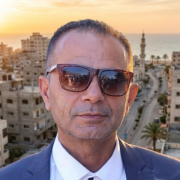
– Hani Al-Salmi is a Palestinian writer from the Gaza Strip. He has published more than twenty novels and children’s stories and has received literary awards throughout the Arab world. Al-Salmi remains in Gaza, where he and his family continue to endure the realities of war, displacement, and siege. He contributed this piece to The Palestine Chronicle.




Hani al-Salmy’s writings are like a dagger to the heart, but there is always infinite hope in them.
I agree!