

New satellite imagery and thermal data indicate significant damage to Saudi oil infrastructure following Yemeni missile and drone operations over the weekend.
Key Takeaways
- Satellite imagery shows damage at Aramco facilities in Yanbu and Abqaiq following Yemeni strikes.
- Thermal anomaly data indicates major fires at Yanbu Industrial City coinciding with Saturday’s attacks.
- The reported damage has coincided with a sharp decline in Saudi oil exports through the Red Sea.
Satellite Images Reveal Damage
Satellite imagery captured on Monday appears to show significant damage to Saudi Arabia’s oil infrastructure following Yemeni missile and drone operations over the weekend.
The images show burn scars surrounding a Saudi Aramco spherical storage tank at the Yanbu Bulk Plant on the Red Sea coast, suggesting the facility sustained damage during the attacks.
Nearby, the Alhamrani-Fuchs Blending & Grease Plant in Yanbu Industrial City appears to have suffered substantially heavier damage, with large sections of the facility showing signs of extensive fire damage.
Yemen Announces New Operations
The satellite images follow an announcement by Yemeni Armed Forces spokesperson Brigadier General Yahya Saree that Sana’a had carried out two major operations against Saudi Arabia in response to what he described as Riyadh’s “blatant and criminal aggression.”
According to Saree, the first operation targeted facilities in Jizan using dozens of ballistic missiles and drones.
BREAKING: Saudi Aramco’s Abqaiq refinery has been struck by drones, causing a massive fire at the facility and the East-West Pumping Station. NASA FIRMS satellite imagery confirms extensive fire activity at the site.
Abqaiq is the world’s largest crude oil stabilization plant,… pic.twitter.com/2pxF02N47C
— The Hormuz Letter (@HormuzLetter) July 27, 2026
The second targeted Aramco-affiliated facilities in Yanbu with ballistic missiles, cruise missiles, and drones.
On Monday, Yemeni forces announced another operation against Yanbu, saying they had struck “several targets and critical points” along the supply and transportation routes carrying crude oil from eastern Saudi Arabia to the Red Sea export terminal.
Thermal Data Supports Reports of Fires
Independent analysis of thermal anomaly data supports reports of damage in Yanbu.
Thermal imagery recorded two fires of approximately 120 megawatts each at opposite ends of the Alhamrani-Fuchs Blending & Grease Plant on Saturday.
Analysts noted that no comparable thermal anomalies had been recorded at the site during any other day in July, suggesting the fires coincided with the reported Yemeni attack.
Export Capacity Declines
The reported strikes have coincided with a significant decline in Saudi oil exports through Yanbu.
According to Windward’s analysis of Vortexa shipping data, crude loading volumes at Yanbu have fallen by nearly 40 percent since July 19, dropping from approximately 5.16 million barrels per day to around 3.09 million barrels per day.
Further south, Saudi Aramco reportedly shut down its 400,000-barrel-per-day Jizan refinery after Saturday’s strikes damaged the facility’s Integrated Gasification Combined Cycle complex and tank farm.
The resulting fire has reportedly continued burning since the attack, with Aramco aiming to resume operations by mid-August.
Iranian allies reportedly struck ARAMCO refinery related facilities in Abqaiq, Saudi Arabia, with drones.
Nasa Firms confirms there are massive fires captured on satellite imagery.
Saudi Arabia has blamed resistance groups in Iraq for the attack and says it reserves the right… https://t.co/lSdJEuJGpg pic.twitter.com/kVTMVYjHmj
— Arya Yadegaar (@AryJeayBackup) July 27, 2026
Damage Reported at Abqaiq
Satellite imagery also indicates damage at Saudi Aramco’s Abqaiq crude-processing facility in eastern Saudi Arabia.
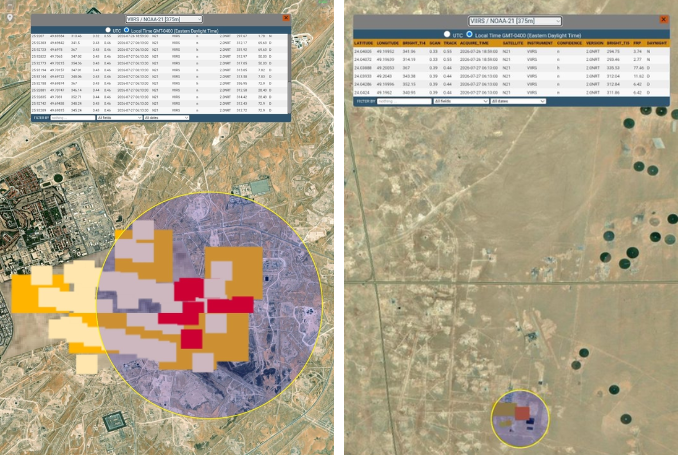
NASA’s Fire Information for Resource Management System (FIRMS) recorded multiple active hotspots at the site following a reported Yemeni drone strike.
Open-source intelligence analysts, citing Sentinel-2 imagery, reported burn scars across four of Abqaiq’s six crude-processing spheroids, with two appearing to have been destroyed.
Abqaiq is one of the world’s most important oil-processing facilities, handling an estimated 5 to 7 percent of global oil production.
The damage spans key components of Saudi Arabia’s east-to-west energy infrastructure.
With Abqaiq affected on the eastern end of the East-West Pipeline and both Yanbu and Jizan sustaining reported damage on the Red Sea coast, analysts say Saudi Arabia’s principal export corridor bypassing the Strait of Hormuz has come under unprecedented pressure.
(PC, Al Mayadeen)