
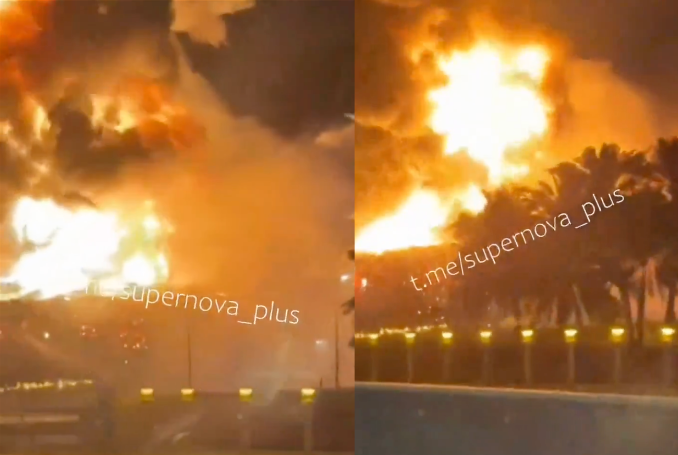

Drone attacks hit UAE energy infrastructure, as tanker damage and Hormuz tensions push oil prices higher and disrupt regional production.
Key Developments
- Drone attacks forced the shutdown of the Shah gas field and sparked a fire in Fujairah’s energy zone.
- A tanker was hit by an unidentified projectile near Fujairah, causing structural damage.
- UAE oil production has fallen by more than half, according to Reuters sources.
Drone Attacks Disrupt UAE Energy Infrastructure
The UAE suspended operations at the Shah gas field on Tuesday following a drone attack, while another strike caused a fire in the Fujairah petroleum industries area.
Local authorities said no injuries were reported in either incident.
The Shah field, located about 180 kilometers southwest of Abu Dhabi, is one of the world’s largest sour gas fields.
The attack has added pressure on the UAE’s energy sector, which is already facing disruptions due to the ongoing regional escalation.
Shah oil field in UAE is burning after Iranian drone strikes – The war is now almost impossible for anyone to contain. pic.twitter.com/iXI5U8fOAK
— Ashok Swain (@ashoswai) March 16, 2026
Tanker Hit Near Fujairah
The United Kingdom Maritime Trade Operations (UKMTO) said in a statement on Tuesday that it received a report that a tanker was hit by an unidentified projectile 23 nautical miles east of Fujairah.
The crew reported that the vessel sustained structural damage while docked, according to the agency.
The incident is part of a series of attacks targeting shipping routes and energy infrastructure in the Gulf.
Reuters news agency, citing two informed sources, reported that the UAE’s daily oil production has fallen by more than half since the start of the conflict and the effective closure of the Strait of Hormuz.
The disruption has forced the Abu Dhabi National Oil Company (ADNOC) to significantly reduce output.
Oil loading operations at Fujairah port, a key export hub, were also suspended twice in recent days following drone attacks, before partially resuming.
Iran Launches New Missile Wave as Hezbollah Intensifies Attacks, Gulf States Hit
Iran Issues Warnings
Iran’s Revolutionary Guard had previously warned US forces in the region, stating: “O soldiers of the United States, leave the region immediately or we will bury you under the rubble wherever you are.”
Iranian officials maintain that their attacks target only military sites and bases linked to the aggression, and that they respect the sovereignty of regional states.
An Iranian military spokesman also called on residents in the UAE to evacuate areas near ports, docks and locations hosting US forces.
Meanwhile, oil prices rose sharply on Tuesday as concerns grew over supply disruptions.
Brent crude increased by 4% to $104.22 per barrel, while US West Texas Intermediate rose 4.06% to $97.30.
Analysts said markets remain focused on the duration of the conflict and the impact on supply routes through the Strait of Hormuz.
Tony Sycamore, a market analyst at IG, said that “the risks remain high,” warning that even limited attacks on tankers could escalate tensions further.
No Time for Losers: Why the War Meant to ‘Save’ Israel May Destroy It
Hormuz Disruption Raises Global Concerns
The Strait of Hormuz, through which about 20% of global oil and gas trade passes, is experiencing major disruptions as the war enters its third week.
Tehran says the strait remains open but is effectively closed to its “enemies” involved in the aggression.
The New York Times reported that the Trump administration has acknowledged that Iran’s ability to disrupt global energy markets is greater than previously expected.
Iranian lawmaker Ibrahim Rezaei warned Washington, saying: “If it approaches the Strait of Hormuz, it should prepare coffins for its soldiers.”
The ongoing escalation continues to raise fears of wider conflict, supply shortages and rising global energy prices.
(PC, Al Mayadeen, New York Times)