
Severe winter weather has worsened Gaza’s humanitarian crisis, with authorities warning that the lack of shelter, reconstruction materials, and heating is turning every storm into a life-threatening emergency for displaced families.
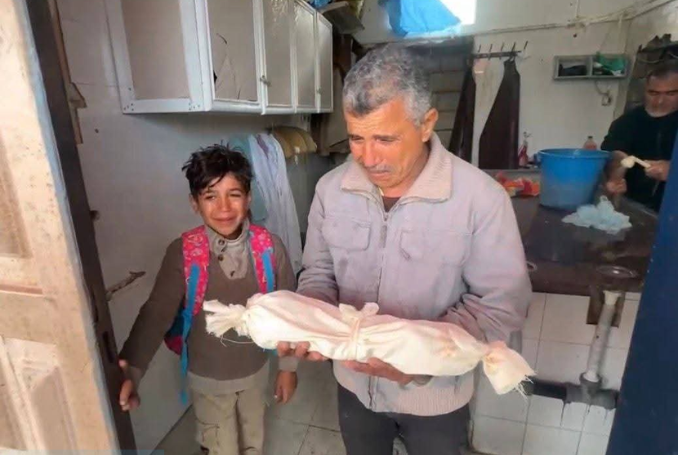
Hospitals in Gaza have reported the death of a Palestinian infant due to severe cold weather in Deir al-Balah, central Gaza, as a new winter storm intensifies the suffering of displaced families living in tents, amid warnings of an impending humanitarian disaster.
According to medical sources, a seven-day-old infant, Mahmoud al-Aqra, was brought to Al-Aqsa Martyrs Hospital, where doctors pronounced him dead after he was exposed to extreme cold in the absence of adequate heating.
Official data indicate that four children have died from cold exposure inside displacement tents across the Gaza Strip, as residents continue to endure dire humanitarian conditions.
He was only one week old… before the cold extinguished the breaths of the infant Mahmoud Al-Aqra in Gaza. pic.twitter.com/F5fV2Y4XpS
— Osama Abu Rabee أسامة أبوربيع (@dn_osama_rabee) January 10, 2026
Gaza’s Civil Defense said that every low-pressure weather system turns into a humanitarian catastrophe due to Israel’s continued ban on the entry of construction materials and the obstruction of reconstruction efforts.
The Civil Defense warned of a looming “catastrophe” caused by the latest storm, which has inflicted severe damage on temporary shelter conditions, with thousands of tents completely destroyed.
The agency urged displaced residents to secure their tents to prevent them from being blown away, noting that Israel continues to prohibit the entry of mobile housing units.
Civil Defense spokesperson Mahmoud Basal said in a statement that what is unfolding “is not a weather crisis, but a direct result of the ban on construction materials and the obstruction of reconstruction,” adding that people are living in torn tents and structurally damaged homes “without safety or dignity.”
Basal noted that some Palestinians have been forced to erect tents along the seashore due to the lack of available space inside cities, following the widespread Israeli destruction of residential areas.
He stressed that conditions in Gaza “do not meet even the minimum humanitarian standards and constitute a flagrant violation of humanitarian principles and international humanitarian law.”
🇵🇸 Este bebé, llamado Mahmoud al-Aqra, de Gaza, murió esta noche a causa del frío intenso de las tiendas. ¡Dos mil millones de musulmanes no pudieron salvarlo ni consolar su pequeño corazón!#FreePalestine 🇵🇸 #ZionismFascism 🇮🇱 pic.twitter.com/XEvEPbUqGl
— IA castillo ✳️🇵🇸🇨🇺 🇪🇭☭ (@uharteko1956295) January 10, 2026
Meanwhile, local media reported that hundreds of tents were damaged by strong winds, as the Palestinian Meteorological Department warned that severe winds and low temperatures are expected to continue, with gusts reaching up to 60 kilometers per hour.
Israeli airstrikes targeting the outskirts of Al-Shati refugee camp, northwest of Gaza City, also caused damage to displacement tents and destroyed their contents, forcing displaced families to sleep in the open.
A new low-pressure system began affecting Gaza on Friday, bringing heavy rain and strong winds. Palestinian meteorologists said on Saturday that scattered rainfall remains possible in some areas, accompanied by powerful winds.
Since the ceasefire agreement came into effect on October 10, Israel has failed to uphold its commitments, including allowing the entry of shelter materials such as tents and mobile homes, as well as construction materials needed for reconstruction and for repairing water and sewage networks, according to official data.
During the previous winter storm at the end of December, hundreds of displacement tents along the coast of Khan Yunis were flooded by rising sea waves.
Since December, successive winter storms have caused the collapse of dozens of residential buildings previously damaged by Israeli bombardment, resulting in casualties.
Teetering on the Brink of Genocide: Why Netanyahu is Keen on Prolonging the Gaza War
These weather systems have further exacerbated Gaza’s humanitarian crisis, which has seen no meaningful improvement despite the end of the war, due to Israel’s continued failure to comply with the ceasefire agreement.
The agreement brought to an end a genocidal war launched by Israel on October 8, 2023, which lasted two years and resulted in more than 71,000 Palestinians killed, over 171,000 wounded, and massive destruction affecting 90 percent of civilian infrastructure. The United Nations has estimated reconstruction costs at approximately $70 billion.
(PC, AJA, Palestinian Media)