
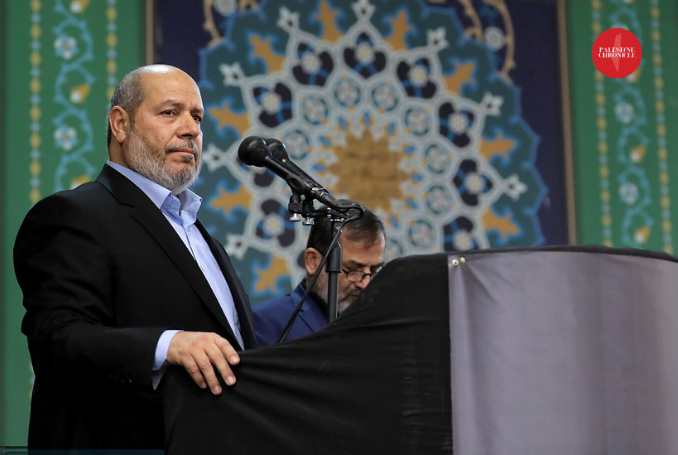

Hamas has elected veteran political leader Khalil al-Hayya to head its political bureau, succeeding former movement chief Yahya Sinwar.
Key Takeaways
- Hamas announced Khalil al-Hayya’s election as head of its political bureau following a second round of internal voting.
- The Gaza-born leader has held senior political, organizational and negotiating roles within Hamas during a career spanning more than four decades.
- Al-Hayya has survived several Israeli assassination attempts and lost four sons and numerous relatives in Israeli attacks since 2007.
Who is the Veteran Leader?
The Palestinian Resistance Movement Hamas announced on Monday the election of Khalil al-Hayya as the new head of its political bureau, succeeding Yahya Sinwar, who was killed during a direct clash with Israeli occupation forces in Rafah in October 2024.
According to information released by the movement, al-Hayya was elected following a second round of voting that decided the contest between him and former political bureau chief Khaled Meshaal, in accordance with Hamas’ internal regulations.
Khalil al-Hayya Reappears after Assassination Attempt, Honors Son Killed by Israel
The announcement came one day after the movement denied media reports concerning the progress and outcome of its internal leadership elections.
Al-Hayya, a veteran political leader, academic and negotiator, has occupied numerous senior positions within Hamas since the movement’s establishment in 1987. In recent years, he emerged as one of its most visible representatives abroad and played a central role in indirect ceasefire and prisoner-exchange negotiations.
His election concludes a transitional period during which Hamas was managed through a temporary five-member leadership council formed after Sinwar’s killing. The council was headed by Mohammed Darwish, who has also served as chairman of the movement’s Shura Council.
Sinwar had been unanimously selected to lead Hamas in August 2024, following the assassination of Ismail Haniyeh in Tehran on July 31 of that year. Al-Hayya was subsequently named Sinwar’s deputy.
From Gaza’s Mosques to the Political Bureau
Khalil Ismail al-Hayya was born in Gaza City on November 5, 1960, into a Palestinian family closely connected to the national struggle.
His early childhood was shaped by the Israeli occupation of the Gaza Strip following the 1967 war. Al-Hayya has recalled witnessing Israeli soldiers storm his family’s home and arrest relatives, including his uncle.
Israeli Media Reveal Foiled Plan to Kill Hamas Leader Khalil al-Hayya in Beirut
He attended Hattin Primary School, Hashem Bin Abdul Manaf Preparatory School and Yafa Secondary School in Gaza. He later studied at the Islamic University of Gaza, graduating from its Faculty of Fundamentals of Religion in 1983.
Al-Hayya received a scholarship to continue his studies at the University of Jordan, where he earned a master’s degree in Sunnah and Hadith studies in 1986. He later obtained a doctorate in the same field from Sudan’s University of the Holy Quran and Islamic Sciences in 1997.
His relationship with Sheikh Ahmed Yassin, the founder of Hamas, began in 1980 and marked his transition from individual religious practice to organized political, social and resistance activity.
While studying at university, al-Hayya became active in the Islamic Bloc and later joined the Islamic Movement associated with the Muslim Brotherhood. Other young activists involved in the movement during that period included Ismail Haniyeh and Yahya Sinwar.
He was first arrested by Israeli occupation forces in 1980 and detained for approximately six weeks. He was arrested again in 1982 and reportedly subjected to severe torture during a week-long detention.
During the mid-1980s, al-Hayya participated in popular, religious and organizational work. He served as an imam and preacher and contributed to organizational efforts aimed at confronting Israeli infiltration and protecting Palestinian society in the Gaza Strip.
He was among the activists who participated in the First Palestinian Intifada, which began in December 1987, and in the emergence of Hamas as an organized Palestinian resistance movement.
Israeli occupation forces arrested him for a third time in 1991 amid his growing involvement in student, union and political activities.
Alongside his political work, al-Hayya pursued an academic career at the Islamic University of Gaza. He returned to the institution as a teaching assistant in the Faculty of Fundamentals of Religion in 1984 and later served as assistant dean and dean of student affairs.
He was also elected vice president of the university’s workers’ union in 1998 and became its president in 2001. His academic work additionally led to his membership in the Association of Palestinian Scholars.
Al-Hayya’s national political profile expanded considerably during the 2006 Palestinian legislative elections. Running on Hamas’ Change and Reform list, he won a seat representing Gaza and was selected to head the movement’s parliamentary bloc in the Palestinian Legislative Council.
Within Hamas, he progressed through a series of senior organizational positions, including membership in the political bureau, deputy leadership of the movement in Gaza and leadership of its Arab and Islamic Relations Office.
‘Negotiate by Fire’: Al-Hayya Says Assassinations Will Not Break Hamas
A Central Figure in Palestinian Negotiations
Al-Hayya became increasingly prominent in Hamas’ diplomatic and political activities following Israel’s major attacks on the Gaza Strip in 2012 and 2014.
He participated in the Palestinian movement’s delegations during indirect negotiations in Cairo and was entrusted with key media, political and regional relations responsibilities.
Following the launch of the Al-Aqsa Flood operation and the beginning of Israel’s genocide in Gaza in October 2023, al-Hayya became one of Hamas’ most important political representatives outside Palestine.
He had left the Gaza Strip shortly before October 7 as part of a redistribution of leadership responsibilities, assuming responsibility for foreign relations alongside other members of the political bureau.
In November 2023, al-Hayya headed a Hamas delegation to Lebanon, where it met then-Hezbollah Secretary-General Hassan Nasrallah after the announcement of a prisoner-exchange agreement between Hamas and Israel.
His role became even more significant following the assassinations of Haniyeh and Sinwar. Al-Hayya led Hamas’ negotiating delegation in successive rounds of indirect talks mediated by Egypt, Qatar and the United States.
These negotiations addressed a ceasefire, an end to the Israeli genocide, the withdrawal of occupation forces from Gaza, the return of displaced Palestinians, humanitarian aid and a prisoner exchange.
The indirect talks eventually resulted in the announcement of a ceasefire agreement in Sharm el-Sheikh in October 2025 under Egyptian, Qatari and US mediation.
Al-Hayya’s extensive experience in negotiations, relations with Arab and Islamic countries, and long-standing connections within Hamas’ political and military structures positioned him as one of the leading candidates to succeed Sinwar.
Al-Hayya, Araqchi Discuss Gaza as Hamas Praises Iran’s Stance on Resistance Fronts
A Family Repeatedly Targeted
Al-Hayya’s political career has been marked by repeated Israeli attempts to assassinate him and devastating attacks against his family.
In 2007, an Israeli airstrike targeted his family residence in Gaza City’s Sheja’iyya neighborhood. Al-Hayya survived, but seven members of his extended family were killed, including two of his brothers, four nephews and a cousin.
His son Hamza, a member of the Al-Qassam Brigades, Hamas’ military wing, was killed on February 28, 2008, when an Israeli reconnaissance aircraft fired a missile at him.
On July 20, 2014, Israeli occupation aircraft targeted the home of al-Hayya’s eldest son, Osama, in eastern Gaza City. Osama, his wife and three of their children were killed in the attack.
Al-Hayya survived another Israeli assassination attempt on September 9, 2025, when an airstrike targeted a Hamas negotiating delegation during a meeting in the Qatari capital, Doha.
Hamas’ senior leadership survived the attack, but al-Hayya’s son Hammam, a member of his personal staff, and several others were killed.
Why Israel Assassinated Azzam al-Hayya — And What US Mediators Knew
On May 7, 2026, another of his sons, Azzam, succumbed to injuries sustained in an Israeli airstrike in Gaza City’s Al-Daraj neighborhood. His death brought to four the number of al-Hayya’s sons killed in Israeli attacks.
Despite these repeated losses, al-Hayya remained active in the movement’s political leadership and negotiations.
His elevation to Hamas’ highest political office places a Gaza-born founding figure at the head of the movement during one of the most consequential periods in modern Palestinian history.
As political bureau chief, al-Hayya will oversee Hamas’ internal and external political work, its relations with Palestinian factions and regional allies, and its approach to negotiations concerning Gaza and the wider Palestinian struggle.
His election also reflects a continuation of the leadership trajectory established under Haniyeh and Sinwar, both of whom were killed by Israel in 2024, while maintaining Gaza’s central role within the movement’s political and resistance structures.
(PC, Al Mayadeen, Al-Jazeera, Hamas statement)



