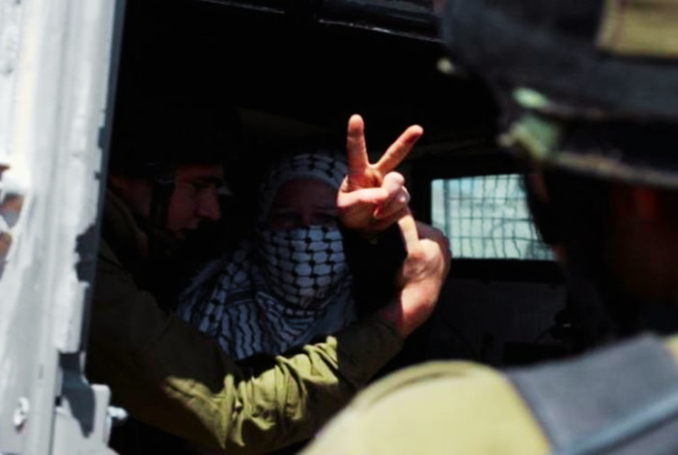
In its latest statement, the Palestinian Prisoners Club said the number of Palestinian female prisoners held in Israeli jails exceeded 90 during April.
Ali Shawahneh, 46, has no time to look for work. Since Israel arrested his wife, Amina Tawil, 36, from their home in Qalqilya, he has become both father and mother to their four children.
Amina had carried these responsibilities alone on several occasions while Israel imprisoned her husband. During his last detention, Ali spent two years in administrative detention and lost 75 kilograms. He had barely recovered when Israel arrested his wife, plunging the family into yet another cycle of hardship.
In its latest statement, the Palestinian Prisoners Club said the number of Palestinian female prisoners held in Israeli jails exceeded 90 during April. It noted that similar figures were previously recorded at the height of arrest campaigns in the occupied West Bank during the early months of the genocidal war and amid the targeting of women in Gaza.
The organization explained that most female prisoners are being held in Damon Prison, near Haifa, including two children, a woman in her third month of pregnancy, 25 administrative detainees, three journalists, two prisoners with cancer, and two women detained since before October 2023.
‘All My Words Failed Me’: Families of Palestinian Prisoners Confront Israel’s Execution Law’
‘Arrest Me Instead of Her’
Two days before Eid al-Fitr, on March 18, Amina was praying with her husband after their children had gone to sleep. She opened her phone to check the news and discovered that the Israeli army was raiding their neighborhood at that very moment.
Fear immediately gripped her that Ali would be arrested again, especially since Israeli forces had raided their house two weeks earlier solely to threaten him with detention.
Only minutes later, soldiers violently stormed the house and began shouting. When Ali saw the officer, he asked, “Why are you raiding the house? Didn’t you come here two weeks ago?” The officer replied, “I’m here today for your wife.”
“I was terrified when I heard that. I’m used to being arrested, but she can’t handle it. I was afraid for her and asked the officer to arrest me instead, but he refused, saying they wanted her. I asked them to give her just a few minutes to get dressed, and then the female soldiers started shouting at her to hurry up,” Ali told us.
For a full hour, Ali was confined with his children in one room while soldiers interrogated Amina in another.
The scene was heartbreaking for the children, who cried throughout the raid and begged the officer not to take their mother away. Instead, the soldiers handcuffed her in front of them and escorted her to a military vehicle.
Amina and Ali’s eldest child is eight years old, while the youngest is only three. Before her arrest, Amina had been suffering from weakness, dizziness, and nausea. After her detention, it was discovered that she was six weeks pregnant, deepening Ali’s fears for her health.
“She was interrogated for 25 days and then transferred to Damon Prison. They told her that her mother and I had been arrested just to frighten her and make her worry about the children. There are no specific charges; every time they mention a different accusation. Most recently, when they couldn’t prove anything against her, they said they would search her phone,” Ali explained.
‘I Liked the House’: When Israeli Soldiers Turn Palestinian Homes into Barracks
That same night, Israeli forces arrested 17 Palestinian women from Qalqilya alone. Most were later released, but four remained in detention. Three were placed under administrative detention, while Amina remains imprisoned with no clear information about her fate.
Ali is deeply concerned about her health, particularly given the malnutrition imposed on prisoners in Israeli jails. Amina already suffers from anemia, and the conditions are worsening the symptoms of her early pregnancy.
After spending a total of 19 years in Israeli prisons, Ali lost his job. Now, he cannot even leave home to look for work because he must care for his children. He cooks, cleans, washes clothes, prepares them for school, and manages every aspect of their daily lives.
“I’m in the final semester of my master’s degree in Nablus, and I have to take my children with me because I can’t leave them alone. I now understand the weight of responsibility my wife carried while I was imprisoned in Israeli jails,” he said.
Ali hopes the Israeli court will agree to release Amina, even under restrictive conditions such as house arrest, due to her health condition and pregnancy, which is not being monitored by medical personnel inside the prison.
However, on Monday, the Israeli court extended Amina’s detention for another eight days without explanation, leaving the family devastated and increasingly worried.
“The children cry for her every day. It breaks my heart, and I don’t know what to do. I try my best to make up for her absence, but a mother’s embrace is always the warmest thing for her children,” he concluded, visibly emotional.
A Real Danger
Female prisoners face harsh detention conditions, including starvation, medical neglect, abuse, solitary confinement, and invasive practices such as strip searches, according to the Palestinian Prisoners Club.
Most arrests of women are carried out under allegations of “incitement.” Since October 2023, more than 700 Palestinian women have been arrested across the occupied West Bank, Jerusalem, and the 1948 territories. Accurate figures for arrests in Gaza remain unavailable.
The Death Penalty Law: Another Tragedy for Palestinian Prisoners
“This escalation comes during one of the bloodiest periods for Palestinian women, amid ongoing grave violations, including physical and sexual assaults and the detention of women as hostages to pressure their families,” the statement added.
In February 2025, Israeli forces intercepted the vehicle of Fidaa Assaf, 50, as she was returning home to the village of Kafr Laqif in the northern West Bank after visiting Ramallah Governmental Hospital. Soldiers handcuffed and arrested her.
Fidaa was transferred between detention centers before being moved to Damon Prison, where she remains imprisoned and on trial more than a year later. Israeli prosecutors are reportedly seeking a two-year prison sentence.
Fidaa was diagnosed with leukemia in 2024. She underwent several treatment sessions and depends on lifelong medication.
Her brother, Raafat Al-Ashqar, told us the family is deeply worried about her health under the harsh conditions endured by female prisoners.
He explained that she was deprived of her medication for more than a month at the beginning of her detention, severely weakening her body. Her lawyer later requested that the prison administration provide her medication.
Fidaa struggled with infertility for 15 years before finally giving birth to her only daughter, Qatr Al-Nada, who is now 13 and suffering severe emotional distress due to her mother’s absence.
“She refuses to speak to anyone and prefers to sit alone in silence all the time. We are very worried about her mental state. She was extremely attached to her mother, and her absence is painful for her. We are sure it hurts her mother even more,” Raafat said.
Fidaa experiences recurring health complications, and only when her condition becomes severe is she transferred to the prison clinic, where she receives no meaningful medical follow-up for her illness.
Significant Challenges
Female prisoners endure compounded hardship due to the physical and psychological pressures imposed on them inside Israeli prisons.
Amani Sarahneh, spokesperson for the Palestinian Prisoners Club, told us that female prisoners face severe deprivation, particularly regarding their specific needs as women. She said the Israeli prison administration deliberately uses this deprivation as a form of punishment.
She added that female prisoners are subjected to constant abuse and humiliation, as well as arbitrary punishments such as solitary confinement. In many cases, a single cell holds between nine and ten prisoners without even the most basic necessities being provided.
“Among the female prisoners are doctors, journalists, lawyers, university students, activists, mothers, wives, and sisters and mothers of martyrs. At least 40 of the female prisoners are mothers, and most of the arrests are based on vague allegations of incitement,” Sarahneh said.
‘A Beating No Child Could Endure’: Israel Intensifies Arrests across West Bank
Two of the female prisoners are under the age of 18, including one child being held under administrative detention without charge.
“One of the most significant challenges facing female prisoners is the policy of humiliating strip searches carried out repeatedly from the moment of arrest until their transfer to Damon Prison,” she said.
“They are forced to remove their clothes under the pretext of inspection. Their cells are constantly raided and sprayed with tear gas. Police dogs are used during searches inside the cells, and the prisoners are forced to sit in degrading positions,” she explained.
During the recent weeks of military escalation involving Iran, at least four incidents of repression against female prisoners in Damon Prison were recorded, which Sarahneh described as extremely harsh.
(The Palestine Chronicle)
– Fayha’ Shalash is a Ramallah-based Palestinian journalist. She graduated from Birzeit University in 2008 and she has been working as a reporter and broadcaster ever since. Her articles appeared in several online publications. She contributed this article to The Palestine Chronicle.