“Every revolutionary thought translated into action is itself an act of resistance.”
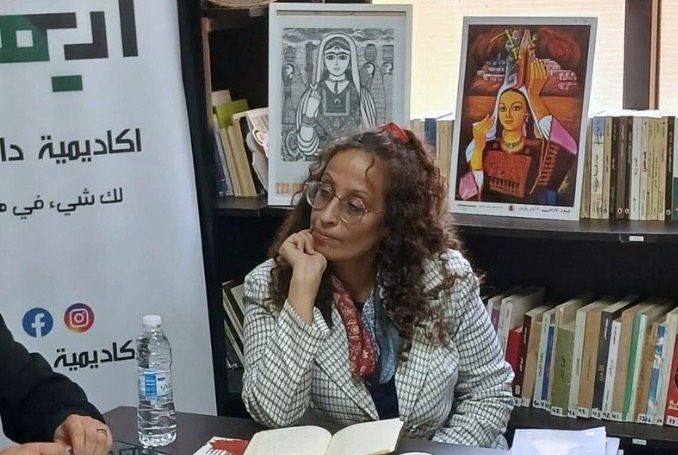
Sprayed with puddles, plotted in the shadows even amidst the heat of Beirut’s early summer, Mar Elias is deceptively labyrinthine, despite being the smallest of the refugee camps in the city. Through alleyways decorated with the posters of Palestinian and Lebanese resistance martyrs, between a thousand flags of Palestine and its factions, near to nursery run by the Ghassan Kanafani Foundation, cultural activist Taghrid Abdel-Al waits in the doorway of the unassuming Dar Al-Thaqafa Academy.
One among the faces of those killed in an ongoing war with a volatile Zionist occupier resembles Taghrid. Assassinated near Mar Elias along with three other activists on September 29, 2024, her uncle Nidal was a key organizer in the resistance activities of the Popular Front for the Liberation of Palestine (PFLP). He was also, uncoincidentally, a cultural figure who shaped her early consciousness: “His presence since childhood had a decisive influence on shaping my aesthetic and intellectual vision.”
Taghrid credits her father, Marwan, a renowned artist, writer, and political leader, as being among her greatest influences. He didn’t merely tell her: “this is what should be done,” she told us, but encouraged her to read voraciously and offered her the freedom to think.
“From my earliest awareness of the harsh realities of the Nahr Al-Bared camp, an inseparable equation was ingrained in me: creativity is a form of struggle, and struggle is the very essence of literature, freedom, and art,” she told The Palestine Chronicle.
Palestine Solidarity and the Songs of Sheikh Imam: The Culture and Politics Show
Uncle Nidal offered an “influence of a different kind, more subtle and far-reaching.” Becoming interested in poetry and reciting it to him, a young Taghrid discovered that such acts were directly linked to the struggle for Palestinian liberation: “Nidal dreamed of a different world and dedicated his heart to that dream. He taught me that art is not a luxury or an ornament, but rather an essence and a different perspective on the world, and that I should trust myself in a world suffocated by fear. In my early friendship with him, I felt that his courage wasn’t merely a rhetorical stance, but a profound love for the cause.”
Nurturing a Culture of Questioning
Working with children in UNRWA schools in Lebanon, Taghrid carried with her the convictions learned during her own childhood in a leftist environment. Her own commitments came, “not through an ‘inherited identity,’ as much as being an accumulation of knowledge,” and a mindset developed around critical culture and revolutionary thought, upholding values of loyalty, freedom, and revolutionary ethics:
“It was also an environment that nurtured its children to question, to critique, and to recreate meaning, rather than simply replicate it.”
Finding that the activist atmosphere she experienced in the camp gave her differing skills and qualities, Taghrid said that, through her educational work, “I brought to schools a different philosophy based on a progressive vision of humanity and education.”
Taghrid admitted that, at the time of our interview, she was still “reeling from the shock” of losing Nidal, in “that cowardly assassination through which the enemy tried to extinguish the flame of a spirit greater than death.” At the same time, she reflected on his entrusting her with a legacy that she felt duty-bound to transmit to the youth: “the legacy of reading, of thought, and of the insistence that everything in life be an instrument of resistance.”
A Right to Resist: People’s Tribunal Condemns Western Backing for Genocide
Remembering Nidal, Taghrid reflects on a metaphor suggesting life beyond the present Palestinian condition: “Our conversations were not only about literature, but about life and existence, about the sea and the eternal question: What lies beyond this sea? A question that was not mere curiosity, but the beginning of my struggle.”
“A Methodology for Linking Thought and Practice”
Now a visual artist and writer of three published collections of poetry and a book of paintings and drawings, Taghrid has taken on the responsibilities of executive coordinator at Dar Al-Thaqafa. A cultural organization involved in Palestinian refugee communities across Lebanon and Syria, the Academy seeks to involve exiled Palestinians in cultural activities and grassroots education.
Book launches, lectures, and talks by a range of Palestinian, Lebanese, and international contributors are counted among a busy program of events organized by Taghrid and her comrades over the past year.
These include discussions led by a veritable vanguard of intellectual strugglers, including Salah Salah, who left his native Tiberius as a child during the Zionist Nakba and became a prominent figure in the Palestinian left in Lebanon; a commemoration for the late Lebanese writer and revolutionary Samah Idriss; and discussion sessions on the role of culture during the Gaza genocide.
Featuring the contributions of Palestine Chronicle editors, our book Ghassan Kanafani: Selected Political Writings was received enthusiastically at a launch event in April 2025. Kanafani’s image is found in all of the Palestinian refugee camps, including in libraries at Dar Al-Thaqafa and the Al-Naqab children’s project in Borj Al-Barajneh camp are packed with his reading materials, available for all to read.
In a previous visit in 2023, Marwan Abdel-Al told us that, although he was only twelve when Kanafani was assassinated by the Zionist Mossad in 1972, he realized the enormity of his presence upon the outpouring of collective grief during his funeral procession. In the 1970s, said Marwan, “we all got to know who Ghassan was and found him everywhere,” in books and through political organizing:
“We were educated in the school of Ghassan and learned that all of his ideas were the thought of the national liberation movement. His ideas were not spiritual, but scientific. He did not analyze phenomena within the confines of academic parameters but used materialist, Marxist methods and translated them to us in Arabic.”
Taghrid explains that, growing up in Nahr Al-Bared camp, “Ghassan Kanafani was a powerful presence in the discussions of my father and my martyred uncle, and this presence was contagious to me. I began reading his short stories and discovered that he spoke about us, wrote about us, and resembled us. Little by little, I understood why my parents considered him one of their own, and why he, too, had become one of my own too.”
Unpacking Ghassan Kanafani: Four Takeaways from FloodGate Interview with Louis Brehony
With clear leftist threads linking the Academy’s intellectual contributors, the guiding role of Kanafani’s PFLP is not shied away from or hidden from view. On the contrary, Taghrid suggested, “the academy views the Popular Front not merely as a political experience, but as a methodology for linking thought and practice, that is, theory and praxis as the foundation of the liberation process.”
This conception of culture, she emphasized, is “not a text isolated from reality,” but rather “a transformative act that springs from the suffering of the people and returns to influence them.”
For Taghrid, while it is important that the Academy has a leftist cultural identity, “this is not a sign of isolationism.” At the center of this organizing philosophy is the idea that culture can be built through the involvement of diverse intellectual currents sharing the same liberationist goals:
“Its relationship with the culture of the PFLP is a foundational and intellectual one, based on the legacy, project, and dream of Ghassan Kanafani and his concept of resistance culture, as a front in the battle for consciousness and existence. However, this relationship does not restrict the project but rather nourishes it. On the contrary, the Academy’s thought remains independent and open to all progressive currents. A response to sectarianism and intellectual fanaticism.”
Seeds of a Future Revolution
Having established a branch in Damascus, alongside the Mar Elias center, the Academy is keen to play an influential role in reorganizing the intellectual lives of Palestinians in exile:
“We believe that culture, when practiced seriously and responsibly, can be a major national force, aside from becoming a direct tool or a mobilization discourse.”
But the very definition of culture requires definition, she says:
“This connection is what shaped the concept of the organic intellectual in the Gramscian sense: one who does not live in an ivory tower, but rather in the heart of their people, in the “camp,” participating in shaping their consciousness and placing their knowledge at the service of a comprehensive national liberation project.”
This vision reaches beyond the cramped walls of Mar Elias refugee camp, where reclaiming Palestinian cultural heritage goes in hand with “nurturing creative individuals and young talents, wherever they may be.” A Palestinian cultural project with stated links to popular mobilization, Taghrid adds that consciousness-building is the key task of the Academy, capable of “confronting reactionary cultural trends such as the culture of defeat and the culture of annihilation and erasure.”
Dar Al-Thaqafa “does not work towards a narrow cultural project” based solely on creativity, thought, or publishing, Taghrid adds, but ultimately aims to influence and contribute to the project for Palestinian national liberation.
In Lebanon, leaders in political culture have paid with their lives, from Kanafani to Mahdi Amel and Sayyed Hassan Nasrallah. Taghrid channels the lessons of her uncle Nidal, committing herself to continuing the unbroken line of artistic strugglers: “Poetry is not mere words, but a courageous and essential act.”
(The Palestine Chronicle)
– Louis Brehony is a musician, activist, researcher and educator. He is author of the book Palestinian Music in Exile: Voices of Resistance (2023), editor of Ghassan Kanafani: Selected Political Writings (2024), and director of the award-winning film Kofia: A Revolution Through Music (2021). He writes regularly on Palestine and political culture and performs internationally as a buzuq player and guitarist. He contributed this article to The Palestine Chronicle.