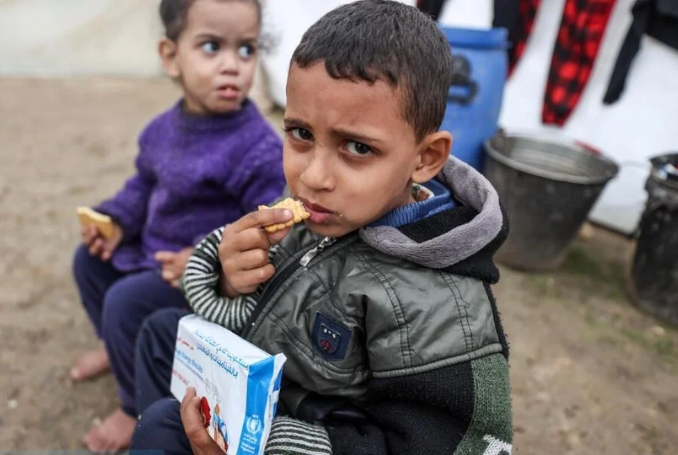

UN agencies warned that limited improvements in Gaza’s food security remain fragile, with 1.4 million Palestinians still facing acute hunger.
Key Takeaways
- Around 1.4 million Palestinians, or 67 percent of Gaza’s population, face crisis-level food insecurity or worse.
- More than 74,000 children are expected to require treatment for acute malnutrition over the coming year.
- UN agencies warned that funding shortages, restricted access, and destroyed livelihoods could rapidly reverse recent gains.
Limited Improvement, Persistent Hunger
An estimated 1.4 million Palestinians in the Gaza Strip continue to face crisis levels of acute food insecurity or worse, despite limited improvements following an expansion of humanitarian assistance, three United Nations agencies said on Thursday.
The Food and Agriculture Organization (FAO), UNICEF, and the World Food Programme (WFP) said the latest Integrated Food Security Phase Classification analysis showed that around 67 percent of Gaza’s population remains in IPC Phase 3 or above.
This represents a decline from approximately 1.6 million people, or 77 percent of the population, at the end of 2025.
However, 212,000 Palestinians remain in emergency conditions, classified as IPC Phase 4, with many living near the Israeli military-controlled “yellow line,” where humanitarian access and essential services remain severely restricted.
Six Killed in Gaza as Israel Intensifies Ceasefire Violations, Death Toll Reaches 73,311
The agencies cautioned that the improvements were driven largely by increased food, nutrition, health, and agricultural assistance and could be reversed rapidly.
“There is progress on food security in Gaza, but it is fragile and can easily be reversed,” WFP Acting Executive Director Carl Skau said.
“The overall humanitarian situation remains brutal: families lack water, sanitation and medicine,” he added.
Aid Expansion Drives Improvements
The UN agencies said food and nutrition assistance expanded significantly following the October 2025 ceasefire agreement.
In May, food parcels reached approximately 1.5 million people, while multipurpose cash assistance was provided to around 700,000 Palestinians.
Nutrition programs reached 60 percent of children under the age of five, compared with less than one percent in September 2025.
The rapid expansion contributed to measurable improvements in food security and child nutrition.
However, UN agencies said food rations remain inadequate in quantity, quality, and dietary diversity, while imports of fresh produce and protein remain inconsistent.
Only the Abu Salem (Kerem Shalom) crossing in southern Gaza remains open, severely limiting the entry of essential goods and leaving most Palestinians dependent on humanitarian assistance.
Malnutrition Threatens Tens of Thousands
Although acute malnutrition rates have declined, the agencies warned that tens of thousands of children remain at risk.
An estimated 74,000 children are expected to require treatment for acute malnutrition over the coming year, including more than 11,000 projected severe cases.
Approximately 25,000 pregnant and breastfeeding women also require nutritional support.
UN Warns No Place is Safe in Gaza amid Collapsing Emergency Services
UNICEF Executive Director Catherine Russell said the improvement demonstrated that children could be “pulled back from the brink” when aid was allowed to enter.
“But it rests on a supplementary feeding program that doesn’t reach all children, and where funding is running out,” she warned.
“Without sustained access and funding, these gains could be lost within months,” Russell added.
Only one in five children in Gaza currently has access to an adequate diet, while nearly half of all households receive less than 15 liters of water per person per day for drinking, cooking, washing, and other essential needs.
Livelihoods Remain Destroyed
The agencies said meaningful economic or livelihood recovery has yet to begin following the destruction caused by Israel’s genocide in Gaza.
More than 70 percent of Gaza’s agricultural land remains inaccessible, and only three percent is currently usable.
Sea access remains prohibited, preventing fishers from producing food, earning income, or rebuilding their livelihoods.
Restrictions also continue on seeds, organic fertilizers, fertilized eggs, small animals, tools, and other agricultural supplies needed by farmers and humanitarian organizations.
“Food security in Gaza cannot recover unless local food production starts again and farmers, herders, fishers and other producers can rebuild their livelihoods,” FAO Director-General Qu Dongyu said.
He called for restrictions on agricultural imports and humanitarian supplies to be lifted.
The agencies said limited evidence showed that recovery was possible where support was sustained, noting that sheep inventories had increased by 33 percent in accessible areas where farmers and herders received assistance.
Destruction Blocks Recovery
The IPC analysis said approximately 83 percent of households have no source of income, leaving most families almost entirely dependent on external aid.
Nearly three-quarters of Gaza’s homes and 70 percent of its roads have been damaged or destroyed, along with 95 percent of agricultural infrastructure and 92 percent of businesses.
A joint World Bank, European Union, and UN assessment estimated physical infrastructure damage at $35.2 billion, alongside $22.7 billion in economic losses.
The assessment calculated that Gaza would require approximately $71.4 billion for recovery and reconstruction.
#Gaza Strip
The October 2025 ceasefire has led to measurable gains in humanitarian access and overall conditions across the Gaza Strip, yet the situation remains deeply fragile.
The entire Strip is classified in Crisis (IPC Phase 3), and 1.4 million people are expected to face… pic.twitter.com/gbRgG7Q9kV
— The Integrated Food Security Phase Classification (@theIPCinfo) July 23, 2026
Funding Shortages Threaten Reversal
The UN agencies warned that humanitarian assistance has declined since February due to funding shortages and uncertainty surrounding the operations of international aid organizations.
Without continued food assistance, an estimated 1.9 million Palestinians—around 90 percent of Gaza’s population—could face crisis levels of food insecurity or worse through December.
FAO, UNICEF, and WFP called for sustained humanitarian access through crossings in both northern and southern Gaza, as well as routes through Egypt, Jordan, and Israel.
They also urged the immediate entry of fuel, cooking gas, shelter materials, agricultural supplies, and commercial goods.
The agencies warned that their funding for Palestine was rapidly running out and said failure to secure additional resources could place all 2.1 million Palestinians in Gaza at renewed risk.
(PC, WFP, AA)