

We are tired, yes. Perhaps we no longer have the strength we once had. But we are still moving.
We are tired and exhausted. We have no strength, no energy, and sometimes not even the desire to get out of bed. Yet we keep moving. We open our eyes in the morning, brush the dust from our faces after another sleepless night, search for water and food, check on the children, try to remember where we put the few things we have not yet lost, and then begin another day. It is different from the days that came before, but just as exhausting.
I do not know how we manage to do this. Perhaps we have become half human, half machine. The human half feels hunger, fear, longing, and disappointment, while the mechanical half takes over. It gets us up, moves our feet, and orders us to keep going even when the batteries are running low. We are no longer living as we once understood it. We are operating in emergency mode.
Sometimes I imagine we are an army returning from a long battle. The soldiers have lost their boots. Some have forgotten the names of their comrades, while others can no longer remember why the war began in the first place. They remind me of Napoleon’s soldiers wandering through the Russian snow. They had entered the country as a mighty army, only to emerge with exhausted bodies and shattered dreams.
But there is one difference: Napoleon’s soldiers knew their campaign was over. We do not know whether our battle has ended or whether another chapter of destruction is about to begin.
History is full of kings who possessed almost everything. They built palaces, raised walls, accumulated gold, and sent armies to the farthest corners of the world. Some believed their power would last forever. Then came a day when they could not even find someone to open the palace gates for them. Alexander the Great, whose conquests stretched from Macedonia to India, died young. He could not take a single city with him. Napoleon, who redrew the map of Europe, ended his days in exile on a distant island.
How fragile power seems beside the strength it takes an ordinary person to get out of bed after a night of fear.
Perhaps this is why I have begun to understand strength differently. Strength is no longer about winning a battle, commanding an army, or raising a flag over a fortress. Strength is being able to make a cup of tea after a sleepless night. It is smiling at a little girl who asks you a question you cannot answer. It is convincing your children that tomorrow might be better, even when you have no evidence that it will be.
Strength is carrying a bag of bread as though it were the spoils of war and rejoicing over a bottle of clean water as kings once rejoiced at the return of their armies from distant conquests.
Sometimes I think about ancient trees. In the mountains of California stands a bristlecone pine known as Methuselah, estimated to be more than 4,800 years old. It grew as kingdoms rose and fell, as civilizations built their temples and watched them turn to ruins, as armies crossed mountains and rivers, and as kings were born and died.
The tree knew nothing of their names. It cared nothing for their victories. It pushed its roots deeper into the earth and endured.
I sometimes wonder how many wars this tree could tell us about if it had a memory. How often would it have heard the sound of horses’ hooves? How many times would it have watched men pass beneath its branches, convinced that the world would never change after them?
We, too, are trying to become trees. But our roots cannot always find stable ground, and our branches are exposed to relentless winds. We move from one place to another, carrying whatever we can and leaving behind things that can never be replaced. Still, we try to put down temporary roots wherever we find ourselves: in a tent, a borrowed room, a corner of a school, or on a patch of land where we may not even stay until morning.
We are learning to grow life in places that were never meant to sustain it.
In Greek mythology, Sisyphus was condemned to roll an enormous boulder up a mountain, only to watch it tumble back down every time he neared the summit. Then he would have to begin again.
I have thought about Sisyphus often these days. How often do we put the place where we live in order, only to be forced to leave it? How often do we search for water, only to run out again? How many times do we piece our daily lives back together, only for war to scatter everything?
How often do we start from zero, until zero itself becomes a familiar place?
Perhaps Sisyphus’s punishment was not simply pushing the stone uphill, but having to repeat the beginning forever. And that is precisely what we have become experts at: beginning again without having finished the previous beginning.
In Miguel de Cervantes’s novel Don Quixote, an old man sets out to confront the world with his sword and his imagination. He mistakes windmills for giants that must be fought. People laugh at his battles, but sometimes I feel that Don Quixote understood life better than many others. He could still imagine an enemy he could confront. We face things we do not know how to name, let alone how to stand against.
Perhaps we, too, are fighting countless windmills: rising prices, fear, waiting, water shortages, power cuts, and memories that never stop replaying old scenes. We fight things that refuse to fall, no matter how many times we strike them.
Even our bodies have changed. We have learned to sleep through noise, to tell sounds apart from a distance, to ration food, to put off being ill, and to save our tears for a moment that never comes.
Each of us now has an operating system of our own. Some have adjusted their bodies to survive on two hours of sleep. Others have programmed their hearts not to feel too much joy, for fear of another disappointment. There is a mother who stores her children’s needs in her mind like a computer’s memory. There is a father who can calculate the cost of food before entering a shop, already knowing which items he will have to put back on the shelf.
We have become remarkably efficient machines for managing scarcity, but we are machines rusting from within.
In the Book of Zechariah, we read: “Not by might nor by power, but by my Spirit, says the Lord Almighty.”
I find myself returning to these words. Perhaps because there comes a moment when muscles are no longer enough, when experience, calculations, and plans can no longer help. A person needs something that cannot be measured, stored, or purchased. Something that gives meaning to staying on their feet.
In the Book of Ecclesiastes, we read, “To everything there is a season.” Yet these days, it feels as though the season of exhaustion has lasted far longer than it should, and the season of rest is terribly late.
I think of the mothers of Gaza, who have learned to turn almost nothing into a meal, a piece of cloth into a blanket, and a story into a safe bed for children who cannot sleep.
I think of fathers who leave in search of food, knowing that returning empty-handed may be harder than the journey itself.
I think of children who have grown older than their years, and of those who learn the names of places along the routes they take when forced to flee, rather than from maps at school.
These are not heroes in a novel or characters in an ancient epic. They are ordinary people who never asked to be heroic, yet life has put them to a test unlike any they have ever known.
Sometimes I want to stop. I want to rest my head on a pillow that does not smell of dust, to sleep without keeping an ear out for sounds outside, and to wake without beginning the day by calculating what we have left.
I want to be an ordinary human being. Someone who carries money in his pockets, walks into a shop without counting how many people he has to feed before buying anything, and reads a book without raising his head every minute to make sure the place is still standing.
But I keep moving.
I do not know whether this is courage or habit, faith or instinct, or simply a malfunction in the machine that keeps it from stopping.
Perhaps we really have become half human, half machine. But the human part of us, despite everything, still refuses to die. It still loves, longs, writes, and sometimes laughs at the wrong moment. It searches for an ancient tree that resembles it, for a king who fell from his throne and might reassure us that thrones do not last, and for a soldier who returned from war to tell us that the road, however long, must eventually come to an end.
We are tired, yes. Perhaps we no longer have the strength we once had. But we are still moving.
Not because the road is clear, but because behind us is an entire life worth carrying to a safe place.
And if history has preserved the names of kings who won battles, perhaps memory should also preserve the names of those who won nothing, yet woke up every morning, fed their children, and tried to remain human.
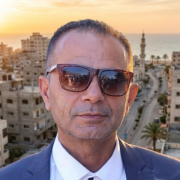
– Hani Al-Salmi is a Palestinian writer from the Gaza Strip. He has published more than twenty novels and children’s stories and has received literary awards throughout the Arab world. Al-Salmi remains in Gaza, where he and his family continue to endure the realities of war, displacement, and siege. He contributed this piece to The Palestine Chronicle.



Hani al-Salmi, this is beautiful but too sad for my spoiled mind.
In Palestine, survival is an act of heroism for a people who don’t want to be heroes, but only want to live a normal life. May God bless you and keep you always.
Your words moved me to tears, even though I’ve seen evidence of the nightmare Palestinians are forced to survive in over and over. But I’ve run out of words to describe how painful it is to watch what’s happening to you all and not be able to do anything to help you. So I shed tears instead. The suffering of the children and their parents who are powerless to save them from these horrors is the worst part. But it’s so important for you to continue telling your experience, so the world keeps hearsing what the powers that be do nothing about. I pray someday, they finally take action to end this madness for you.