
By Palestine Chronicle Editors
Did Iranian strikes kill Israeli leaders? The viral rumor reveals the dangerous power—and risks—of wartime information warfare.
Key Takeaways
- Rumors thrive during wartime because governments censor information and battlefield realities remain opaque.
- Israeli military censorship severely restricts information about casualties and damage inside Israel.
- Iranian and pro-Iranian narratives sometimes rely on claims that cannot be independently verified.
- When specific rumors prove false, they damage the credibility of anti-war narratives.
- Responsible journalism requires verification, especially during wars dominated by propaganda and information warfare.
The Weaponization of Rumor
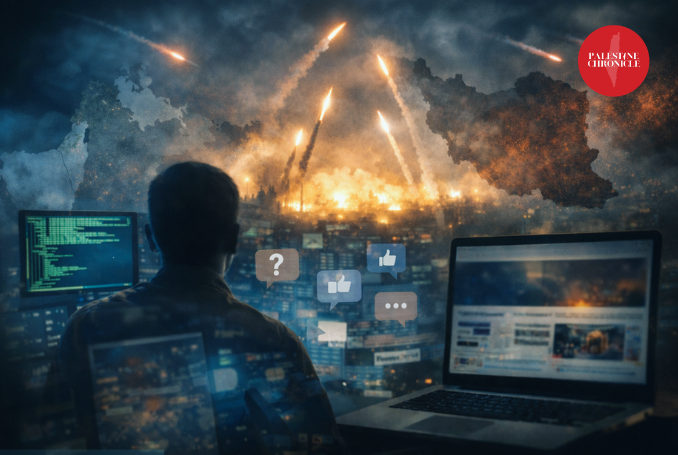
During war, information becomes as important as missiles. Armies fight not only for territory, but also for narrative dominance. Few recent episodes illustrate this better than a rumor that circulated widely on March 9 claiming that several senior Israeli figures had been killed or wounded by Iranian strikes.
On March 9, Scott Ritter, a former US Marine intelligence officer and former UN weapons inspector, appeared on RT’s program The Sanchez Effect. In clips from that appearance that circulated widely online, Ritter was presented as endorsing claims that Iranian strikes had hit locations linked to senior Israeli leaders, including claims involving National Security Minister Itamar Ben-Gvir and members of Prime Minister Benjamin Netanyahu’s family.
The claims spread rapidly across social media networks. Some Iranian outlets and pro-Iranian commentators repeated the story, attributing it to Ritter’s statements. Israeli media quickly addressed the rumor as well, largely to dismiss it.
Yet within hours, it became clear that no credible evidence supported the claims. Neither Israeli officials nor independent sources confirmed them. The episode quickly turned into a case study in the volatile role of rumors in wartime.
But the deeper story is not whether the rumor was true. It is why such rumors thrive—and how they can ultimately damage the very narratives they seek to support.
Why War Produces Rumors
Wars create perfect conditions for rumors to flourish. Governments restrict information, battlefield access is limited, and propaganda becomes a central tool of strategy.
Israeli military censorship is one of the key factors behind the current information vacuum. Israeli law allows military authorities to block or alter the publication of sensitive information related to national security, including casualties, military damage, and strategic vulnerabilities.
This practice is not new. Israel has historically restricted coverage of military losses in order to prevent panic, maintain morale, and avoid providing intelligence advantages to its adversaries.
The result is a situation in which much of what happens inside Israel during wartime remains opaque. Because of this, analysts and observers often rely on indirect indicators such as satellite images, leaked videos, eyewitness reports, social media posts, and statements by opposing governments.
This environment creates fertile ground for speculation. As the American sociologists Gordon Allport and Leo Postman argued in their classic 1947 study The Psychology of Rumor, rumors spread when two conditions are present: importance and ambiguity. War provides both.
When events are highly consequential and information is scarce, rumors inevitably fill the gap.
The Strategic Incentive to Exaggerate
Iran also operates within this informational environment. Unlike the United States, Israel, or NATO states, Iran does not possess the same level of publicly accessible satellite imagery capabilities that allow it to regularly document battlefield damage inside Israel.
This means that Iranian officials and media often rely on claims of successful strikes that cannot easily be verified by outside observers. Such claims may or may not be accurate, but the lack of independent confirmation makes them difficult to assess.
There are understandable incentives behind these narratives. For governments under attack, wartime communication serves several strategic purposes: maintaining domestic morale, signaling deterrence to adversaries, projecting strength to allies, and shaping global public opinion.
Inflating battlefield achievements has therefore long been a feature of warfare. The Prussian strategist Carl von Clausewitz noted nearly two centuries ago that “war is the realm of uncertainty,” where information is often incomplete, contradictory, or manipulated.
In modern conflicts, this uncertainty has evolved into what analysts now call information warfare, where perception and narrative become strategic tools alongside military force.
The Double-Edged Sword
Yet rumors can quickly become counterproductive. When a claim becomes too specific, such as the alleged death of a particular political leader, it becomes much easier to disprove.
Once disproven, the narrative can backfire.
In the case of the March 9 rumor, Israeli commentators and officials used the episode to argue that Iranian or pro-Iranian narratives were unreliable. This creates a powerful propaganda opportunity for the opposing side.
False rumors do not simply disappear. They often become tools that strengthen the credibility of the adversary, allowing them to present themselves as the more reliable source of information.
Moreover, repeated rumors that fail to materialize can produce unintended psychological effects. Instead of creating fear, they may actually reassure the targeted society.
When rumors repeatedly claim that leaders have been killed or severely wounded, only to be disproven, they can reinforce the perception that those leaders remain protected and untouchable.
A Contrast with the Gaza War
The information dynamics of the Iran-Israel confrontation differ sharply from those of the war in Gaza.
Palestinian resistance groups in Gaza adopted an unusual communication strategy during the war. Through carefully documented videos, images, and battlefield footage, they provided detailed accounts of daily military engagements.
This documentation gradually increased their credibility among observers. Over time, many analysts and journalists began paying closer attention to Palestinian battlefield statements precisely because they were accompanied by evidence.
The Iranian case is structurally different. Iranian forces cannot film events inside Israel’s battlefield environment in the same way Palestinian fighters in Gaza documented combat on their own territory.
As a result, Iranian narratives often rely on indirect evidence or official claims rather than visual documentation. This structural limitation increases the likelihood that rumors will fill informational gaps.
Strategic Reality vs Tactical Narratives
Ironically, the spread of exaggerated rumors can obscure an important reality.
From a strategic perspective, the current war has not achieved the objectives originally sought by Israel and the United States. One of the widely discussed goals of the military escalation was to weaken Iran to the point of triggering internal instability or regime change.
That outcome appears far from imminent.
Meanwhile, the aggression on Iran has already produced several strategic consequences, including regional instability across the Gulf, rising energy prices, and increased global economic pressure.
In that sense, Iran has demonstrated an ability to absorb and respond to military pressure without collapsing politically. Yet rumors about dramatic tactical victories—such as the deaths of senior Israeli officials—can paradoxically undermine this broader strategic reality.
When those claims prove false, they distract from more substantive developments taking place within the war.
The Responsibility of Journalism
For journalists, the lesson is clear.
War reporting must navigate a landscape dominated by propaganda, censorship, and psychological warfare. This is particularly true when covering conflicts involving Israel, where military censorship restricts information and Western media narratives often align closely with Israeli government positions.
But the existence of censorship and misinformation does not justify repeating unverified claims.
Responsible journalism requires verification.
At The Palestine Chronicle, this principle remains central. Our role is to report the competing narratives of war, analyze their implications, and examine available evidence carefully. But we cannot confirm claims that lack credible sourcing.
This does not mean that rumors are always false. Perhaps some of them are true. In wartime, people have every right to ask questions, speculate, and attempt to understand events that governments deliberately hide from public view.
If a leader such as Benjamin Netanyahu disappears from public view for days at a time, people will inevitably ask questions. Some may suggest that he has left the country. Others may speculate that he was targeted by an attack. In a conflict where information is tightly controlled, such speculation is unavoidable.
The issue we raise here is different.
As journalists, we operate under a different set of responsibilities. Our task is not to amplify every rumor circulating in the fog of war, but to verify information before presenting it as fact.
This is precisely why journalism—at least in theory—is supposed to be the most credible form of information during times of war.
Unfortunately, mainstream Western media has repeatedly violated this principle, spreading misinformation and uncritically echoing official narratives.
But independent media cannot respond by abandoning journalistic standards. If anything, our responsibility to accuracy and verification must be even greater.
In the information wars that accompany modern conflicts, credibility remains one of the most powerful weapons of all.
(The Palestine Chronicle)




Everything is ” mirrored ” today. i always trace it back to the original source.
Journalists, Free-Thinkers, Diggers, we know the real truth.
It is a human property to look for and own messages that aling with their own point of view and wishes. It is called confirmation bias and widepread in journalism, alternative media and social media. In the beginnig of the Ukraine and Gaza wars I did believe a lotof claims, but now I am more carefully. We have to be always critical to any message. The maximum you can say is that there are unverified rumors or claims.