
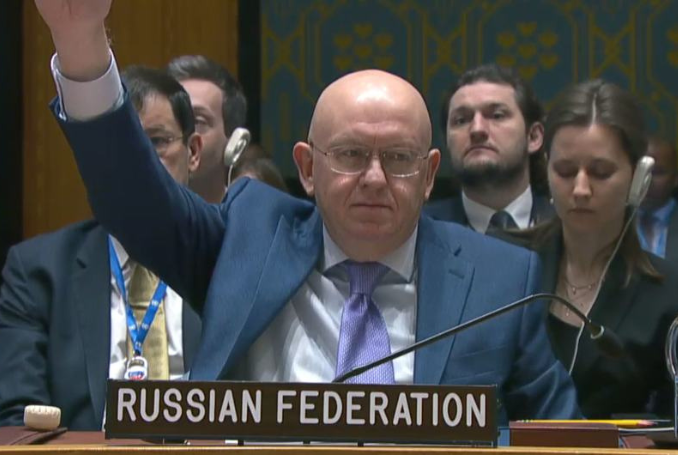

Russia and China veto Hormuz resolution as Iran denounces US-backed draft and warns of escalating confrontation at UN.
Key Developments
- Russia and China veto Bahrain-backed Hormuz resolution at the UN Security Council.
- Iran rejects draft as ‘misleading,’ asserting its actions fall under self-defense and accusing Washington of shaping the text.
- Moscow warns resolution grants ‘carte blanche for aggression’ while China cautions of ‘very serious consequences.’
Security Council Showdown
Russia and China on Tuesday vetoed a draft UN Security Council resolution concerning the Strait of Hormuz, blocking a Bahrain-backed proposal despite it receiving 11 votes in favor.
The resolution, introduced by Bahrain on behalf of Gulf states and supported by the United States, failed after Moscow and Beijing exercised their veto power, while Pakistan and Colombia abstained, according to reporting by the Associated Press.
The vote underscored deep divisions within the Council as tensions continue to escalate in the region surrounding Iran and key global shipping routes.
Iran: ‘Misleading’ and ‘Unjustifiable’
Iran’s ambassador to the United Nations, Amir Saeid Iravani, strongly rejected the draft, describing it as fundamentally flawed and politically motivated.
He said the resolution “unjustifiably and misleadingly portrays Iran’s lawful measures… as threats to international peace and security,” according to reporting by The Washington Post.
Iravani emphasized that Iran’s actions in the Strait of Hormuz fall under its “inherent right of self-defense in accordance with the UN Charter,” rejecting claims that Tehran is responsible for destabilizing maritime security.
He also criticized the framing of the resolution, arguing that it ignored the broader context of the conflict, including recent military actions targeting Iran.
Russia: ‘Carte Blanche for Continued Aggression’
Russia’s ambassador to the United Nations, Vassily Nebenzia, issued one of the strongest warnings during the session, defending Moscow’s veto.
He said the draft resolution would have effectively granted “carte blanche for continued aggression,” referring to the United States and its allies, according to Associated Press reporting.
Nebenzia criticized the text for presenting a one-sided account of the crisis, stating that it “does not reflect the real situation,” and fails to acknowledge the sequence of events that led to the current escalation.
He also warned that similar language in past Security Council resolutions had been used to justify military interventions, referencing precedents such as Libya.
China: ‘Serious, Very Serious Consequences’
China’s ambassador, Fu Cong, also delivered a forceful rejection of the draft, warning that its adoption could further inflame the situation.
He said the resolution was “highly susceptible to misinterpretation or even abuse,” according to The Washington Post.
Fu added that passing the resolution would “send a wrong message and have serious, very serious consequences,” stressing the risk of deepening the conflict rather than resolving it.
China called for de-escalation and renewed diplomatic efforts, arguing that the draft failed to address the root causes of the crisis.
US: ‘Global Economy at Gunpoint’
The United States responded sharply to the veto, accusing Russia and China of enabling actions that threaten global stability.
US Ambassador Mike Waltz said: “No one should tolerate that they are holding the global economy at gunpoint,” referring to Iran’s actions in the Strait of Hormuz.
He argued that blocking the resolution undermines efforts to protect international shipping and energy flows through one of the world’s most critical maritime chokepoints.
Draft Resolution and Revisions
The Bahrain-backed resolution focused on ensuring freedom of navigation in the Strait of Hormuz and called on Iran to halt actions affecting commercial shipping.
Earlier versions of the draft reportedly included language authorizing “all necessary means,” which could have opened the door to military enforcement.
That language was later removed in an attempt to secure broader support and avoid a veto, but Russia and China maintained that the revised text remained problematic.
Both countries argued that the resolution could still be interpreted in ways that might justify further military action.
The Security Council vote comes amid heightened tensions following US and Israeli aggression on Iran, which Tehran has cited as the trigger for the current crisis.
Iran has since taken measures affecting maritime traffic in the Strait of Hormuz, a vital route for global oil shipments.
‘Refuse Orders’: Fears Trump Could Launch Nuclear Strike on Iran
(Al Mayadeen, AP, WaPo, PC)


” US Ambassador Mike Waltz said: “No one should tolerate that they are holding the global economy at gunpoint,” referring to Iran’s actions in the Strait of Hormuz. ”
no, dunce! we the USA are doing that!
idiot!
But committing a genocide is just dandy, right? Especially when it’s against a certain populace. These people are evil idiots.