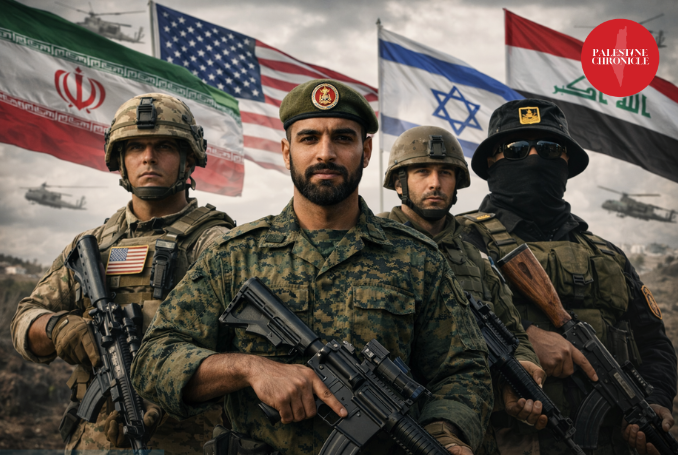
Iraq’s armed resistance is re-emerging as a decisive front in the regional war, shaped by decades of occupation, intervention, and unresolved conflict.
Key Takeaways
- Iraqi resistance factions are intensifying attacks on US military presence, signaling Iraq’s re-emergence as a central battlefield in the regional war.
- Groups formed during the fight against Daesh, particularly within the Hashd al-Shaabi framework, now possess significant military capacity and experience.
- The escalation reflects decades of accumulated resentment toward US intervention, linking Iraq’s current resistance to the wider Axis of Resistance.
Imperial Foundations of Iraq’s Long War
After more than two decades and a million dead later, armed resistance groups in Iraq are shaping up to be one of the defining features of today’s regional war. Although greatly overlooked in the Western media, it is a historic instance of blowback, coming back to bite Washington.
When the United States and Israel chose to attack Iran on February 28, their decision truly did ignite an “epic fury” across West Asia, but not in their favor. Iraq in particular is shaping up to be one of the most difficult fronts to face, and therefore it is important that the story – which the corporate media dares not tell – be explained.
Baghdad, the city where Iraqi resistance factions are now targeting US bases, its embassy, personnel, and facilities day in and day out, was the first city ever subjected to a sustained aerial bombing campaign.
In the 1920s, the British Royal Air Force (RAF) became the first to adopt the strategy of committing aerial bombardments in order to reduce the quantity of ground forces needed to subdue a city’s population. The British would later pass the torch on to the United States when it came to their project of imperial domination, in the land once called the cradle of civilization.
The Iraqi population has for decades survived the terrorism of the United States, whether that be Washington’s use of Saddam Hussein to invade Iran, to the First Gulf War, the sanctions that killed hundreds of thousands of children, or the invasion of 2003. While covering all of this nation’s history would be too tall a task for this article, it suffices to say that the Yankee boot has ceased to lift from the Iraqi throat.
A War that Backfired: Why the US-Israeli Campaign Is Strengthening Iran
Over a million people were said to have perished as a result of the US regime change operation against Iraq, with many millions more scattered to all corners of the globe. Yet, the failed nation-building exercise, Israeli-style occupation camps, and dismantlement of a nation slowly faded from the headlines, especially with the eventual withdrawal of the majority of foreign soldiers from its territory.
While the cameras turned away, the US embedded itself in Iraq, using its economic and soft power control to dictate outcomes inside the country, never truly permitting total independence and refusing to withdraw its soldiers and contractors from the country. A large part of the reason why was because of their need to ensure they were able to set up their next regime change operations, the most important to them being the toppling of the government in Tehran.
Blow Back over Two Decades Later
The rise of the so-called “Islamic State” (IS), known in the region as Daesh, provided the United States with the perfect excuse to enter the Iraqi arena once again in 2014. However, contrary to the narrative popularized in the West, the United States’s role in fighting Daesh was rather limited and mainly conducted through air campaigns – evidently with exceptions.
So, where the United States saw the opportunity for further involvement in West Asia, in particular the way that Daesh aided in their covert operation to topple the Syrian government, so too did their arch nemesis Iran seize the opportunity.
The fight to defeat the Takfiri death cult was in need of a ground force, which is where the Iraqis themselves took up the fight. With the help of Iran’s Islamic Revolutionary Guard Corps (IRGC), the Hashd al-Shaabi, or Popular Mobilization Units (PMU), were formed. The PMU, alongside the Iraqi national armed forces, would then wage on-the-ground battles against Daesh in order to put down their ever-expanding extremist State project.
It was a bloody fight, not one that anyone should have any illusions about, but in the end, the PMU were the military units that turned the tide and crushed Daesh. The man who was chiefly responsible for aiding the rise of these groups was the IRGC’s Quds Force Commander Qassem Soleimani. In other words, the man that US President Donald Trump assassinated in 2020 was the man who is widely credited with playing a decisive role in defeating Daesh.
An important point to note is that the majority of Iraq’s population is Shia Muslims, which equaled a natural affinity between many Iraqis and Iran’s religious leadership, in particular Ayatollah Seyyed Ali Khamenei. Therefore, when the United States and Israel decided to murder Khamenei, they immediately triggered a reaction from Iraq.
But the struggle goes deeper than this. The Iraqis have been under the boot of the US for decades now, having lost the nation they once knew, with everyone collectively understanding who stole it from them, whether they love or loathe Iran. If you listen to the rhetoric coming from the Iraqi factions today, you hear this rage that has been brewing over what has been done to them, along with evident Shia religious themes and anti-imperialist slogans.
Hezbollah Returns: It Didn’t Start a War, It Is Ending One – Analysis
Iraq’s Return to the Regional War
Groups like Saraya Awliya Ad-Dam (The Guardians of the Blood Brigades) and the Islamic Resistance in Iraq have emerged as important players in the recent widespread operations across the country and against Israel.
The Islamic Resistance in Iraq was the group that offered a support front to the Palestinian resistance during the Gaza genocide, while Awliya Ad-Dam appears to have been founded back in 2020 and only recently began advertising itself.
Both these groups possess drones and missiles of varying types, evidently armed by Iran. But then you have the full power of Hashd al-Shaabi itself, which, when fully mobilized, has a force of around 250,000 fighters at its disposal. Within the Hashd, there are various groups, one of the most well-known being Kataeb Hezbollah, many of whom have more advanced weapons. The PMU is not “Iranian proxies”, but instead constitutes a crucial part of Iraq’s security apparatus.
Recently, the Islamic Resistance in Iraq claimed to have shot down the US’s KC-135 refueling aircraft, killing 6 American servicemembers, while other groups have been hammering US military installations. US Central Command (CENTCOM)’s narrative about how the aircraft was downed appeared nonsensical, but they denied it was shot down by enemy fire. The importance of this is that the announcement in itself demonstrates just how far the Iraqi groups are willing to go.
What we are currently witnessing is an Iraq that has returned to the way of resistance against US imperialist domination. Similar to how Hezbollah had waited for 15 months for the correct set of circumstances to fight for the liberation of Lebanon from Israeli occupation, the Iraqis had also long held their fire.
For those who have long followed developments across the region, it was obvious that the firepower and battle experience acquired by the Iraqi groups were being held in reserve for the day that it would eventually have to be used. The time has now come. Tehran also knew that supporting the rise of such groups inside Iraq would work as a pillar of their defense against any US-Israeli aggression.
It appears as if the US and Israelis have been taken aback by just how aggressive the Iraqi factions have been in their fight against them. Similarly, the Israeli Hebrew media have been expressing their shock at the intensity of Hezbollah’s fire during the war. All of which goes to show that Tel Aviv and Washington appear to have forgotten the history of what they put the region through.
Israel And The US Will Lose against Iran: Here’s Why – ANALYSIS
The US-Israeli coalition has killed millions across West Asia, destroyed Iraq and Syria in order to place them under their control, fostered inorganic sectarianism, with the help of their allies in the Arab World, all while causing a mass exodus. Everyone they are now fighting is a product of their own endless aggression, their arrogance, and their refusal to allow the region’s people to simply live.
The same behavior has been demonstrated with the Palestinians, born of racist and orientalist beliefs, that if you just oppress them enough, they won’t be capable of fighting you, or will give up. Iraq, Lebanon, Yemen, Iran, and Gaza form what is known as the ‘Axis of Resistance’, who are fighting with a vengeance. In the case of Iraq, it took over 22 years for there to be a force capable of sufficiently fighting back. On February 28, the US and Israel gave them the perfect circumstances under which to do so.
(The Palestine Chronicle)
– Robert Inlakesh is a journalist, writer, and documentary filmmaker. He focuses on the Middle East, specializing in Palestine. He contributed this article to The Palestine Chronicle.