
By Palestine Chronicle Editors
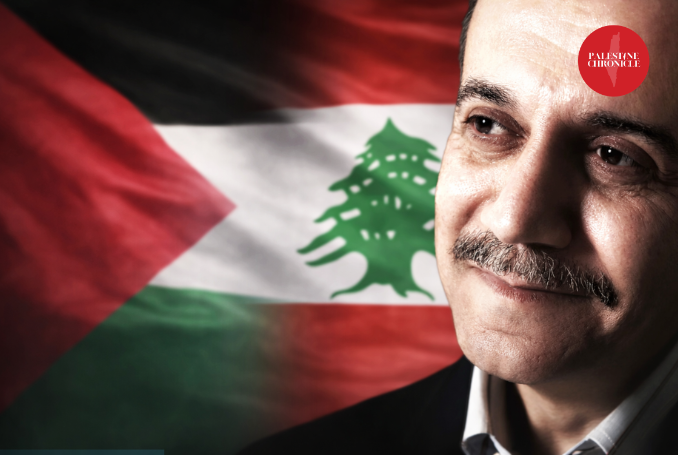
Lebanese singer Ahmad Kaabour, whose voice became central to Palestinian resistance, leaves behind a legacy that transcended borders.
For many across the Arab world—and especially in Palestine—Ahmad Kaabour was not merely a Lebanese singer. He was something far more profound: a voice that dissolved borders, a melody that carried exile, and a conscience that seemed inseparable from the Palestinian struggle itself.
So complete was this identification that many who grew up listening to his songs assumed, without hesitation, that he was Palestinian.
They were not mistaken in spirit.
Born in Beirut in 1955, Kaabour came of age in a region already marked by dispossession, war, and the unfinished story of Palestine. Yet unlike many artists who observed from a distance, Kaabour immersed himself in that story—not as an outsider expressing solidarity, but as a participant in a shared political and emotional landscape.
His most iconic song, “Ounadikom” (“I Call on You”), became one of the most enduring anthems of Palestinian resistance. Its opening lines still echo across generations:
“I call on you,
I shake your hands,
I kiss the ground beneath your feet,
And I say: I sacrifice myself for you.”
These are not the words of a detached observer. They are words that collapse the distance between singer and subject, between Lebanon and Palestine, between self and struggle.
“Ounadikom” was not simply performed—it was adopted. Sung in refugee camps, at protests, in classrooms, and in moments of grief and defiance, the song became part of the living archive of Palestinian resistance.
Kaabour understood something essential about resistance: that it is not only fought with arms or negotiated in political chambers, but carried in culture—in memory, in language, and in sound.
At a time when Palestinian identity was under constant assault, when exile threatened to fragment not only geography but consciousness itself, his music helped to restore continuity. His voice gave emotional coherence to a people scattered across borders.
He did not romanticize suffering, nor did he reduce Palestine to a symbol emptied of its people. Instead, his work preserved the intimacy of struggle—the human texture of longing, dignity, and steadfastness.
Another of his well-known songs, “Ya Hadi El-Bayara”, drew from the imagery of the land itself, invoking orchards, labor, and rootedness. Like much of his work, it evoked a return to the land not only as geography, but as memory and identity—where the relationship between people and soil remains unbroken despite exile.
In Kaabour’s repertoire, Palestine was not an abstraction. It was soil, memory, and presence.
This is perhaps why his work resonated so deeply inside Palestine itself. While many solidarity efforts remained external, Kaabour’s music entered the internal rhythm of Palestinian life. His songs were not only listened to—they were lived.
Over the decades, as political realities shifted and regional priorities changed, Kaabour remained remarkably consistent. He did not dilute his message, nor did he reposition himself to accommodate shifting narratives. His commitment to Palestine was not episodic; it was foundational.
In this sense, his music functioned as a form of cultural steadfastness—sumud expressed through melody.
Generations of Palestinians grew up with his voice as part of their emotional landscape. For those in the diaspora, his songs bridged distance. For those under occupation, they affirmed presence. For those who had lost, they offered a language for grief that did not surrender to defeat.
It is not an exaggeration to say that Kaabour helped shape how Palestine was felt, not just how it was understood.
And yet, there was always a quiet humility in his work. He did not seek to center himself within the narrative. Instead, he positioned his voice in service of something larger—allowing the song to belong to the people who needed it most.
That is why, even in death, Ahmad Kaabour cannot be confined to biography.
He belongs to a collective memory.
His passing on March 26 marks the loss of a singular artist, but not the end of his presence. His songs continue to circulate, to be sung, to be rediscovered by younger generations who may not know his face but recognize his voice.
And perhaps that is the truest measure of his legacy.
Because in Palestine, and among those who carry Palestine in their hearts, Ahmad Kaabour was never simply a singer.
He was—he remains—a voice that called, and was answered.
“I call on you…”
And Palestine, in all its fragments and resilience, answered back.
“Ounadikom” – English Translation
I call on you,
I shake your hands.
I call on you,
I shake your hands.
I kiss the ground beneath your feet,
And I say: I sacrifice myself for you.
I offer you the light of my eyes,
And I give you the warmth of my heart.
For the tragedy I live
Is but my share of your tragedies.
I call on you,
I shake your hands.
I was never humiliated in my homeland,
Nor did my shoulders ever bow.
I stood in the face of my oppressor—
An orphan, naked, barefoot.
I carried my blood in my palm,
And I never lowered my flags.
And I guarded the grass
Above the graves of my ancestors.
I call on you…
I shake your hands.
About the Author: Tawfiq Ziad
Tawfiq Ziad was a leading figure in Palestinian cultural and political life, known for poetry rooted in resistance and steadfastness.
Born in 1929 in Nazareth, he belonged to the generation that remained after the 1948 Nakba. His work reflects that experience—dispossession, endurance, and an unyielding connection to the land.
Ziad also served as mayor of Nazareth, advocating for Palestinian rights. His poetry, especially “Ounadikom”, became a defining expression of defiance and sumud.
(Palestine Chronicle)


I love this poem, the song, the singer. May he rest in heavenly peace.