
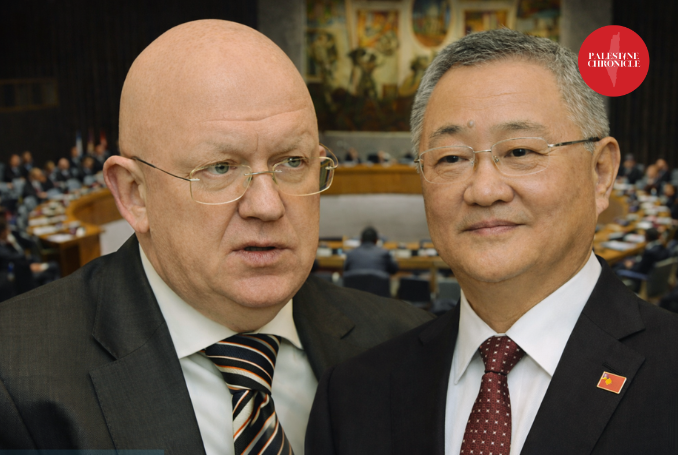

Russia and China intensify diplomatic backing for Iran as Trump accuses Moscow of aiding Tehran and rejects uranium proposal.
Key Takeaways
- Russia’s UN envoy says the US-Israel “blitzkrieg” against Iran has failed and warns Washington lacks an exit strategy.
- Trump claims Vladimir Putin may be helping Iran, even as reports suggest Moscow proposed a diplomatic nuclear compromise.
- China and Russia both accuse Washington of undermining diplomacy and escalating the regional war through military force.
Russia Says ‘Blitzkrieg’ Failed
Russia has sharply intensified its diplomatic defense of Iran at the United Nations as the war between Iran and the US-Israel alliance enters a dangerous new phase.
Speaking to media outlets on Friday, Russia’s Permanent Representative to the UN, Vasily Nebenzya, said the Western military campaign had failed to achieve its core objectives.
“The situation is really dire and we call for a diplomatic solution,” Nebenzya said. He added that the US-Israeli attempt to rapidly defeat Iran had collapsed.
“We do not know what will happen. The blitzkrieg failed. The Iranian regime, as they call it, did not collapse. The people did not revolt against it,” Nebenzya said.
“That looks like there is no exit strategy for the United States in this game.”
His remarks came after a Russian-sponsored resolution calling for an immediate halt to military operations in the Middle East failed to pass at the UN Security Council.
The proposal received support from Russia, China, Pakistan and Somalia, but was opposed by the United States and Latvia, while several other members abstained.
Nebenzya said those who opposed the Russian-backed resolution bore responsibility for blocking a diplomatic path.
The Russian diplomat also emphasized that Iran has the right to defend itself.
“Iran has the right to ensure its own security and the right not to condone attacks on civilians and civilian infrastructure,” Nebenzya said.
His comments reflect a broader shift in Moscow’s rhetoric since the start of the war, with Russian officials increasingly framing the conflict as a failed Western attempt to impose regime change in Tehran.
A War that Backfired: Why the US-Israeli Campaign Is Strengthening Iran
Trump Accuses Russia
At the same time, US President Donald Trump has publicly suggested that Russia may be assisting Iran.
In a radio interview with Fox News host Brian Kilmeade, Trump said he believed Russian President Vladimir Putin might be offering some level of support to Tehran.
“I think he might be helping them a bit, yeah,” Trump said.
Trump quickly framed the situation as part of a broader geopolitical rivalry.
“And he probably thinks we’re helping Ukraine, right?” he added.
The president also suggested that such behavior was typical among major powers.
“It’s like, ‘Hey, they do it, and we do it, in all fairness,’” Trump said.
The comments came days after Trump held a phone call with Putin amid growing international concern about the expanding war.
At the same time, a report by Axios, citing unnamed US officials, claimed that Putin recently proposed a potential diplomatic arrangement involving Iran’s enriched uranium.
According to the report, the Russian leader suggested transferring Iran’s stockpile of enriched uranium to Russia as part of a possible framework for ending the war. Axios reported that Trump rejected the proposal.
However, the claim relies on anonymous sources and neither Washington nor Moscow has publicly confirmed the details of the alleged offer.
Russia previously played a role in managing Iranian nuclear material under the 2015 nuclear agreement, which allowed Tehran to export certain enriched uranium stocks abroad.
Iran has historically resisted proposals to remove its nuclear material from its territory, instead proposing that enrichment levels be reduced under international monitoring.
The differing accounts point to parallel public accusations and possible back-channel diplomacy.
China Pushes Diplomacy
China has also stepped up its criticism of Washington’s role in the crisis.
Addressing the UN Security Council earlier this week, Chinese Ambassador Fu Cong argued that the current escalation is rooted in Washington’s abandonment of diplomacy.
“The Iranian nuclear issue must ultimately return to the track of a political and diplomatic settlement,” Fu told the council.
He emphasized that the crisis was triggered by the United States’ decision to withdraw from the Joint Comprehensive Plan of Action (JCPOA).
“It was precisely the United States that unilaterally withdrew from the JCPOA, which triggered the Iranian nuclear crisis,” Fu said.
The Chinese diplomat also criticized Washington for resorting to military force during diplomatic negotiations.
“It was also the United States that… resorted to a blatant use of force against Iran during the negotiation process, which rendered the diplomatic efforts futile,” he added.
Fu further argued that Washington’s actions violated the principles of international law and the UN Charter.
“The United States, as the instigator of the Iranian nuclear issue crisis, violates international law and the purposes and principles of the UN charter,” he said.
The statements from Moscow and Beijing reflect a growing diplomatic alignment in support of Tehran’s position.
While neither country has formally entered the conflict militarily, both governments are increasingly framing the war as a destabilizing Western intervention that risks expanding across the region.
(The Palestine Chronicle)


Dondolf Twitler; the fake Jew. If he converted to Islam, he wouldn’t be such a scumbag.