
By Yves Engler
Canada’s participation in Trump’s Gaza “Board of Peace” reflects a long historical pattern of imperial decision-making over Palestine, sidelining Palestinian consent and enabling dispossession.
Canada is at it again, ignoring the wishes of the people affected and instead helping an imperial power.
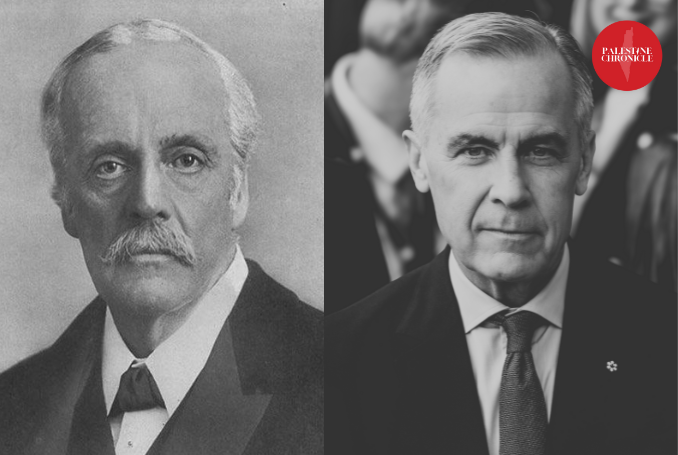
Donald Trump’s “Board of Peace” for Gaza will be remembered as something similar to the Balfour Declaration, in which London promised to create a Jewish home on Palestinian land. And just like that crass expression of British colonial thought, Canada looks set to participate in the US president’s imperial plan.
Prime Minister Mark Carney has joined the Trump-chaired Board of Peace for Gaza. Other imperial trustees include Jared Kushner, Marco Rubio, Steve Witkoff, and Tony Blair.
The Board of Peace controls aid into Gaza and the reconstruction of the devastated coastal strip. It is effectively a US colonial protectorate to safeguard Israel’s illegal occupation, which Palestinians overwhelmingly reject.
Two months ago, The New York Times reported that a small number of Canadian soldiers were participating in the first phase of the colonial facility. Canada may also assist in building the Palestinian security force intended to suppress resistance in Gaza, which it has been doing in the West Bank. Canada has a two-decade-old initiative to train and assist Palestinian Authority security forces to act as subcontractors of Israel’s occupation there.
As Rami Khouri told Al Jazeera, the Board of Peace for Gaza is akin to British Foreign Secretary Arthur Balfour’s 1917 proclamation of support for a Jewish homeland on land occupied mostly by Muslim and Christian Palestinians. In a letter to Walter Rothschild and the Zionist Federation of Great Britain, written just before British forces captured Jerusalem, Balfour stated:
“His Majesty’s government view with favour the establishment in Palestine of a national home for the Jewish people, and will use their best endeavours to facilitate the achievement of this object.”
Balfour later explained his thinking:
“In Palestine we do not propose to go through the form of consulting the wishes of the present inhabitants of the country. … The four great powers are committed to Zionism and Zionism, be it right or wrong, good or bad, is rooted in age-long tradition, in present needs, in future hopes, of far profounder import than the desire and prejudices of the 700,000 Arabs who now inhabit that ancient land.”
Fresh from leading the First World War Anglo-French conquest of German West Africa, Québec City-born Royal Military College graduate Lt.-Gen. Charles Macpherson Dobell commanded a force that attempted to seize Gaza during the 1917 Sinai and Palestine Campaign. As many as 400 Canadians (about half recruited by the Federation of Zionist Societies of Canada specifically for the task) also fought in British General Edmund Allenby’s Jewish Legion, which subsequently helped conquer Palestine.
During the two decades after the Balfour Declaration, the British Empire provided the Zionist movement with the necessary protective umbrella to thrive. Spurred on by British support, between 1919 and 1921, Canadians raised $458,000 (about $7 million today) to support projects colonizing Palestine.
At the end of the 1920s, Canadians raised $1 million for a Jewish National Fund project to pay an absentee landlord in France for 7,500 acres of coastal territory between Haifa and Tel Aviv. This project displaced more than 1,000 people—mostly nomadic Bedouin—whose descendants had lived on the land for hundreds of years.
Many Canadian political leaders were overjoyed by the Balfour Declaration. Several years after the First World War, Conservative Party leader Arthur Meighen claimed, “Of all the results of the war, none was more important and more fertile in human history than the reconquest of Palestine and the rededication of that country to the Jewish people.”
Three decades after the release of the declaration, Canada’s representative on the United Nations Special Committee on Palestine—dispatched to the region to propose a solution for the British mandate—challenged members of UNSCOP who failed to recognize the legitimacy of the Balfour Declaration.
In response to criticism of his proposal to give the Zionist movement a larger piece of land than it had officially requested, Canadian Supreme Court Justice Ivan C. Rand argued “that since Britain had not fulfilled its obligations to the Jews, they deserved to be compensated by the United Nations.”
Mark Carney’s participation on the Gaza Board of Peace reflects Canada’s continued contribution to Palestinian dispossession. All Canadians are complicit if we allow our government to ignore the wishes of fellow human beings who have already suffered too much.
– Yves Engler is the author of Canada and Israel: Building Apartheid and a number of other books. He contributed this article to The Palestine Chronicle. Visit his website: yvesengler.com.




Yves, a questionable specious statement “Carney joined”. In fact: “Mr. Carney said he agreed [PDP: in principle] because he wants Canada to participate in the rebuilding of Gaza after the Israel-Hamas war. “There is a humanitarian tragedy in Gaza that is ongoing and Canada will make every effort possible to address the situation,” alleviate the suffering and “ultimately move toward peace and a two-state solution,” he said. Mr. Carney said unrestricted aid flows to Gaza are a precondition for Canada’s participation.”
https://www.theglobeandmail.com/politics/article-trump-gaza-board-of-peace-carney-palestine-israel-hamas/
“Prime Minister Mark Carney has been asked by U.S. President Donald Trump to join the “Board of Peace” that will supervise the temporary governance of the Gaza Strip, a senior Canadian official told journalists travelling with the prime minister on his overseas trip.
“Carney will accept the invitation, the official said.”
https://www.cbc.ca/news/world/carney-invite-trump-board-peace-gaza-9.7049719
Coward.