
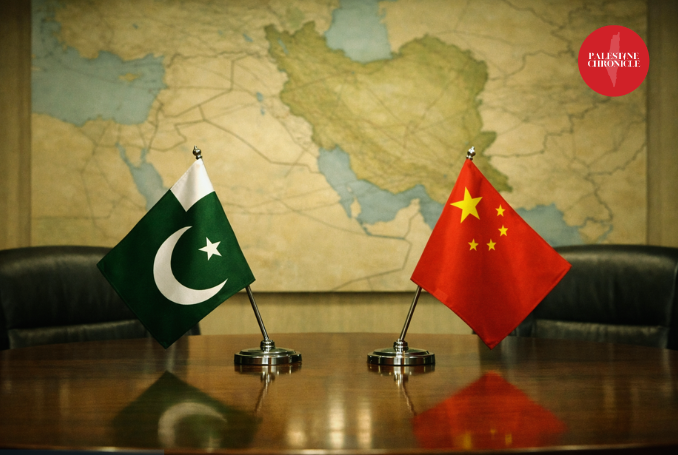

China and Pakistan propose ceasefire, talks, and maritime security plan as Iran war escalates and global concerns deepen.
Beijing Talks and Diplomatic Context
China and Pakistan have unveiled a joint five-point initiative aimed at de-escalating the ongoing US-Israeli war on Iran and restoring stability across the Gulf and the wider Middle East.
The proposal was announced following talks held in Beijing on March 31 between Chinese Foreign Minister Wang Yi and Pakistan’s Deputy Prime Minister and Foreign Minister Mohammad Ishaq Dar.
The initiative comes as the war on Iran enters its second month, with regional escalation intensifying and global economic concerns mounting, particularly following disruptions to energy supplies and maritime routes.
Both sides stressed the urgency of halting the escalation and warned against the expansion of the conflict, presenting their proposal as a framework to prevent further destabilization.
Five-Point Plan: Ceasefire, Talks, and Regional Stability
China and Pakistan outlined a structured five-point roadmap addressing both the immediate escalation and the broader regional risks:
First: Immediate ceasefire and de-escalation
The two countries called for an immediate halt to hostilities and urged all parties to take concrete steps to prevent the war from expanding further.
They also stressed the need to allow humanitarian aid to reach all affected areas without delay, amid growing concerns over the impact on civilian populations.
Second: Launch of peace negotiations
Beijing and Islamabad emphasized the urgency of initiating peace talks as soon as possible.
They underscored the importance of respecting the sovereignty, territorial integrity, and security of Iran and Gulf states, while affirming that dialogue and diplomacy remain the only viable path to resolving the conflict.
Third: Protection of civilians and infrastructure
The initiative calls for strict adherence to international humanitarian law and the protection of civilians and non-military targets.
China and Pakistan warned against attacks on vital infrastructure, including energy facilities, electricity networks, water desalination plants, and civilian nuclear sites.
Fourth: Securing maritime routes, including Hormuz
The two sides highlighted the strategic importance of the Strait of Hormuz and surrounding waters as vital international corridors.
They called for ensuring the safety of commercial shipping and restoring normal navigation, as disruptions continue to impact global energy flows and trade.
Fifth: Upholding international law and UN framework
The final point stresses the need to strengthen multilateralism and reinforce the central role of the United Nations.
China and Pakistan urged the international community to work toward a comprehensive solution based on the UN Charter and international law, aimed at achieving lasting regional peace.
Growing Diplomatic Push Amid Escalation
The initiative reflects a broader diplomatic effort to contain the conflict as fears grow over its long-term consequences.
With the Strait of Hormuz at the center of the crisis and economic pressures mounting globally, the China-Pakistan proposal emerges as one of the most structured attempts to outline a path toward de-escalation.
As military operations continue and regional tensions deepen, the plan signals an increasing push from key international actors to shift the trajectory from escalation toward negotiation.
‘Go to the Strait, and Just TAKE IT’ – Trump Blasts Allies – Iran War News in Brief
(PC, Multiple Sources, AP, Al Mayadeen)





I’ll pay this five-point plan the ultimate accolade of saying it is achievable and sane. And for that reason alone, it will be rejected by the White House in Washington DC – thus proving that the UK meaning of White House, as a psychiatric outpatients ward, also applies to the current US White House.
It is too soft on the American warmongers. Must include, all U.S. bases out of the region.