
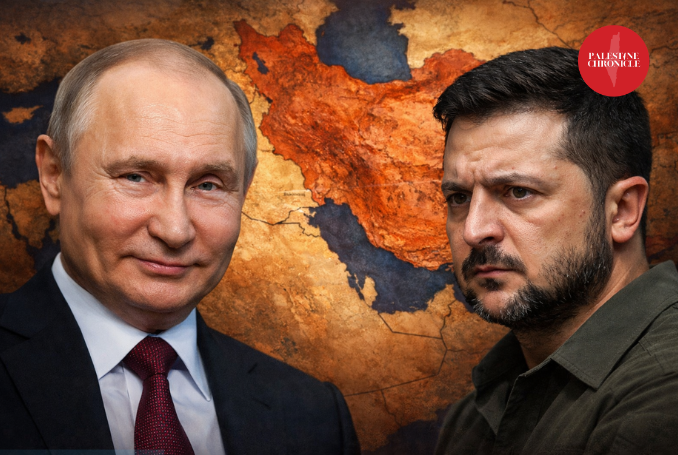

Zelensky’s Gulf tour exposed Ukraine’s entry into the Iran war and how quickly that role was challenged.
Volodymyr Zelensky arrived in Saudi Arabia on March 26 as part of a multi-country Gulf tour aimed at securing military and economic support at a time of growing pressure on Ukraine’s war effort.
A defense cooperation agreement with Riyadh followed on March 27, marking the beginning of a series of deals focused on long-term military coordination, technology sharing, and energy support.
By March 28, Zelensky had moved to Qatar and the United Arab Emirates, where additional agreements were announced. These included cooperation on missile defense systems, drone warfare, and broader security coordination, alongside efforts to secure fuel supplies critical for Ukraine’s military operations.
On March 29, Zelensky arrived in Jordan for “important security talks,” confirming that the visit was part of a broader regional push rather than a symbolic stop, as reported by Reuters.
Why Was Zelensky in the Gulf?
The visit was driven by urgency, as Ukraine faces sustained battlefield pressure and increasing uncertainty over Western military aid. Kyiv has therefore sought to diversify its partnerships, turning to Gulf states that can provide both financial backing and strategic flexibility.
Zelensky framed the agreements as long-term partnerships centered on joint defense production, counter-drone systems, and air-defense capabilities.
Ukraine also offered its expertise in intercepting drones and missiles—experience gained through years of war with Russia—while securing diesel supplies essential for both military and economic stability.
At a deeper level, this outreach reflected Ukraine’s attempt to reposition itself within a changing geopolitical landscape, where regional wars are increasingly interconnected and technological expertise has become a form of currency.
What Happened in Dubai?
It was in this context that a dramatic claim emerged. On March 28, Iran’s Revolutionary Guards said they had destroyed a Ukrainian anti-drone or air-defense depot in Dubai, stating that the facility was linked to US military operations.
The timing raised immediate questions, as the claim surfaced within hours of Zelensky’s presence in the UAE becoming public.
Ukraine rejected the allegation outright, with its Foreign Ministry stating: “This is a lie. We officially refute this information,” describing it as part of a broader pattern of disinformation, as cited by The Kyiv Independent.
Was Russia in the Background?
The wider geopolitical context makes the episode more significant. The Washington Post had recently reported, citing officials familiar with the intelligence, that Russia has been providing Iran with targeting information, including the locations of US warships and aircraft in the region.
Zelensky stated that Ukraine has “irrefutable evidence” that Russia is sharing intelligence with Iran, a claim reported by Reuters on March 25, 2026. The assertion points to a deepening level of coordination between Moscow and Tehran that extends beyond previously known military cooperation.
He also suggested that this intelligence-sharing should be understood within the broader context of Russia’s response to Western military support for Ukraine, indicating that Moscow is adjusting its strategic posture accordingly, though without framing it as a direct or explicit conditional exchange.
This development does not exist in isolation. Iran has been a crucial partner for Russia throughout the Ukraine war, particularly through the supply of Shahed drones, which have played a significant role in Russia’s aerial campaign.
That earlier phase of cooperation now appears to be evolving into a more reciprocal arrangement.
What was once a one-directional flow of military support—from Tehran to Moscow—now increasingly appears to operate in both directions, with Russia potentially offering intelligence and strategic advantages in return.
Was Washington Seeking Reinforcements?
At the same time, the United States appears to be under increasing strain as it attempts to manage multiple theaters of conflict.
Washington has been seeking broader participation from allies, particularly in securing maritime routes and containing escalation in the Gulf, but responses have been cautious.
While some states have shown willingness to engage in defensive cooperation—especially around the Strait of Hormuz—there has been little appetite for deeper military involvement.
Discussions about redirecting weapons originally intended for Ukraine toward the Middle East further suggest growing pressure on US military resources.
This reflects a broader difficulty. Washington is attempting to expand the scope of the war by drawing in new actors, but these efforts have not yet produced a decisive shift in the balance.
Did Ukraine’s Role Collapse Quickly?
Whether or not the Dubai strike actually occurred, the political implications are difficult to ignore. If the claim were true, it would suggest that Ukraine’s attempt to establish a foothold in the Gulf was neutralized almost immediately.
If false, it still indicates that Iran is closely monitoring—and responding to—the possibility of Ukrainian involvement in the region.
In both scenarios, Ukraine’s role appears constrained. Zelensky arrived with agreements, technical expertise, and urgent needs, yet there is no clear indication that his visit altered the strategic balance in any meaningful way.
Finally, this episode points to a deeper reality. Efforts to introduce new actors into the conflict are not fundamentally changing its trajectory, which continues to be shaped by entrenched dynamics: Iranian capabilities, Russian counter-pressure, cautious regional actors, and mounting strain on US resources.
(Palestine Chronicle)




The grifter that keeps on grifting. Zelensky.
Beware the Green Goblin Curse!
Clearly the Civilian Indoctrination Agency put Zelensky up to it.
It’s like they’re not even trying to be covert anymore: they don’t care if we disagree. And that is a civilian organization working inside the government: making decisions for the government.
Nothing is real, but the outcome of their actions.