
By Romana Rubeo 
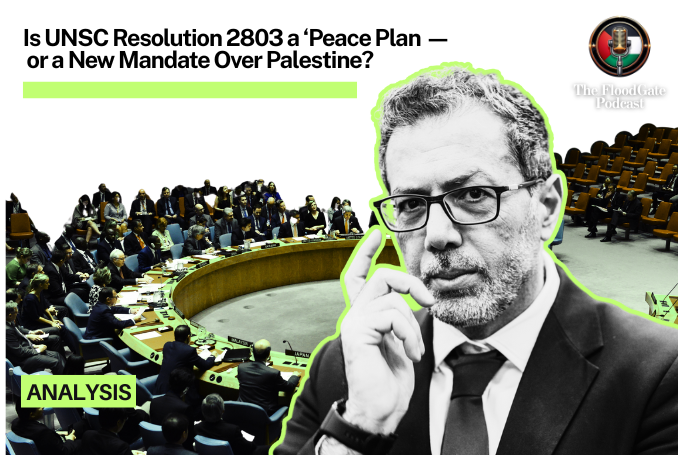
In this FloodGate episode, Ramzy Baroud argues that Resolution 2803 risks replacing military occupation with an internationally imposed mandate over Gaza.
UN Security Council Resolution 2803, which was approved on Monday, is being promoted as a breakthrough. However, for Palestinians, jurists, and political analysts, it signals a dangerous shift: Gaza is placed under international trusteeship, regulated by geopolitical interests rather than international law.
Palestinian resistance factions have rejected the resolution unequivocally, calling it a violation of their right to self-determination and a continuation of US-backed control.
While the US frames the plan as “stability,” its structure echoes colonial precedents: British Mandate governance, American security coordination, and Oslo’s subcontracted model of authority.
China and Russia abstained, Arab states aligned with Washington, and the Palestinian Authority endorsed the plan despite widespread rejection across Gaza and the West Bank.
In this FloodGate episode, Ramzy Baroud asks the central question: Is this a peace framework, or the beginning of a new phase of foreign administration?
The Resolution is a Political Project, Not a Peace Framework
Resolution 2803 was not written to resolve the war — it was written to manage its political consequences. The plan offers an administrative victory after a military failure.
“It makes absolutely no sense — well, it does make some sense from an Israeli-American point of view,” Baroud observes. “Israel is now capable of trying to achieve in Gaza what it has failed to achieve using military means.”
Rather than security or reconstruction, the resolution’s true purpose is to govern and reshape Gaza under external control. According to Baroud, its core objective is clear: “To completely subdue and crush the Palestinian resistance and the Palestinian political will in Gaza.”
Arab and Muslim States Endorsed It before the Vote
Perhaps the most politically consequential detail is not the text, but who stood behind it.
“Well, you’re not going to believe this. The Arabs and the Muslims actually issued a statement prior to the vote supporting the Trump initiative.”
Baroud frames this as a historic rupture — not silence, but participation: “The Arabs are supporting the very incarceration and humiliation of the Palestinians.”
The symbolism is devastating: governments that claimed custodianship of the Palestinian cause now align themselves with a framework Palestinians themselves rejected.
Russia and China Opposed in Rhetoric, Abstained in Practice
Moscow and Beijing criticized the resolution, yet ultimately refused to veto it.
Their abstention reflects a core political reality: they cannot appear more committed to Palestinian rights than the states claiming to represent those rights.
“They couldn’t be holier than thou,” Baroud says. “They have their own Arab allies, and they are doing good business in the Middle East.”
His point captures the contradiction: “You want (other countries) not to normalize while the Arabs are normalizing?”
Russia and China opposed the terms, but not enough to challenge the regional order backing them.
The Palestinian Authority Accepted Marginalization for Survival
The resolution sidelines the Palestinian Authority, yet the PA publicly welcomed it. Baroud argues this response exposes its political function.
“You are welcoming the very UN resolution that existed to marginalize you,” he says, “and make Tony Blair the new governor of Gaza.”
According to Baroud, the motive is simple: “As long as the money keeps flowing… it’s not about sovereignty.” The result is a widening gap between Palestinians resisting on the ground and leadership structures aligned with foreign policy priorities.
Gaza’s Agency and Sumud Make Implementation Unworkable
The resolution assumes Gaza can be governed by force, incentives, or pressure. Baroud rejects that premise: “The Palestinian resistance in Gaza is sumud — steadfastness. You can’t disarm that.”
He warns that imposing foreign rule risks confrontation, not compliance: “The moment a child in Gaza is hurt by this stabilization force, there would be a million Palestinians on the streets.”
For him, resistance is not primarily military — it is collective will:
“It’s not about bullets and guns. It’s the will of the people — and you cannot disarm that.”
(The Palestine Chronicle)

– Romana Rubeo is an Italian writer and the managing editor of The Palestine Chronicle. Her articles appeared in many online newspapers and academic journals. She holds a Master’s Degree in Foreign Languages and Literature and specializes in audio-visual and journalism translation.





Makes sense. Especially since my shady, corrupt US government is a seasoned professional when it comes to destabilization. Just look at
” 7 countries in 5 years ” , a plan to destabilize 7 countries in 5 years, but it’s been closer to 20 by now. Those countries are: Iraq, Iran, Syria, Libya, Sudan, Somalia, Lebanon. Then later they added, Yemen. Notice a common thread? Many of them involve the Israeli Nazis and the US, and are vital positions for US/Israeli dominance throughout the Middle East.
But of course the real issue is: who is the Big Boss, above Israelica?
They don’t have to be holier than anybody, but they could take a principled stand. Not taking a stand, as they did, is also taking a stand. Not good, but a warning for those of us, like me, who think something good might still come from Russia or China. Makes me sad.