By Benay Blend
For these reasons, adhering to the duopoly in US politics was meaningless for al-Amin because it meant preserving an oppressive economic system.
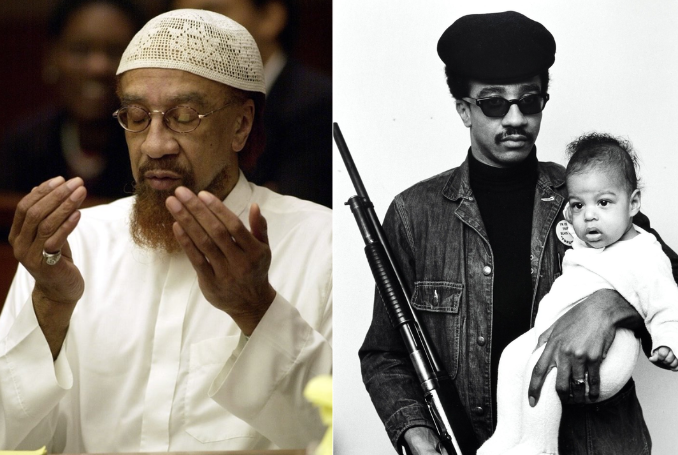
On November 23, 2025, Imam Jamil al-Amin passed away due partly to medical neglect by prison authorities. An elder political prisoner and former Black Panther, al-Amin’s death, only a few days before Palestine Solidarity Day on November 29, leaves behind a legacy that inspires all revolutionary struggles, including that of Palestine.
In order to honor al-Amin’s life and work, Black Agenda Report (BAR) republished a 2012 Black Agenda Radio article by the late Bruce Dixon.
“As a SNCC leader in rural Alabama, he helped lay the foundation for what black political power currently exists in the deep south today,“ Dixon wrote. Targeted by the Federal Bureau of Investigation (FBI) and COINTELPRO for his organizing work supporting black political and economic power, self-defense and the eradication of drugs, he spent several years in prison. Known in the Black Panthers as H. Rap Brown, he later converted to Islam, becoming Jamil al-Amin in 1976.
In 2000, al-Amin was framed for a crime that he didn’t commit, resulting in his incarceration in the federal supermax prison at Florence, Colorado, which Dixon describes as “a living tomb where conditions of enforced isolation and sensory deprivation are widely recognized as torture.”
As a political prisoner, al-Amin knew that his work did not end with incarceration. After converting to Islam, he served as a spiritual leader to fellow inmates. At the time of his death, many other political prisoners remained in jail, including Mumia Abu-Jamal and several members of the Move organization.
Palestinian political prisoners, too, are at the heart of the resistance movement. In These Chains Will Be Broken: Palestinian Stories of Struggle and Defiance in Israeli Prisons (2020), Ramzy Baroud records individual narratives that together form a recurring “theme—a thread in the narrative that represents the collective story of Palestinian resistance” (p. 5).
In 1969, as H. Rap Brown, al-Amin published Die Nigger, Die!, known as his political autobiography. Upon his death, BAR republished an excerpt from al-Amin’s book. Written while he was out on bail in 1968, it resembles Palestinian resistance literature in that his writing is from the margins, what Tahrir Hamdi terms an inclusive space that only those who stand in solidarity with the oppressed and are willing to give up their privileged positions can enter (Imagining Palestine: Cultures of Exile and National Identity, 2022, p. 31).
Like the late revolutionary writer Ghassan Kanafani, who called dialogue with the oppressor “a conversation between the sword and the neck,” al-Amin believed that “our job is not to convert whites.” Instead, he advocated for “destruction of a system that makes slavery possible,” reflecting Kanafani’s belief that “resistance is the essence” of any struggle for liberation.
“We should have learned by now from history that the process of negotiating freedom and not winning it by armed struggle has built-in limitations,” al-Amin explained. For him, capitalism was at the core of global repression, and so it was the system that needed to be overthrown.
For these reasons, adhering to the duopoly in US politics was meaningless for al-Amin because it meant preserving an oppressive economic system. It could be added that both parties are committed to supporting the Zionist regime, making electoral politics equally useless for bringing about Palestinian liberation from colonial command.
Moreover, al-Amin criticized what today is called the “Black misleadership,” those public officials who “gain popularity in Black america [and] are later used as tools by white america.” Currently, this would include politicians like former mayor of New York, Eric Adams, who, writes BAR columnist Margaret Kimberly, “followed the orders of wealthy zionists in ordering attacks on student encampments at Columbia University and City College.”
“Blackness alone is not revolutionary,” wrote al-Amin, a claim that holds true on Palestine Solidarity Day 2025, the date that the UN General Assembly called to commemorate the partition resolution of 1947.
Journalist Jon Jeter notes that, “with the exception of the Palestinians themselves, no group has paid a higher price for supporting an end to Israel’s illegal occupation than Blacks.” Like Kanafani, who saw Palestine as the spearhead of international anti-colonial struggle, al-Amin viewed the struggle of Black Americans as the key to global freedom. “We are a vanguard force in the revolution because we have been the most dispossessed,” he claimed. “The Mexican-American, the Puerto Rican, the American Indian, Japanese-American, poor whites; all these groups have reason to fight.”
Al-Amin did not include Palestinians in this quote, but his analysis is very close to Kanafani, who saw imperialism as a giant octopus laying its tentacles around the world. “If we view this country as an octopus,” al-Amin wrote, “then we see that her tentacles stretch around the globe.” Because it is an anti-colonial struggle, Palestinian resistance is a de facto part of al-Amin’s work.
As Jon Jeter claims, the bond between Black America and Palestine goes back to 1967 at latest. Spearheaded by the Student Non-violent Coordinating Committee (SNCC) and the Black Panthers, the “movement went beyond integrationist domestic reform to a global understanding of settler colonialism.”
This trajectory angered many donors as well as a segment of SNCC’s members, eventually leading to a “shuttering” of the organization. Perhaps this is what some pro-Palestinian groups, along with certain politicians, fear when they back away from calling for the dismantling of the Zionist state.
The turning away from non-violence by al-Amin, among others, also split the movement, much like the pro-Palestinian movement is divided today between individuals/groups who, for various reasons, want to impose their own non-violent stance onto Palestinians and those who support all forms of resistance.
“This country was born in violence,” al-Amin explained. “Violence is as American as apple pie.” He continued that “violence is a necessary part of revolutionary struggle. Nonviolence, as it is advocated by negroes is merely a preparation for genocide,” the same ending that Palestinians would endure if they adhered to colonial demands to disarm. “Power, indeed,” concludes al-Amin, “must come from the barrel of a gun.”
Palestinians do not “seek to explain, contextualize or justify forms of collective resistance they use,” Baroud contends. “Historically, only circumstances determine the type, time and place for armed or unarmed resistance.” On the other hand, the Western stance “is predicated on the concept of preferentiality, as in one strategy is better than the other, and that one is ethical, while the other is not.” Such positions create clear distinctions between “‘peaceful’ Palestinians, dubbed moderate, and the violent ones, dubbed radical.”
Moreover, Baroud contends, these commentators ignore the historical context of such language. By doing so, they perpetuate “colonial perceptions of the colonized.” While Baroud uses as an example “colonial Europe’s relationship with virtually all colonized space,” such language is also used to differentiate between “good” activists, such as Martin Luther King, and those who fall under the label “terrorist,” like al-Amin.
In 1977, the UN designed the International Day of Solidarity with Palestine in order to put forward “the inalienable rights of the Palestinian people—including the right to self-determination, national independence and sovereignty, and the right of refugees to return to their land after being expelled in 1948.”
Sadly, the recently passed UNSC 2803 resolution does just the opposite. It calls for disarming of the resistance along with the establishment of a transitional “oversight council,” a ruling party that excludes all Palestinians.
With the exception of Colombian President Gustavo Petro, along with certain states in Latin America, Africa, and the Global South, official bodies have done little to stop “Israel’s” genocide.
Not so grassroots movements, many of which have heeded the call from Palestinian Resistance Movement Hamas to “escalate mass action, framing the day as a renewed opportunity to confront Israeli breaches of the ceasefire agreement in Gaza and the intensification of Israeli terrorism in the West Bank and occupied Jerusalem.”
Relevant to today’s debates between reformism and revolution, al-Amin chose the latter: “We cannot end racism, capitalism, colonialism and imperialism until the reins of state power are in the hands of those people who understand that the wealth, the total wealth of any country and the world, belongs equally to all people,” and that can only come about through revolution.

– Benay Blend earned her doctorate in American Studies from the University of New Mexico. Her scholarly works include Douglas Vakoch and Sam Mickey, Eds. (2017), “’Neither Homeland Nor Exile are Words’: ‘Situated Knowledge’ in the Works of Palestinian and Native American Writers”. She contributed this article to The Palestine Chronicle.