
By Benay Blend
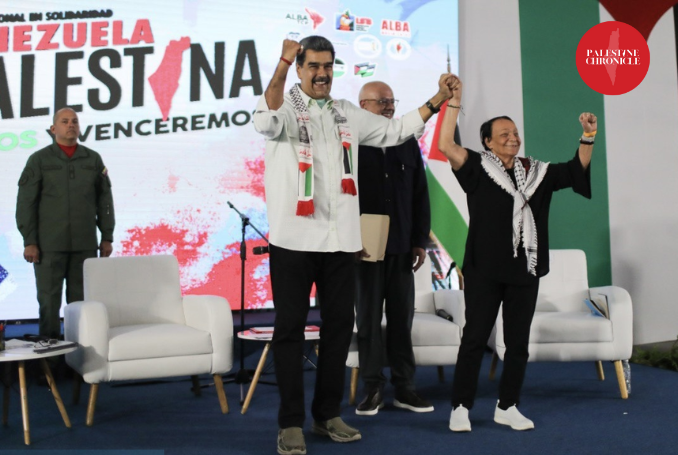
Drawing on Ghassan Kanafani’s internationalist vision, Benay Blend traces the deep connections between Palestine, Venezuela, and Indigenous struggles in the US, arguing that imperial violence abroad and repression at home are inseparable—and demand a unified global response.
In his introduction to Ghassan Kanafani’s “Strategy for the Liberation of Palestine” (1969), Khaled Barakat acknowledges that many changes have occurred in the world since the document’s publication. Still, he holds that the analysis presented by Kanafani remains the fundamental guiding principles of the Popular Front for the Liberation of Palestine (PFLP), of which Kanafani was a founder (Ghassan Kanafani: Selected Political Writings, edited by Louis Brehony and Tahrir Hamdi, 2024, pp. 93-95).
“The Palestinian and Arab liberation movement does not move in a vacuum,” Kanafani wrote.
“It lives and fights in the midst of specific world circumstances that affect and react with it, and all this will determine our fate. The international ground on which national liberation movements move has always been, and will remain, a basic factor in determining peoples’ destinies (Selected Political Writings, pp. 111-112).”
Taken in light of today’s events, Kanafani’s transnational approach sheds light on the importance of anti-colonial solidarity among various global struggles. As Louis Brehony notes, Kanafani was an “uncompromising internationalist” who “pointed to the international significance of the Palestinian struggle.”
“Imperialism has laid its body over the world, the head in Eastern Asia, the heart in the Middle East, its arteries reaching Africa and Latin America. Wherever you strike it, you damage it, and you serve the world revolution.”
On January 3, 2026, the United States struck Venezuela in a raid that included the bombing of military targets along with the kidnapping of President Maduro and his wife, Cilia Flores, from their residence in Caracas.
According to the Venezuelan defense minister, a total of 83 people were murdered in the raid, including 32 Cuban soldiers, some of whom belonged to President Maduro’s personal protection force.
Long before the attack on Caracas, commentators were drawing parallels between Indigenous struggles in Venezuela, the United States, and Palestine. In an August 23, 2025 interview with Venezuelanalysis, Lakota historian Nick Estes traces the links between US settler colonialism and imperial measures abroad, such as attacks against Bolivarian and Latin American struggles, along with the genocide that the US and Israel are carrying out in Palestine.
Connecting imperialism to internal colonialism, Estes provides two important policies that reinforce both colonialism and imperialism: Manifest Destiny and the Monroe Doctrine, the latter being an extension of the project of white supremacy to the entire hemisphere.
“Half a century ago, the Red Power movement went international,” Estes said. Like the Black Radical Tradition, it built alliances with Nicaragua, the Palestine Liberation Organization (PLO), and other revolutionary movements around the world.
In 2019, Estes visited Venezuela, taking with him a group of young Indigenous people from the U.S. When he returned in 2020 and 2021, Estes notes that he was “very taken by the resilience of the Indigenous communities, specifically the Pemón community, which identified openly and explicitly as Chavista, saying they are part of the revolutionary project.”
Returning to the Monroe Doctrine, Estes sees this policy continuing today, with Palestine as an “extreme example.” For this reason, various leaders of the Palestine resistance affirmed their support for Venezuela shortly after the American attack.
In a statement issued on the Masar Badil: Palestinian Alternative Revolutionary Path website, Mohammed Khatib, a member of the organization’s executive committee, affirmed that the Palestinian resistance stands firmly alongside the Bolivarian Republic of Venezuela and its people in opposing US aggression.
He added that “the battle Venezuela is waging today is not an isolated one, but rather an integral part of the struggle of the world’s peoples against hegemony, colonialism, and violations of national sovereignty.”
In line with this stance, it follows that the annual Masar Badil conference will be held this March-April in São Paulo, a location that recalls not only the siege on Venezuela but also the plight of Latin America as a whole. A region marred by the advance of right-wing politics and elections tarnished by imperialist intervention, Latin America’s plight calls for the creation of a “historic, revolutionary, and organized response.”
Recalling the words of Kanafani, the conference might take place in a stronghold of the ongoing US imperialism, but its organizers understand that “in times of reactionary offensive and recolonization, our historical task is to rebuild an international front of resistance, reconnect the threads of the struggle between Palestine and Latin America,” and in response to build a revolutionary movement commensurate to the task at hand.
“Israel’s” ongoing intervention in the region adds another layer to cementing the connections between people of the Global South.
In an article for Palestine Chronicle, Robert Inlakesh explains how America’s attack on Venezuela has brought to light “Israel’s” deeper goals to weaken Iran, reshape Latin America, and establish control over global energy resources.
“Greater American imperial domination aids and legitimizes [the Zionist’s ‘Greater Israel’] project,” Inlakesh writes, “and so does Washington’s control over Venezuela’s oil.” Regime change in Venezuela also results in Iran losing the Maduro government as an ally, thus adding to “Israel’s” support of the attack.
While Venezuela has a long history of anti-colonial resistance, Indigenous people in the US are part of the same struggle, a connection that has become particularly germane since the murder of 37-year-old Renee Nicole Good by an Immigration and Customs Enforcement (ICE) agent in Minneapolis, Minnesota.
In their quest to randomly detain people of color regardless of citizenship status, ICE arrested four members of the OGLALA Sioux Tribe, three of whom were transferred to a facility at Fort Snelling.
According to Nick Estes, an associate professor in American Indian Studies at the University of Minnesota and a member of the Lower Brule Sioux Tribe, Fort Snelling served as a military outpost where Dakota people were incarcerated during the Dakota War of 1862. It has a “troubling history” for Indigenous people.
“It has this really notorious anti-Indigenous, specifically anti-Dakota, history,” Estes said. “It’s kind of like a continuation of the monopoly of violence from the military outpost to the ICE facility.”
While commentators have drawn parallels between ICE enforcement and Israeli violence toward Palestinians, Inlakesh notes that the connection runs much deeper.
Like the police force in various cities that often train in Israel, ICE maintains “a direct relationship with the Israeli military, which is training its forces to treat American citizens like Palestinians under occupation.”
“Not only are the violent tactics used by the illegal occupying military committing genocide in Gaza exported to US cities through the likes of ICE,” Inlakesh writes, “but there is also a demonstrable ideological connection between ICE and the Israeli army.”
Long before the shooting of Renee Good, US Army veteran and whistleblower, Antony Aguilar, said “ICE agents and DEA agents, and other three-letter agencies, train with the Israelis,” thus Americans were already warned that the violence exported abroad would eventually return home.
‘We pay Israel our tax dollars so they can continue to bomb and kill unarmed civilians,” he said. “We bomb boats off the coast of Venezuela, we blow up Colombians in fishing boats. If you don’t think that won’t come to your neighbourhood, think again.”
Black and Indigenous people, the marginalized, the poor—all understand that the state violence tearing up neighborhoods in Minneapolis did not begin with Trump. Indeed, Nick Estes traces the connections between US imperialism abroad, along with internal colonialism at home, back to the “so-called Indian Wars” beginning in the 18th century.
Writing for Black Agenda Report (BAR), Ajamu Baraka ties it all together. “The state is not drifting toward repression,” Baraka writes, “it is building it with serious intent. ICE raids, militarized police, and mass surveillance are the tools of a system designed to manage and silence people in crisis.”
Through the connections between US police and Israeli forces, Baraka notes, security forces in this country import “an entire political logic: that certain populations are not citizens but problems, not constituents but threats, not humans but risks.”
“The empire has come home,” explains Baraka, bringing with it a system built on “coercion, control and violence.”
Baraka’s words are sobering, but his solution falls in line with ways that have stood Palestinians well in their long-running resistance to genocide.
“The task before us is not reform within the architecture” of a repressive security state, he concludes, but rather “confrontation with it. Not technocratic fixes, but political resistance” through building an anti-imperialist global struggle against repression.
– Benay Blend earned her doctorate in American Studies from the University of New Mexico. Her scholarly works include Douglas Vakoch and Sam Mickey, Eds. (2017), “’Neither Homeland Nor Exile are Words’: ‘Situated Knowledge’ in the Works of Palestinian and Native American Writers”. She contributed this article to The Palestine Chronicle.


Be the first to comment