
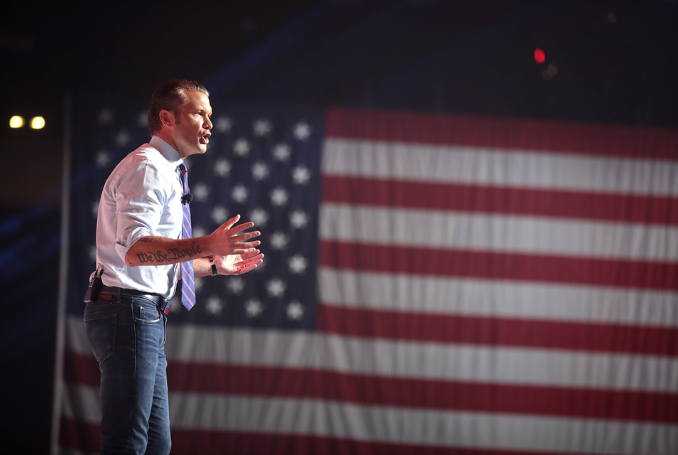

US Defense Secretary Pete Hegseth said Iran “cheered on 9/11” while linking the 2001 attacks to the current war. Contemporary reports tell a different story.
Key Takeaways
- Hegseth said Iran had “cheered on 9/11” during remarks marking the 25th anniversary of the attacks.
- Contemporary reporting from September 2001 documented condemnations from Iranian leaders, public expressions of sympathy and vigils for the victims.
- Iran later cooperated with the US on Afghanistan despite continued hostility between Washington and Tehran.
US Defense Secretary Pete Hegseth said Friday that Iran “cheered on 9/11” as he and President Donald Trump used remarks commemorating the 25th anniversary of the September 11 attacks to draw a connection between the attacks and the ongoing US-Israel war against Iran.
Speaking at the Pentagon, Hegseth referred to US military campaigns following September 11 before turning to Iran.
“Our warriors have fought an Islamic theocracy that has wished us death for nearly half a century, that cheered on 9/11,” Hegseth said, according to Common Dreams.
But contemporary reporting from September 2001 does not support the broad assertion that Iran — whether understood as its government or its population — “cheered” the attacks.
Instead, reports published immediately after September 11 documented official Iranian condemnations of the attacks, public expressions of sympathy for the victims and candlelight vigils in Tehran.
9/11 and Iran War
President Trump also referred to the current war during Friday’s Pentagon commemoration.
“We salute every member of the United States military who served in the ‘war on terror,’” Trump said, before referring to US forces currently fighting Iran and saying Tehran would “never ever” obtain a nuclear weapon.
Trump later connected the current fighting to the pledge made following September 11.
“Today we renew the sacred oath that we first swore in their names a quarter of a century ago. We will never, ever forget,” Trump said. “That’s why we fight today. We don’t have a choice. There can only be victory. We fight hard. We fight to win.”
Hegseth similarly described the war against Iran as part of a continuing struggle against what he called “evil.”
“The struggle against evil continued, and it continues now,” he said. “It will continue until judgment day.”
Did Iran ‘Cheer on 9/11’?
Contemporary accounts of Iran’s response to September 11 contradict Hegseth’s characterization.
On September 19, 2001, the Washington Post reported that both Iran’s government and its population had offered “messages of sympathy and condemnations of terrorism” following the attacks. The newspaper reported that conservative and reformist political figures, religious officials and ordinary citizens had condemned the hijackings.
Then-Iranian President Mohammad Khatami condemned the attacks on the day they occurred, describing the targeting of civilians in American cities as terrorism.
Common Dreams writer Stephen Prager, reporting on Hegseth’s remarks Friday, cited Khatami’s statement and noted that the Iranian president later described September 11 as “the ugliest form of terrorism ever seen.”
Iran’s political leadership was hardly sympathetic toward Washington at the time.
Supreme Leader Ali Khamenei remained deeply critical of US foreign policy and later rejected participation in a US-led military coalition. But he too condemned the killing of innocent people following September 11.
Contemporary Washington Post reporting noted that Khamenei had condemned the attacks before subsequently refusing to support the US-led war in neighboring Afghanistan.
Vigils and a Minute of Silence
Ordinary Iranians also expressed sympathy. The Washington Post reported on September 19, 2001, that approximately 200 people, many dressed in black, attended a candlelight vigil in northern Tehran.
More strikingly, approximately 50,000 spectators at a World Cup qualifying match between Iran and Bahrain observed a minute of silence for the victims.
The contemporary report also said Iranian state television and radio, despite their normally anti-American editorial positions, had provided unusually sympathetic coverage of the attacks.
Common Dreams cited additional reporting of a subsequent Tehran candlelight gathering at which participants condemned terrorism and expressed sympathy with Americans.
Cooperation over Afghanistan
Iran’s response extended beyond public statements. The Taliban government in Afghanistan was itself a regional adversary of Iran. Taliban forces had killed Iranian diplomats in Mazar-i-Sharif in 1998, bringing the two countries close to war.
In the weeks following September 11, the Bush administration explored whether Iran could assist the campaign against Al-Qaeda and the Taliban. Contemporary reporting said Washington sought to determine through indirect channels what intelligence or other assistance Tehran might provide.
Iran subsequently played a role in diplomatic efforts surrounding Afghanistan after the Taliban government’s fall.
Former US Secretary of State Colin Powell later acknowledged that Iran had played “a helpful role” at the Bonn Conference that established Afghanistan’s post-Taliban interim authority and had contributed to reconstruction efforts.
Common Dreams’ Stephen Prager also noted that a 2002 State Department report documented Iranian cooperation with US operations against Al-Qaeda and the Taliban, including offers of search-and-rescue assistance for downed US aircrews and cooperation during the Bonn process.
A More Complicated Record
None of this meant that relations between Iran and the United States ceased to be hostile after September 11.
Washington continued to designate Iran a state sponsor of terrorism, while Tehran continued supporting resistance organizations opposed to Israel and strongly criticized subsequent US military policy.
Iran also refused to join the US-led military coalition against Afghanistan, with Khamenei declaring later in September 2001 that Tehran would not assist a US attack on its neighbor.
Those disputes, however, are separate from the question of Iran’s immediate reaction to September 11.
The available contemporary record shows Iranian officials condemning the attacks, citizens holding vigils and observing a minute of silence, and Tehran subsequently cooperating in limited ways against the Taliban and Al-Qaeda.
Hegseth’s statement that Iran “cheered on 9/11” is therefore not supported by the documented public response of either the Iranian government or Iranian citizens in the immediate aftermath of the attacks.
Hegseth on Iran:
Our warriors have fought an Islamic theocracy that has wished us death for nearly half a century, that cheered on 9/11. pic.twitter.com/8jh8y1SMjn
— Clash Report (@clashreport) September 11, 2026
(PC, Common Dreams, Guardian, US Media)




Liar!
What a piece of sh!t he is! Iran had nothing to do with it, but any involvement from any party in the Middle East, was due to US hegemony and all we had done to them over the past 70 years.
But it was our own government that executed the plan to destroy the WTC, no one from the Middle East had anything to do with it. 9 of the supposed hi-jackers were alive the next day. Obviously their identities were used to create the phantom culprits as an excuse to attack Iraq and Afghanistan.
I seem to remember it was five Israeli’s (mossad” agents) with explosive residue found in their van that were filming and cheering the event. All five were arrested but, of course, the US government allowed them to fly out the next day.
Sorry, but do you honestly believe that real agents from Mossad would really allow themselves to be filmed that way? In your opinion, would the CIA, or KGB, or MI5, or 6 allow themselves to be filmed that way? I agree that some people were very conveniently ” caught ” but i find it very hard to believe it was real. No offense to you personally though.