
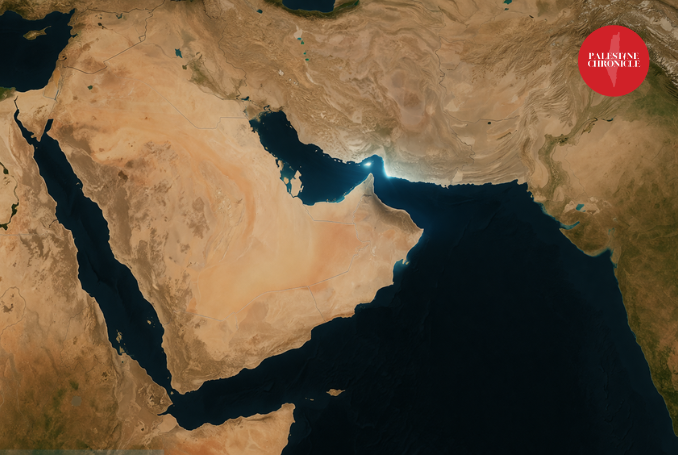

Iran says US naval movement in the Strait of Hormuz failed, as negotiations in Islamabad enter a critical phase.
Key Developments
- US vessel reportedly turned back after Iranian warning in Hormuz.
- Iran denies US transit claims, calls them “fabricated victories.”
- Drone deployment and military pressure cited in maritime standoff.
- Talks in Islamabad proceed amid threats of escalation.
Naval Confrontation
An Iranian political-security source told Al Mayadeen that a US attempt to cross the Strait of Hormuz ended in failure, rejecting reports that an American vessel successfully transited the strategic waterway.
The source described the circulating claims as “fabricated” and part of a broader media effort to project “imaginary victories,” particularly in outlets close to the White House.
According to the same source, the vessel in question was a smaller craft that attempted to pass through the strait but was met with a full encirclement and a firm warning by Iranian forces, forcing it to withdraw and alter course.
Escalation Signals
Separate reporting cited by Bloomberg indicated that Iranian forces launched a drone toward two US vessels attempting to navigate the strait, prompting both to retreat.
Iran’s Fars News Agency also reported that a US destroyer approaching from the port of Fujairah was forced to halt its movement after a direct warning from Iranian armed forces.
According to Fars, Tehran conveyed through Pakistani intermediaries that the vessel would be targeted within 30 minutes if it continued its advance, a message that reportedly led to an immediate decision to stop the destroyer.
Denial and Messaging
Iranian officials have consistently denied claims, including those reported by Axios, that any US vessel successfully crossed the Strait of Hormuz.
Officials framed the reports as part of a broader attempt to influence global energy markets by projecting control over one of the world’s most critical maritime chokepoints.
An Iranian source told Reuters that navigation through the strait is now being linked directly to the release of frozen Iranian assets, some of which are reportedly held in Qatar and other foreign banks.
Talks Under Pressure
The maritime tensions are unfolding alongside ongoing trilateral negotiations between Iran, the United States, and Pakistan in Islamabad.
Iranian officials have entered the talks with clear red lines, including the release of frozen assets and a ceasefire across regional fronts.
Deputy Foreign Minister Kazem Gharibabadi said Tehran is prepared for “all scenarios,” reflecting the low level of trust between the negotiating sides.
Meanwhile, Foreign Ministry spokesman Esmail Baghaei criticized statements in US political and media circles calling for the assassination of Iranian negotiators, describing them as “open incitement to terrorism.”
“These are not the actions of a party negotiating in good faith,” Baghaei said, warning that such rhetoric undermines the diplomatic process.
Baghaei described the current moment as “historically sensitive,” emphasizing that diplomacy is being conducted as “the continuation of war by other means.”
Iranian officials have repeatedly stressed that negotiations are unfolding in parallel with military readiness, presenting diplomacy and deterrence as two sides of the same strategy.
Iran and US Meet Face-to-Face in Islamabad as Talks Enter Technical Phase
(Al Mayadeen, PC, X, Iranian Media, US Media)




Iran has proven itself to be the exact opposite of all our government told us they were. Yes, they are repressive toward women, and brutally so. i don’t agree with that one bit, but that is their business. As a culture, they have shown; honor, respect, patience, while being constantly maligned by the, mostly US-led and fed media, and by the scummy Israeli Jewish Nazis.
More power to anyone who resists and defeats the tyranny and war-mongering of Israelica.