

Gaza’s death toll continues to rise despite a ceasefire, as severe weather floods displacement camps and Israeli raids intensify across the West Bank.
Death Toll Continues to Climb in Gaza
Although a ceasefire went into effect on October 11, the number of Palestinians killed in Gaza has continued to rise, reaching 72,267, most of them women and children, since the start of the Israeli war in October 2023.
At least 171,976 others have been wounded, according to the Ministry of Health in Gaza, which noted that the toll remains incomplete as many victims are still trapped under rubble or in areas inaccessible to rescue teams.
Medical sources reported that the bodies of two Palestinians, including one who succumbed to earlier injuries, and 17 wounded individuals were brought to hospitals across the Gaza Strip over the past 24 hours.
Since the ceasefire came into effect, 691 Palestinians have been killed and 1,876 injured, while at least 756 bodies have been recovered from under the rubble.
Israeli attacks continue across the Strip amid the ongoing siege and repeated violations of the ceasefire agreement, further worsening conditions on the ground.
Storms Flood Camps
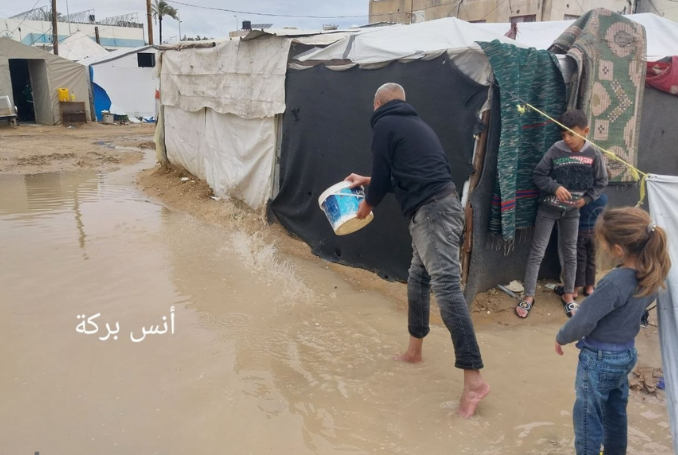
Heavy rains and a low-pressure weather system have added a new layer of hardship for displaced Palestinians across Gaza.
Floodwaters inundated hundreds of tents sheltering displaced families, forcing many to evacuate or attempt to reinforce their shelters with limited and improvised materials.
In Gaza City, several people were injured after a wall collapsed onto tents along Al-Wahda Street due to strong winds and heavy rainfall.
Field footage showed displacement camps transformed into pools of water and mud, with tents flooded from within and movement across camps becoming extremely difficult.
Heavy rain and strong winds flooded tents sheltering displaced Palestinians near Gaza’s port, worsening already dire conditions
Families face shortages, limited shelter, and ongoing violence, with thousands killed and infrastructure largely devastated pic.twitter.com/NQ3hrG0KFV
— Anadolu English (@anadoluagency) March 26, 2026
The conditions exposed the fragility of temporary shelters, which are not equipped to withstand harsh weather, further endangering vulnerable populations, particularly children and the elderly, amid dropping temperatures.
The rains also highlighted the extensive destruction of Gaza’s infrastructure, with damaged drainage and sewage systems leading to water accumulation in streets and leakage into shelters.
The crisis comes as hundreds of thousands of Palestinians remain without permanent housing after entire neighborhoods were destroyed during the war.
Approximately 1.9 million displaced people—out of a population of 2.4 million—are living in extremely harsh conditions, with severe shortages of food, water, and medical care.
Much of Gaza’s civilian infrastructure, including homes, hospitals, schools, and water systems, has been extensively damaged or destroyed, contributing to the near-total collapse of basic services.
Israeli Raids Intensify across West Bank
At the same time, Israeli occupation forces have escalated operations across the West Bank, carrying out widespread raids and arrests.
According to Quds Network, Israeli occupation forces raided multiple areas on Thursday, searching homes, detaining residents, and conducting field interrogations.
In Al-Arroub camp north of Hebron (Al-Khalil), a boy and two women were arrested, while additional arrests were reported in Hebron, Nablus, Jenin, and Tulkarm.
These arrests are part of ongoing daily campaigns that have intensified in recent weeks.
Imagine this.
You’re Palestinian, living in the West Bank, in the home your family has had for generations.
Then they appear:
Israeli settlers storming your house like beasts, backed by the IDF.
This is pure brutality. pic.twitter.com/9o8NwJ1KI6
— Parody Jeff (@Parodyjeffx) March 25, 2026
Alongside military raids, illegal Israeli Jewish settler attacks have sharply increased.
Over the past five days, settlers carried out 109 attacks across the West Bank, targeting homes, vehicles, agricultural lands, and infrastructure.
Nablus recorded the highest number of incidents, followed by Ramallah and Hebron, with attacks including arson, destruction of olive groves, and assaults on schools and roads.
Settlers also carried out road attacks, throwing stones at vehicles, blocking access routes, and targeting farmers in rural areas, causing widespread damage and disruption.
(PC, Al Mayadeen, WAFA, QNN)




Be the first to comment