
Iran warned a US attack would trigger regional war, as military threats, European sanctions, Israeli anxieties, and cautious diplomatic signals converge.
Key Developments
- Iran’s Supreme Leader warned that any US military strike would escalate into a region-wide conflict.
- Washington increased military threats while simultaneously signaling openness to negotiations with Tehran.
- Iran moved against European armies after the EU designated the IRGC a ‘terrorist’ organization.
- Israeli media warned that a war with Iran would inflict severe economic damage, even if led by the US.
- Tehran emphasized missile and drone deterrence while acknowledging limits in its air force.
A Stark Warning from Tehran
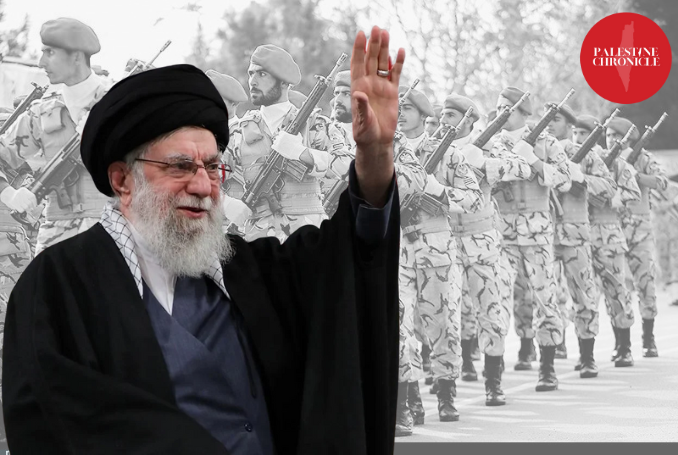
Iran’s Supreme Leader Ali Khamenei warned on Sunday that any US military attack on Iran would ignite a regional war, as tensions between Tehran and Washington reached a critical peak.
Speaking in Tehran ahead of the 47th anniversary of the 1979 Islamic Revolution, Khamenei said Iran would not initiate war but would respond decisively to any aggression. He dismissed US naval deployments to the Persian Gulf as routine pressure tactics, saying they would not intimidate the Iranian people.
“If the US initiates a war this time, it would spill over across the entire region,” Khamenei said, adding that Iran “does not seek to attack any country” but would “deliver a firm blow” to any aggressor.
US Military Threats
Khamenei’s remarks followed a series of statements by US President Donald Trump, who said a “massive armada” of US warships was heading toward Iran while urging Tehran to negotiate.
At the same time, Trump told reporters that Iran was “seriously talking” with Washington and expressed hope that negotiations would lead to an acceptable outcome, particularly regarding Iran’s nuclear program.
The dual messaging—escalating military pressure alongside claims of diplomatic engagement—has fueled uncertainty across the region, with analysts warning that miscalculation could quickly turn threats into confrontation.
Iran Rejects Assassination Reports, Signals Readiness with Burial Sites for Potential US Casualties
Protests and the ‘Coup’ Narrative
Addressing recent anti-government protests, Khamenei characterized the unrest as a failed attempt to destabilize the country, likening it to a coup aimed at dismantling key state institutions.
He said demonstrators targeted police stations, government buildings, Revolutionary Guard facilities, banks, mosques, and even religious sites. Iranian authorities have accused the US and Israel of backing what they described as violent elements within the protests, framing the unrest as externally driven rather than domestic dissent.
A day earlier, Khamenei visited the shrine of Imam Ruhollah Khomeini in Tehran, a highly symbolic gesture widely interpreted as defiance in the face of reported US threats against Iran’s leadership.
Iran–Europe Confrontation over IRGC
Tensions also escalated sharply between Tehran and European capitals after the European Union designated Iran’s Islamic Revolutionary Guard Corps (IRGC) a terrorist organization.
In response, Iran’s parliament announced it would classify European armies as terrorist organizations. Parliamentary Speaker Mohammad Bagher Ghalibaf condemned the EU decision as politically motivated and taken to appease Washington.
Members of parliament appeared in IRGC uniforms during the session, chanting slogans in support of the force. Iran’s judiciary and military leadership warned the EU decision would not go unanswered, deepening Tehran’s diplomatic isolation from Europe.
Mapping Epstein’s Israel Connections: What the Documents Show
Israeli Economic Fears
As talk of a US-Iran confrontation intensified, Israeli media began openly warning of severe economic fallout for Israel.
According to Israeli outlet i24NEWS, economists cautioned that any war with Iran—even if initiated by the US—would disrupt ports and airports, cripple foreign trade, raise shipping and insurance costs, and trigger capital flight. Analysts warned of billions of shekels in losses within days, soaring military spending, falling tax revenues, and potential credit-rating downgrades.
“The bill would be Israeli even if the strike were American,” one assessment concluded, reflecting growing unease within Israel’s economic and security establishment.
Iran’s Military Posture
Iranian officials and analysts have emphasized that Tehran’s primary deterrence lies in its missile and drone capabilities rather than its conventional air force.
While Iran maintains one of the region’s largest missile arsenals and has significantly expanded its unmanned aerial vehicle (UAV) program, its air force relies largely on aging US- and Russian-made aircraft dating back to the 1960s–1980s.
To address these gaps, Iran has pursued acquisitions from Russia, including Yak-130 trainer jets and prospective Su-35 fighters, while expanding domestic drone production. Tehran has also unveiled new capabilities, including a locally built drone carrier for the IRGC Navy, signaling a shift toward asymmetric and technological deterrence.
From the Age of Catastrophe to the Age of Hope: Why a Free Palestine Matters to the World
Energy Politics
Parallel to the military escalation, Trump announced that India would buy Venezuelan oil instead of Iranian crude, part of Washington’s broader effort to redirect global energy flows away from Iran and Russia.
Trump said China could also purchase Venezuelan oil under US-approved arrangements, underscoring Washington’s intent to use energy markets as leverage against Tehran while reshaping geopolitical supply chains.
Despite the escalating rhetoric, Iranian officials have continued to signal cautious openness to diplomacy. Senior figure Ali Larijani said a “structured framework” for negotiations was taking shape, while reiterating that talks must be based on fairness and mutual respect.
(Al-Mayadeen, PC, Anadolu, Iranian Media, AJA)