
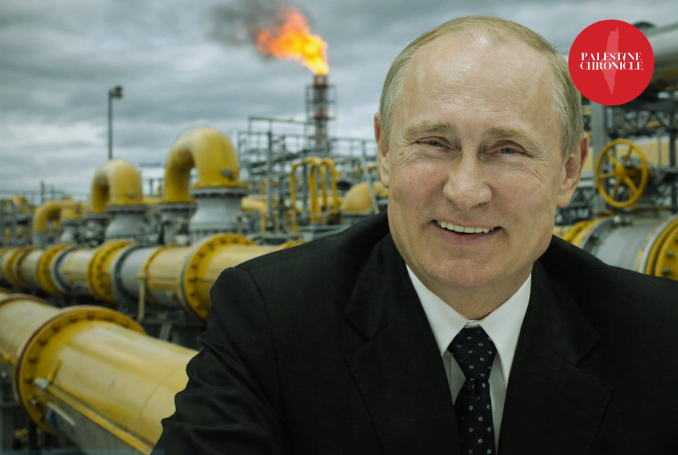

Putin warns Russia could halt gas supplies to Europe as aggression on Iran disrupts global energy markets.
Key Developments
- Putin warned Russia may halt gas supplies to Europe amid the energy shock triggered by US-Israeli aggression on Iran.
- Oil and gas prices have surged as attacks on Iran disrupt shipping and energy infrastructure across the Middle East.
- Shipping through the Strait of Hormuz—handling roughly one-fifth of global oil—has slowed dramatically.
- Russia is expanding energy exports toward China and India as Europe attempts to phase out Russian gas imports.
- Analysts say the crisis could strengthen Russian leverage over global energy markets while increasing economic pressure on Western economies.
Putin Threatens Gas Cut
Russian President Vladimir Putin warned that Moscow could halt gas supplies to Europe as global energy markets surge following the US-Israeli aggression on Iran.
Speaking on Wednesday, Putin suggested that Russia may reconsider its remaining exports to the European market as energy prices rise sharply amid the widening conflict in the Middle East.
According to a Kremlin transcript cited by Reuters, Putin said Russia may ultimately find it more profitable to redirect gas exports toward new markets rather than continue supplying Europe.
“Now other markets are opening,” Putin said. “Perhaps it would be more profitable for us to stop supplying the European market now and move to those markets that are opening.”
Putin stressed that no final decision had been taken, describing the remarks as “thinking aloud,” while adding that the Russian government would study the issue with energy companies.
The warning comes as the European Union moves toward banning purchases of Russian pipeline gas by 2027 and restricting new short-term contracts for Russian liquefied natural gas beginning in April 2026.
Russia once supplied roughly 40 percent of the European Union’s pipeline gas, but that share fell dramatically following sanctions and Europe’s attempts to diversify its energy supplies.
Despite this decline, Russia continues to export gas to several European states through the TurkStream pipeline, including Hungary and Slovakia.
Global Energy Prices
Putin’s warning comes amid a broader energy shock triggered by the ongoing US-Israeli aggression on Iran.
Oil and gas prices have surged globally as the conflict disrupts energy infrastructure and shipping routes across the region. Brent crude has climbed above $80 per barrel, with analysts warning prices could rise further if the crisis continues.
A central factor driving the surge is the disruption of shipping through the Strait of Hormuz, the narrow waterway connecting the Persian Gulf to global markets.
Around 20 percent of the world’s oil supply normally passes through the strait, making it one of the most critical energy chokepoints in the global economy.
Following the attacks on Iran and Tehran’s retaliation across the region, tanker traffic through the strait has sharply declined, with shipping companies suspending transit due to security risks.
The disruption has already triggered widespread volatility in energy markets, pushing up oil and gas prices while increasing fears of supply shortages across Europe and Asia.
Higher energy prices are also affecting consumers directly. In the United States, gasoline prices have already jumped sharply in the days following the escalation of the war.
‘Hiroshima Would Be Child’s Play’ — Medvedev; Lavrov Condemns US ‘Aggression’
Russia’s Energy Pivot
As Europe attempts to reduce its dependence on Russian energy, Moscow has increasingly redirected its oil and gas exports toward Asia.
Russia has expanded pipeline gas deliveries to China, while crude oil shipments to India have also increased as global markets tighten.
Deputy Prime Minister Alexander Novak said Moscow is prepared to boost oil shipments to both China and India as the crisis triggered by the war on Iran reshapes global supply routes.
Shipping data cited by Bloomberg indicates that some Russian oil cargoes originally destined for East Asia have recently been diverted toward Indian ports, suggesting renewed demand as global supply becomes more uncertain.
Indian refineries, which had reduced purchases earlier this year amid pressure from Washington, now appear more willing to accept Russian crude as global markets tighten.
Meanwhile, Chinese refiners are also increasing imports of Russian oil and liquefied natural gas as concerns grow about shortages resulting from disruptions in the Middle East.
The shift reflects a broader transformation in global energy flows that has accelerated since Western sanctions against Russia following the Ukraine war.
Our Strategic Analysis
Beyond the battlefield developments, the aggression on Iran is increasingly evolving into a broader geopolitical and economic confrontation.
One of Iran’s most powerful strategic tools lies in its ability to disrupt global energy flows, particularly through the Strait of Hormuz. By threatening shipping routes that carry a large share of the world’s oil and gas supplies, Tehran can exert pressure on global markets and drive up energy prices.
Rising oil and gas prices translate quickly into higher fuel costs, electricity prices, and inflation across Western economies.
This dynamic has already begun to appear. Energy prices in Europe and Asia have surged, and analysts warn that prolonged disruptions could deepen inflation and economic instability.
Russia, meanwhile, stands to benefit from these developments.
Higher oil prices increase Moscow’s export revenues and strengthen the financial position of its energy sector despite Western sanctions. At the same time, rising global demand for alternative energy supplies allows Russia to expand exports to Asian markets.
Putin’s warning about halting gas supplies to Europe should therefore be understood within this broader strategic context.
Russia retains the capacity to influence European energy markets at a moment when the continent is already facing rising prices due to the war on Iran.
If Moscow reduces exports while Iran continues to disrupt global energy flows, Western economies could face simultaneous pressure from multiple directions.
While there is no public confirmation of coordination, the strategic interests of Russia and Iran increasingly overlap.
Both countries benefit from higher global energy prices, both seek to weaken Western economic pressure, and both have strong incentives to exploit vulnerabilities in global energy markets.
For Western governments supporting the war, the greatest pressure may ultimately emerge not only on the battlefield, but in their own economies.
(Russian Media, PC, Anadolu, AJA, Bloomberg)




Putin is a genius. More power to anyone who stands against imperialism today.
Dondolf Trump and his entire Nutzi Party are an embarrassment. And now Zelenskyy feels better that Russia is distracted, but it won’t matter. Ukraine was never in the lead and never will be.