It is these notions, together with hauntologies of genocide, that we need to reimagine for a world that is based on planetary justice as an urgent consciousness for care and love.
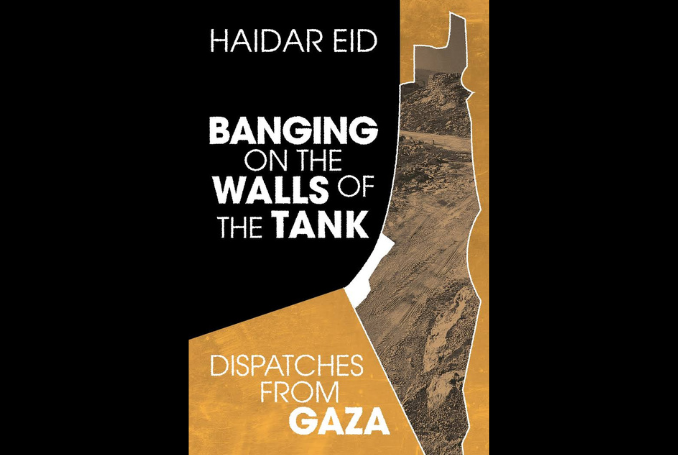
I begin with the proviso that this review is of a book written by my beloved friend, Haidar Eid, acknowledging the backdrop of the genocide in Gaza. Wherever we travel, we are confronted with the hauntology (the absence of presence) on the land. At the heart of the genocide, Haidar Eid offers us another view, “I am there, but not there” (p.29).
It is another kind of hauntology, a remembrance of the embrace of love in the presence of erasure. Eid demands that we see the hauntology through a lens on power. What happens when we live with the keen sense of a haunting presence in the silent absence of the people who were once there on the land? Who decides who can be erased? This is the formidable question that is put before us? Eid, in his book, invokes Ghassan Kanafani’s real-life story of the three men who died in the tank as they were smuggled out of Iraq to Kuwait. Thus, this collection of public pieces is intertextual and historically placed to map the ongoing 1948 Nakba of Palestinians as a result of European arrogance to push people off the land.
The reader is introduced to this collection of essays through Richard Falk’s foreword, emphasizing the relevance of this book for Westerners; reminiscent of John Paul Satre’s foreword to Frantz Fanon’s The Wretched of the Earth (1961), where he warns of something similar but loses his nuance because Satre misrecognized the presence of his friend, confining Fanon to the (Black) other, removing the hu/man to a construct that inevitably leads to dehumanization.
When engaging my friend and interlocutor’s words, I am reminded of the weight of the moment because Eid’s loss can only be felt by Eid, who lost more than sixty-five members of his family in the death frenzy of the Gaza Holocaust.
For Eid, hauntology is not an abstraction, but a living reality. It is with compassion-consciousness that I hold Eid in my heart with his suffering, although I will not be able to fully comprehend the magnitude of his pain. Our shared grief in bearing witness to the indignity and cruelty of a system in all its horror is traumatizing.
Banging on the Walls of the Tank invites you into an intimate conversation that demands truth-telling. In a letter to former President Obama, Eid observes Obama’s transformation from recognizing the truth in Edward Said’s warnings about the devaluation of Palestinian life when Israel’s security is measured against the mundane violence of occupation.
Hence, Eid cautions against the two-state solution as the Bantustanization of the Levant, with Palestine becoming the proverbial prophet that is crucified on the sacrificial cross of Western Imperialism. As Eid points out, our senses are numbed through the incessant violence normalized to the extent that genocide is a banal factor in our day-to-day lives.
Eid demands BDS on the basis of its efficacy during apartheid South Africa, especially when the balance of power is against Palestinians (p. 34):
Was the boycott of apartheid meant to end South Africa as a country or to end racism in its ugliest form?
Transforming Israel from an ethno-religious apartheid state into a democracy should be the objective of every single person believing in liberal democracy in general. But some “liberals” keep whining that one of the “scary aims of BDS” is equal rights and warning that the state of Israel might be in peril if BDS has its way.
I return to South Africa with its attendant violence, accompanied by an apartheid curriculum inferring the normalization of the superiority of whiteness. For all of Europe’s color washing, whether white, pink or green, whiteness reifies the center in the epistemological project with the emptying of decolonization from its work of returning to the land.
In this way, the education economy reaffirms white male supremacy, etching into the body the fungibility of Black life. In situations where power is overwhelmingly and with impunity against our pigment, how does one navigate power when the only power we have is our temporal existence?
In light of this, the letter to Obama is the very use of the pen when the sword is unavailable – but, more importantly, how do we resist when the only tool we have is a body that is marked by violence and when the voice itself can lead to death, as in the case of Shireen Abu Akleh and the 295 Gazan journalists killed in this genocide?
It is these questions, in particular, that Eid is demanding that we rethink for a decolonized world. The very logic of settler-colonialism must be resisted for the pitfalls that have led to our very fungibility. Eid is critiquing the false utopias, when the realpolitik is busy distracting us from the very questions that might lead us out of the quagmire that settler-colonialism, with its apartheid logic, has led us to.
Eid maps out the massacres perpetrated in Gaza since 2009 and laments the brutal Israeli onslaught resulting in the death of innocents. Israel justifies their deeds by focusing on the threat from Hamas and not through the prism of resistance. Through Israeli incremental genocide, they appropriate the narrative for their crimes against humanity.
Yet, Althusser’s ideological state apparatus, which in essence is the soft power of normalization, leading to the erosion of civil liberties through a repressive state apparatus, like in the convoluted case of Palestine Action in the United Kingdom, which gets proscribed for their peaceful civil protest as support for terrorism. Vigilance to such everyday violence against free speech is a colonial tactic that seeks to ensure internalized oppression.
In this way, Gaza is the center of the pluriverse because it calls us to review the soft power of pernicious ideologies that are normalized with threats of censure. Eid has been warning since 2006 that the now non-existent Gaza civilian infrastructure, then managed by the Palestinian Authority, reduced electricity supply and did not maintain the water system as an act of collective punishment because Gazans had dared to vote for Hamas. Eid finally throws up his hands in frustration by saying, ‘The international community has utterly failed us. Period.’ (p.63).
Finally, reflecting on Palestine and post-apartheid South Africa – who can claim purity? Eid begs, how pure is pure, if preservation is the birthright of the Jewish m/other? What value does purity hold juxtaposed against danger, as in Mary Douglas’ (1966) work, which questions the borderlands of othering?
It is these notions, together with hauntologies of genocide, that we need to reimagine for a world that is based on planetary justice as an urgent consciousness for care and love. And, in Eid’s conclusion: ‘… the longing for the kind of justice and dignity all Palestinians are fighting for, since one’s original land is a precondition for a decent life, free from alienation and exploitation’ (p.192). Thus, Eid is calling us to action through thinking about our connection to the self and the land.