

Iran moves to reshape Strait of Hormuz access, introducing new rules, permits, and coordination with Oman after war.
Key Developments
- Iran says a new Strait of Hormuz navigation system is in the final stages, coordinated jointly with Oman.
- Tehran signals that wartime conditions will redefine access, including potential restrictions on aggressor-linked vessels.
- Officials insist the new system will ensure security and safety while maintaining the Strait open to global transit.
New Rules Emerging
Iran has announced plans to implement a new navigation system in the Strait of Hormuz, signaling a major shift in how one of the world’s most critical maritime corridors will operate.
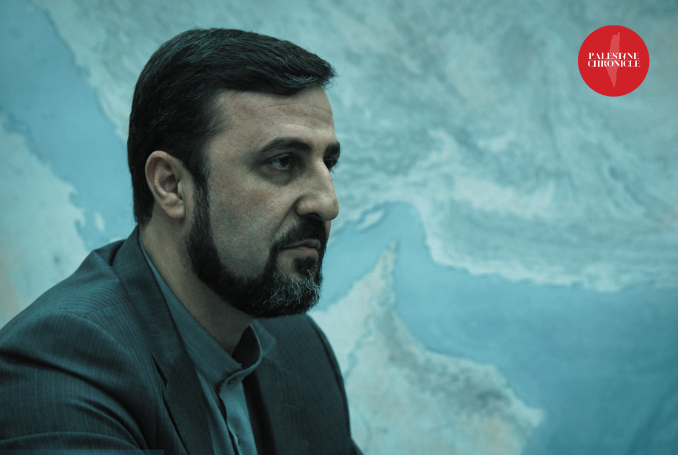
Deputy Foreign Minister Kazem Gharibabadi said Tehran is already working with Oman on a joint framework to oversee transit through the strategic waterway.
“We are drafting a protocol for Iran and Oman to supervise transit in the Strait of Hormuz,” he said, according to statements carried by Iran’s state media and confirmed in international reporting.
The proposal, he added, is now approaching its final stages of preparation, indicating that implementation could follow the end of the current war.
Iranian officials made clear that the shift is rooted in the current confrontation, with Tehran openly linking the new system to wartime conditions.
“We are now in a state of war, and wartime conditions cannot be governed by peacetime rules,” Gharibabadi said.
He explained that maritime traffic, while historically smooth through the strait, is directly affected by military escalation.
“When we face aggression, movement encounters serious disruptions,” he added.
In separate remarks, he stressed that “currently, in a state of war, the same rules that applied before the war should not be applied in this strait,” reinforcing Iran’s intent to redefine the framework governing passage.
‘The Whole Family Is Ready’ – Ghalibaf Says 7 Million Iranians Prepared to Fight US, Israel
Permit System Planned
A central element of the new system is the introduction of coordinated permits and licensing for vessels passing through the strait.
Gharibabadi said that, even in peacetime, all ships would be required to secure prior agreements with both coastal states.
“All vessels transiting the Strait of Hormuz must obtain the necessary agreements with the two coastal states, Iran and Oman, and receive the required permits and licenses in advance,” he said.
The measure, he emphasized, is intended to formalize coordination rather than disrupt navigation.
“These requirements do not mean restrictions, but rather aim to facilitate and ensure safe passage and provide better services to ships,” he added.
Gharibabadi warned that vessels linked to hostile actions could face exclusion under the new framework.
He said ships belonging to “aggressors and their allies,” whether commercial or military, and those participating in or supporting military operations, should be prevented from passing through the Strait of Hormuz.
He described this as “a very important point” that represents a central pillar of Iran’s future approach.
At the same time, he noted that discussions between Tehran and Muscat also include environmental protection and maritime safety, reflecting a dual-track approach combining security and operational coordination.
US-Israel Bomb Iran’s Pasteur Institute—Sudan’s Al-Shifa Shadows Reawaken
Joint Coastal Control
Iran’s plan is built on the geographic reality of the strait itself, which is bordered by Iran on one side and Oman on the other.
Gharibabadi emphasized that both countries have historically ensured the safety of navigation in the waterway.
“In reality, it is the services provided by the two coastal states that make this passage safe,” he said.
He added that both countries are now working closely to formalize that role through a new agreement, which would place significant responsibility on Tehran and Muscat for managing transit and ensuring security.
Other Iranian officials are framing the move as part of a broader geopolitical shift tied to the outcome of the war.
Senior adviser Mohammad Mokhber said that a new system in the Strait of Hormuz would be one of the direct consequences of the current conflict.
“After the end of the aggression and with the establishment of a new system in the Strait of Hormuz, Iran will move from the position of a sanctioned state to the position of a powerful state in the region and the world,” he said.
The statement reflects Tehran’s view that control over the strait—through regulation, coordination, and enforcement—will redefine its regional and global standing.
Despite the sweeping changes being proposed, Iranian officials insist that the Strait of Hormuz will remain open to global shipping.
Gharibabadi reiterated that “the Strait of Hormuz is open and transit is proceeding smoothly,” even as tensions continue.
At the same time, the introduction of a new system—built around permits, coordination, and security conditions—signals that access will increasingly be governed by rules defined by Tehran and its regional partner Oman.
(Anadolu, Al Mayadeen, PC)