
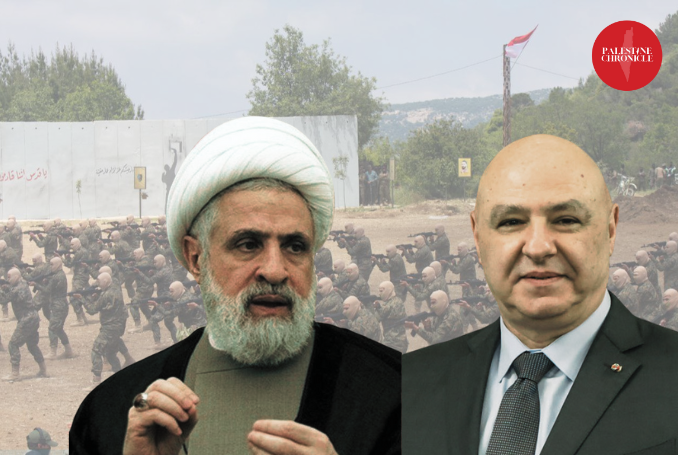
Instead of achieving anything through diplomacy, the rhetoric coming from the Lebanese government only grew more and more hostile against Hezbollah and its chief backer, Iran.
The current leadership of Lebanon is arguing that Iran is using them “as a bargaining chip” and insists on pursuing Hezbollah’s weapons, arguing that everyone except Israel is an impediment to “peace”. Not only are these claims blatantly false, but they may also have rendered the government of Beirut completely illegitimate.
Earlier this week, yet another “ceasefire agreement” was formally announced by the United States, coming after a third round of direct negotiations between Lebanese and Israeli officials in Washington. However, the only place the ceasefire actually existed was in the imaginations of Lebanese officials and on the White House’s website. On the ground, these declarations have no bearing on what Israel does, nor how Hezbollah responds.
Come Friday, a frustrated Lebanese President Joseph Aoun and his Prime Minister Nawaf Salam publicly lashed out at both Hezbollah and Iran. Despite speaking to the media separately, they carried precisely the same pro-Israeli talking points.
Although some have chosen to hold their tongues on the nature of Nawaf Salam and Joseph Aoun’s behavior, they are now making charges that must be systematically debunked.
Living in Beirut, Working for Washington
To begin with, the Lebanese PM and President both claim that Hezbollah does not represent the will of the Lebanese people. Putting it bluntly, neither do they.
Although there is no official census proving definitively what percentage of the Lebanese public is of each specific religious denomination, the consensus opinion is that the Shia are the largest group. This is important to begin with, as Lebanon is a country that you cannot talk about without including sect.
Beirut has a confessionalist system of government, meaning that the President must be a Maronite Christian, the Prime Minister a Sunni Muslim, and the Speaker of Parliament a Shia Muslim. In addition to this, the public does not elect the PM or President as they do in other countries, but they do elect members of parliament and can have their say in local elections.
Hezbollah is the biggest political Party in the country, and alongside the Amal movement, which is also popular amongst the Shia of Lebanon, neither Nawaf Salam nor Joseph Aoun would have been elected to power. Aoun was the former commander of the Lebanese Army and the US’s favored pick, while Salam left his post as a judge on the International Court of Justice (ICJ) to assume his current role, making him a relative outsider that the Lebanese public knew little about before he assumed office.
Without the vote of Hezbollah and the Amal Movement, the current Lebanese government would not be in power at all, meaning both the President and Prime Minister are allowed to be there. In 2022, the will of the Lebanese people was to vote in a way that created an enormous divide between parliamentary blocs.
The Lebanese Parliament itself has half its seats reserved for Muslims and the other half for Christians; this does not change depending upon whether one group is a larger percentage of the population or not. In the last elections, instead of the Free Patriotic Movement taking the largest number of Christian assigned seats – a Party that has cooperated with Hezbollah and Amal – the right-wing Lebanese Forces (LF) gained the largest number of seats amongst Christian Parties.
For those who are not aware, the LF have their roots in the Israeli-backed fascist militias and is led by a staunchly pro-US former warlord, Samir Geagea, a convicted murderer who was later pardoned. This created a political deadlock, where neither side would agree upon forming a government.
That was until Israel launched its full-scale attack and invasion of Lebanon in September of 2024. In order to try to stabilize Lebanon, following the war, Hezbollah and Amal essentially ceded to their political rivals, allowing Joseph Aoun and Nawaf Salam to assume power.
Therefore, the government formed in February of 2025 is not the representation of the Lebanese public’s will; it was imposed upon a nation that had just suffered the costs of Israel’s indiscriminate attacks against it. Additionally, the polling data released earlier this year clearly shows that a plurality of Lebanese oppose disarming their country’s resistance without a proper defense plan in place and that they view Israel as the number one threat.
‘Hezbollah Started the War on Iran’s Orders’
Joseph Aoun and Nawaf Salam contend that Hezbollah is responsible for the ongoing war in Lebanon and that it was launched on orders sent to its Secretary General, Sheikh Naim Qassem, from Tehran. This is nothing more than an Israeli hasbara talking point and can be easily demonstrated.
To begin with, Hezbollah began launching retaliatory strikes against Israel on March 2, 2026; they did not “start the war”. Israel and Lebanon agreed to a ceasefire on November 27, 2024. Hezbollah did not violate the agreement by firing upon Israel even a single time, yet for 15 whole months, the Israelis never stopped bombing the south of the country, occasionally bombing Beirut and the north.
Israel committed over 15,400 violations of the ceasefire agreement, according to the United Nations peacekeeping forces (UNIFIL) stationed in southern Lebanon, including by attacking UNIFIL positions and using chemical weapons.
According to the November 27, 2024, ceasefire agreement, Israeli forces that had invaded southern Lebanon were supposed to withdraw from the nation’s territory completely by January 26, 2025. This deadline was later extended to February 18, after Israel gave excuses about needing more time. However, the Israelis never withdrew; instead, they would go on to establish more military positions inside Lebanese territory and destroy farmland, along with civilian infrastructure.
Meanwhile, the Lebanese government did nothing to pressure the Israelis to withdraw from occupied Lebanese lands. Instead, the US sent a plan to the government in Beirut, demanding that they completely disarm Hezbollah and all other resistance groups operating inside the country. By August of 2025, the Lebanese government adopted legislation regarding a disarmament plan.
For 15 months, Hezbollah repeatedly told the Lebanese government that they had agreed to put in power, that they would not discuss the handing over of their weapons before Israel had withdrawn from the south and ended its constant bombing attacks against southern Lebanon. Hezbollah’s position has long been clear: they have been willing to discuss integrating with the Lebanese Army and have even fought alongside them in the past to stop Daesh from seizing Lebanese lands.
Instead of achieving anything through diplomacy, the rhetoric coming from the Lebanese government only grew more and more hostile against Hezbollah and its chief backer, Iran, while refusing to do anything about the occupation of the south. In most cases, Salam refused to even address Israeli attacks on civilians in south Lebanon.
Then came March 2, 2026. Israel and the US launched an illegal war of aggression against the Islamic Republic of Iran. Now, regardless of whether you believe that Hezbollah got involved for Iran’s sake or on their orders or not, it is undoubtedly true that if they were ever going to resist Israel’s non-stop aggression and expansion into Lebanese territory, it was going to be in the context of a wider war that would put them in a stronger position.
‘Iran is Using Lebanon as a Bargaining Chip’
The Lebanese President claimed that Tehran is using Lebanon as a bargaining chip in its negotiations with the United States, the same charge that Nawaf Salam also makes. How they even managed to keep straight faces while stating this is beyond human comprehension. It really is that ridiculous.
If anything, Iran’s insistence that Lebanon be included in any ceasefire agreement holds them back from achieving their own national goals. While the latest “ceasefire” deal that was accepted by Salam and Aoun does not guarantee a total end to Israeli strikes in Lebanon and refuses to guarantee any withdrawal from Lebanese lands, Iran demands that, in order for them to sign any agreement, there must be a full Israeli withdrawal from Lebanon and a guarantee that it won’t launch attacks inside the country.
Instead, the Lebanese government is publicly complaining that its “ceasefire agreement” isn’t being respected by Hezbollah. It proposes “experimental zones” where the Lebanese Army would be permitted by Israel to enter the south of its own country, with no guarantees that Israel would end its attacks. The agreement they made only compels Hezbollah to withdraw from the south of the country – so abandoning the Shia population it represents – while it must stop firing at Israeli forces occupying its country and then disarm fully, with no guarantees from Tel Aviv about anything.
The Lebanese government seeks to normalize ties with Israel and immediately sided with Israel when Hezbollah began retaliating in March of this year by condemning Hezbollah for daring to resist and claiming they have “dragged” the country into a new war. What this exposes is that, yet again, the people of South Lebanon are not considered equal in the eyes of the government, because for them, many could not return home to their villages, there was no reconstruction guaranteed despite there being a 15-month ‘ceasefire’, and the war never truly ended.
Similarly, following Israel’s 1982 invasion of Lebanon – a time when Hezbollah didn’t even exist – they killed around 20,000 Palestinians and Lebanese, then claimed they were operating in a “buffer zone” in southern Lebanon. This followed the Palestine Liberation Organization (PLO)’s decision to relocate its leadership to Tunisia and its fighters relocated to other countries. The government of Lebanon did nothing for the people of the south during the “buffer zone” period, and by 1985, the Israelis had established a fully fledged illegal occupation of southern Lebanon, complete with torture centers and the infamous “South Lebanon Army” fascist proxy forces.
This time, however, there is a key difference. A Lebanese leadership is in place that is meeting directly with the Israelis, and it is openly attempting to normalize ties. In 1982, Bashir Gemayel became President of Lebanon, a figure who had close ties with the Israeli Mossad. Even Gemayel didn’t publicly advertise his desire to normalize ties in the way we see the current leadership. He was assassinated by a fellow Maronite Christian within a month of taking office.
The Israelis and the US have long promoted the narrative of an “Iranian occupation of Lebanon”, offering a weak argument that because Tehran backed Hezbollah, it is holding the country hostage. But this couldn’t be further from the truth.
Hezbollah is militarily powerful enough to take over Lebanon, but it doesn’t. Even when the leadership that it decided to permit to take power, openly turns against it, abandons the entire south of the country, and sits at the table with the enemy while it continues to massacre civilians, Hezbollah still has not acted violently towards the government.
On the contrary to Hezbollah being a “security burden” and “dragging Lebanon into war”, it was Hezbollah that liberated south Lebanon in 2000. It was then Hezbollah that forced Israel out of Lebanese territory in 2006, allowing for 17 years of deterrence, during which Israel would not dare bomb the country. When it came to an “Iranian occupation”, and there was a major fuel shortage in Lebanon, Iran sent shipments of fuel that were facilitated by Hezbollah in 2021. A year later, Tehran offered free fuel to Beirut.
In 2022, as the country was suffering economically, Hezbollah made another historic achievement in the interests of the Lebanese State: it managed to force Israel to acknowledge Lebanon’s maritime borders. Threatening all-out war if the Israelis attempted to seize Lebanon’s gas fields, Hezbollah pressured Tel Aviv into recognizing the rights of the Lebanese State.
There is simply nothing that the Lebanese government has ever achieved against Israel in the way of sovereignty, security, or even in the economic sphere. It refuses to allow its armed forces to even resist when its nation is invaded. Nawaf Salam even summoned the current Commander of the Lebanese Army, Rudolphe Haykal, when he not only refused to go after Hezbollah’s weapons in March but even aided in repelling an Israeli landing operation in the Bekaa Valley.
In order to communicate the idea that Iran is “using Lebanon as a bargaining chip” implies that the Iranians gain something from their position. Instead, Tehran’s position is attempting to save Lebanon from Israeli occupation and continued bombardment.
When Israeli PM Benjamin Netanyahu threatened to bombard Beirut on Monday, this pledge was made with direct Lebanese-Israeli talks in Washington scheduled the very next day. The only reason that Netanyahu refrained from ordering the strikes was that Iran stepped in and pledged to retaliate directly.
Iran directly threatens to fight for the sovereignty of Lebanon and imposes red lines in its negotiations that include protecting the Lebanese people from Israeli attacks, but the Lebanese government refuses to do either.
Whose Flag is Flying?
Nawaf Salam and Joseph Aoun do not represent the Lebanese people; they represent foreign entities that manipulate them. They point the finger at Iran for two reasons:
- They are not sovereign representatives of their own State; they are clearly working on behalf of foreign influences.
- If Hezbollah and Iran do secure a victory that requires Israel to withdraw, their careers are permanently over, and they lose the small amount of legitimacy they have left.
Other governments in the region have long collaborated with or directly maintained ties with the Israelis, but Salam and Aoun have taken this to an entirely different level. They are willing to literally hand over their own territory and allow Israel freedom of action to attack their people, if it means that their owners will be pleased.
Some could even argue that they are proponents of separatism because they completely overlook the predicament of South Lebanon. The Shia population of the country is frequently undermined, and the government’s statements read as if they came right out of Washington-based Zionist think-tanks like the Foundation for Defense of Democracies (FDD) or Washington Institute for Near East Policy (WINEP).
Another key point to take from all of this is that Hezbollah would not exist without grassroots support. If the Lebanese people overwhelmingly opposed it, how could it survive and consistently perform well in both the national and local elections?
When we talk about Hezbollah, we aren’t talking about an armed militia alone. Hezbollah is a political Party within which it has doctors, architects, engineers, politicians, scholars, and so on. It represents the people of the society it comes from, because it is a totally organic national resistance organization, not some foreign militia. Considering that the Shia are the biggest single religious sect in the country, Hezbollah and their Amal allies do represent a considerable portion of the Lebanese public, all of which are totally ignored by the US-proxies in Beirut.
– Robert Inlakesh is a journalist, writer, and documentary filmmaker. He focuses on the Middle East, specializing in Palestine. He contributed this article to The Palestine Chronicle.

Mr. Inlakesh, excellent article!
When Nasrallah was assassinated, I read what he said about his vision for Lebanon. He dreamed of an integrated society, the way he experienced it growing up. You NEVER hear that from Lebanon’s other leaders. You NEVER hear that from US politicians. You will NEVER get anything like that from Israelis.