
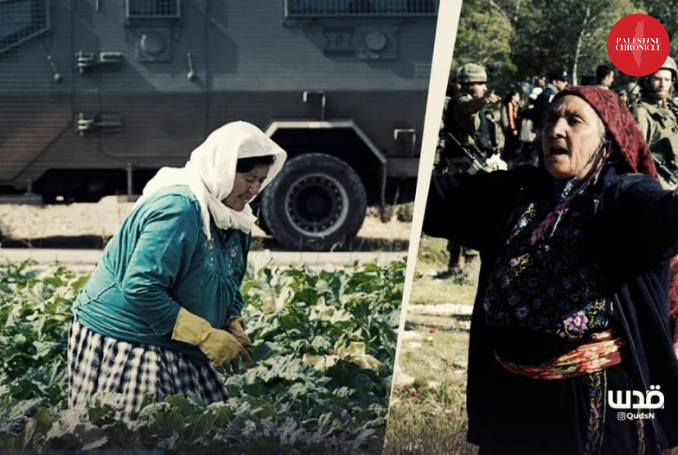

For generations, women in Atara relied on wild herbs for income and tradition. Today, settler expansion has turned their harvest into a risk.
For generations, the women of Atara, a Palestinian village northwest of Ramallah, have known the surrounding hills by scent.
Before sunrise each spring, they climbed the rocky slopes carrying baskets and generations of inherited knowledge, searching for wild sage, thyme, mint, plantain and other medicinal herbs that flourished across the landscape.
The harvest was more than a seasonal routine—it was a way of life, a source of income, and a tradition passed from mothers to daughters.
Today, many no longer dare make that journey.
Residents say the establishment of a nearby Israeli settlement outpost, coupled with an increase in settler attacks, has transformed the hills that once sustained them into places of fear.
A Harvest That Sustained Families
Women from Atara told Quds News Network that gathering wild herbs has long formed part of the village’s cultural and economic fabric.
From the early hours of the morning, women would head into the surrounding mountains to collect whatever nature offered before selling the herbs in local markets or drying them for household use.
One woman recalled learning to identify sage and wild thyme as a child, continuing the practice throughout her adult life.
The income she earned from selling herbs, she said, helped raise her children, contribute to their weddings and even assist in building the family home.
During the harvesting season, a single bundle of herbs could sell for between 40 and 50 shekels, providing an important source of income for families with few economic opportunities.
When the Mountains Became Off-Limits
That reality changed dramatically after settlers established an outpost near the village.
Women say they can no longer reach the hills where they once gathered sage, thyme, plantain and other native plants because they fear harassment and assault.
According to their accounts, Palestinians attempting to access the area have increasingly been chased, threatened or attacked.
“The land is not simply where we gather herbs,” one woman explained. “It is part of our identity and our daily life.”
Despite the dangers, she said leaving the land is not an option.
“Our land is our homeland and our inheritance,” she said, insisting that neither she nor her family would abandon it.
Fear Reaches Every Corner of the Village
Najma Mahmoud, a member of Atara’s local accountability committee and one of its community leaders, said the impact of nearby settlers extends well beyond farmland.
Speaking to Quds News Network, Mahmoud said settlers regularly move along roads used by residents, creating constant anxiety for women, children and young people alike.
She explained that concerns over settler violence have affected children’s journeys to school and disrupted daily life throughout the village.
According to Mahmoud, settlers operate under the protection of Israeli forces, leaving residents feeling powerless when confronted with attacks.
She recounted an incident in which a Palestinian resident had his mobile phone and car keys seized by a settler and was unable to recover them.
Women, she said, have paid a particularly heavy price.
Many depended on the annual herb harvest as a primary source of household income. But after reports of women being assaulted while gathering herbs in nearby areas, many have stopped entering the surrounding hills altogether.
Holding onto Tradition
Unable to safely reach the mountains, some families have begun planting sage and thyme inside their own yards.
The effort has helped preserve part of a tradition deeply woven into Atara’s identity, but residents say home gardens cannot replace the abundance—or the freedom—once offered by the surrounding hills.
Water shortages have made even that adaptation difficult.
According to residents, some homes receive running water only one day each week, limiting their ability to cultivate herbs at home.
For generations, Atara has been known for the fragrant plants covering its hillsides each spring, including several varieties of thyme, sage, wild mint and the native herb known locally as shawa. Their scent became synonymous with the village itself.
Now, residents say, those hills have become increasingly inaccessible.
One woman described how even her home no longer feels secure after an attack left doors and windows damaged, leaving lasting psychological scars on her family despite subsequent efforts to reinforce the house.
More Than a Lost Season
For the women of Atara, the disappearance of the wild herb season represents far more than the loss of seasonal income.
It marks the erosion of a relationship with the land that has shaped their families, memories and identity for decades.
Yet despite the restrictions, the fear and the shrinking space available to them, they insist they will remain rooted.
Engineering Hope: How the School of Sumud Bloomed amid the Rubble
(QNN, PC)



