

Netanyahu’s heightened security posture also comes as he remains a wanted war criminal under international law, following the issuance of an arrest warrant by the International Criminal Court (ICC) over crimes committed during Israel’s genocide in Gaza.
Despite Israel’s close ties to some of the world’s most powerful technology firms and cyber warfare units, Israeli Prime Minister Benjamin Netanyahu appears to place limited trust in digital security alone.
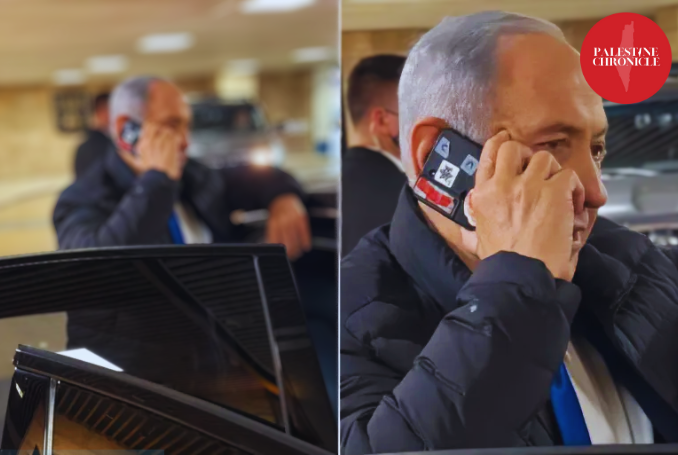
Recent images circulating on social media show Netanyahu, a wanted war criminal, using both a Samsung phone and an iPhone with their camera lenses carefully covered with adhesive tape.
The images, reportedly taken during a phone call and later inside the Knesset, quickly sparked widespread online discussion over the prime minister’s apparent concern about visual surveillance.
Observers noted that covering smartphone cameras has become a common security practice among high-risk individuals, including heads of state, senior military officials, intelligence officers, and technology executives, amid growing awareness of remote camera activation and spyware threats.
Iranian-Linked Handala Group Claims Hack of Ayelet Shaked’s Phone
Cybersecurity experts have long warned that smartphones can be transformed into powerful surveillance tools, capable of activating cameras and microphones without a user’s knowledge. While software-based protections may be bypassed, physical barriers—such as covering lenses—remain one of the few safeguards that malicious code cannot overcome.
The renewed attention to Netanyahu’s phone security comes amid mounting evidence of advanced Iranian cyber capabilities, including successful breaches targeting Israeli political, military, and intelligence-linked figures.
In recent years, Iran-linked cyber groups have been accused—by Israeli and Western cybersecurity firms—of infiltrating Israeli officials’ mobile devices, accessing personal data, communications, and location information. Several incidents reportedly involved phishing campaigns and spyware operations directed at senior Israeli security personnel, political advisers, and military officers.
Israeli media have previously acknowledged that Iranian cyber units have expanded from defensive operations to offensive intelligence-gathering, exploiting vulnerabilities in smartphones and messaging platforms widely used by Israeli officials.
In some cases, compromised devices were reportedly used to map networks of contacts, monitor movements, and collect sensitive personal and professional data—highlighting how visual access through phone cameras could pose a severe security risk during confidential meetings.
Hackers Claim Breach of Netanyahu Chief of Staff, Threaten to Release Sensitive Files
Israeli Media Confirms
Israel’s Maariv newspaper confirmed that the taped cameras were not intended to prevent photography inside restricted military zones, as is standard protocol, but rather to block the remote activation of phone cameras via malicious software.
The report said the measure is designed to prevent smartphones from being turned into surveillance devices capable of transmitting images of classified documents, sensitive meetings, or secure locations to hostile intelligence services without the user’s awareness.
In this context, Netanyahu’s precaution reflects broader concerns within Israel’s security establishment about cyber espionage, particularly amid escalating tensions with Iran and ongoing regional confrontations.
‘We Breathe Your Air’ – Iranian Hackers Gain Deep Access to Israeli Nuclear Expert (VIDEO)
A Leader Under International Indictment
Netanyahu’s heightened security posture also comes as he remains a wanted war criminal under international law, following the issuance of an arrest warrant by the International Criminal Court (ICC) over crimes committed during Israel’s genocide in Gaza.
The warrant has further restricted Netanyahu’s international movement and placed him under unprecedented legal and diplomatic pressure, reinforcing concerns within Israel’s leadership over surveillance, intelligence exposure, and personal security amid mounting global scrutiny.
Netanyahu's mobile phone camera covered with tape pic.twitter.com/Rvp2x4TKTF
— Globe Observer (@_GlobeObserver) January 26, 2026
(PC, Social Media, Israeli Media, AJA)





Someone needs to give him a new pager.