
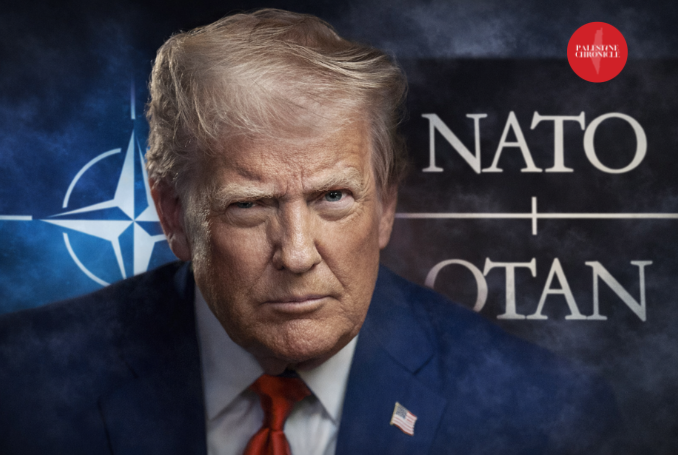

US President Donald Trump threatens NATO withdrawal after allies refuse Iran war support, calling alliance a “paper tiger”.
Key Takeaways
- Trump says US exit from NATO is “beyond reconsideration.”
- Tensions rise after allies refuse to support Iran war operations.
- European leaders reject involvement, deepening transatlantic rift.
‘Beyond Reconsideration’
US President Donald Trump said he is seriously considering withdrawing the United States from NATO following allies’ refusal to support his war on Iran, the Telegraph reported on Wednesday.
He described the alliance as a “paper tiger” and said leaving it is now “beyond reconsideration,” signaling one of the most serious threats yet to the bloc’s future.
“I was never swayed by NATO. I always knew they were a paper tiger, and (Russian President Vladimir) Putin knows that too,” Trump said.
The remarks reflect growing frustration in Washington after NATO members declined to participate in efforts to reopen the Strait of Hormuz, where Iran has effectively halted maritime traffic.
At the core of the dispute is Trump’s demand that allies contribute military assets, including warships, to support operations linked to the war on Iran.
Trump suggested that US support for allies in previous conflicts had not been reciprocated.
“We’ve been there automatically, including Ukraine. Ukraine wasn’t our problem. It was a test, and we were there for them, and we would always have been there for them. They weren’t there for us,” he said.
The refusal by European allies to engage in the war has exposed limits within the alliance, particularly given that NATO’s collective defense clause does not apply to offensive operations like the current conflict.
UK Pushback and Military Concerns
The United Kingdom emerged as a central point of tension.
British Prime Minister Keir Starmer rejected involvement, stating: “This is not our war, and we’re not going to get dragged into it.”
Trump responded with a sharp rebuke of Britain’s military capabilities, claiming: “You don’t even have a navy. You’re too old and had aircraft carriers that didn’t work,” he said, reportedly referring to the state of Britain’s fleet of warships.
The exchange comes amid reported weaknesses within the Royal Navy, with several destroyers out of service and reliance on allied vessels to meet NATO obligations.
Despite the criticism, Starmer reaffirmed support for NATO, calling it “the single most effective military alliance the world has ever seen.”
Trump’s comments were reinforced by US Secretary of State Marco Rubio, who criticized NATO as a “one-way street” and said the US would need to “re-examine” its membership after the war.
Speaking on Fox News soon before Trump’s interview with The Telegraph, Rubio stated that the US would have to “re-examine” its Nato membership when the war in Iran came to an end.
“If Nato is just about us defending Europe if they’re attacked, but them denying us basing rights when we need them, that’s not a very good arrangement. That’s a hard one to stay engaged in,” Rubio said.
The administration is reportedly considering broader changes, including a “pay-to-play” model that would limit influence for members failing to meet spending targets, as well as a potential withdrawal of US troops from Germany.
However, despite the rhetoric, a US withdrawal from NATO would face significant legal hurdles.
A 2023 law requires congressional approval before any president can exit the alliance, meaning Trump would need backing from lawmakers to follow through on his threat.
The dispute also raises questions about the future of NATO’s core principle—Article 5, the mutual defense clause—which applies only when a member state is attacked, not in wars initiated by alliance members.
(PC, The Telegraph)


” paper tiger ” …
better than a plastic POTUS, who can’t fight his own dirty fight.