
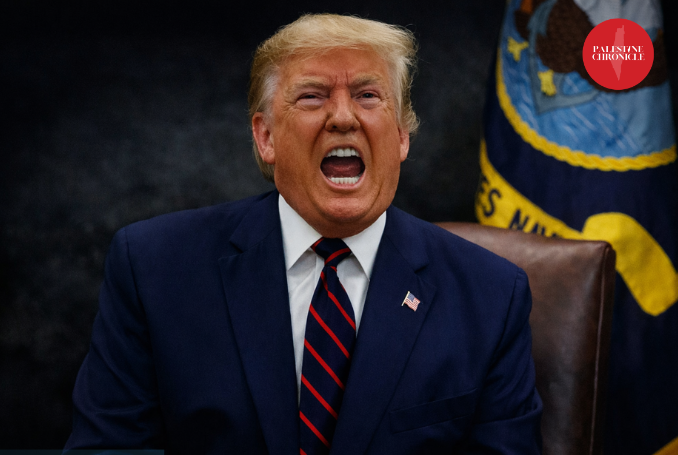
Whoever threatens today to return others to the “Stone Age” may not be displaying overwhelming power, but rather revealing—perhaps unintentionally—a deep tremor within the very nerves of empire.
The louder the American threat becomes, the more the emptiness behind it is exposed. Self-assured nations do not rely on “Stone Age” rhetoric, nor on such bluster, to conceal unclear objectives or an inability to translate firepower into political outcomes.
If the first part of this article examined the American threat through the lens of civilizational ignorance, this second part turns directly to the core question: What does this language reveal about America itself?
The issue is no longer confined to Iran, nor merely to the limits of military escalation. It concerns the nature of a power that speaks in such terms, and the dysfunction that afflicts empires when they lose the ability to distinguish between deterrence and neurosis, between politics and impulse, between the state and personal whim.
When Power Loses Its Language
Self-confident nations do not speak this way. Great powers, when certain of their objectives, do not need to raise their voices or substitute institutional language with that of cultural humiliation. They define their goals, understand their limits, and calculate the cost before embarking on action.
But when rhetoric devolves into a mixture of open threats, nervous boasting, and promises not only of military destruction but of civilizational erasure, it signals not strength, but anxiety.
Here, the empire does not speak from composure, but from confusion—attempting to compensate for a lack of vision with crude language. This verbal escalation is less a reflection of power than a desperate effort to mask fractures in political certainty.
Ambiguous Objectives, Amplified Threats
The most dangerous aspect of Trump’s rhetoric is not its aggression, but its emptiness.
He speaks of a “mission” nearing completion without defining it. He claims decisive victory while simultaneously opening the door to further escalation. He gestures toward an end, only to extend the conflict into new phases.
Such contradictions are not the hallmark of a power in control, but of one attempting to obscure confusion through noise.
The threat to return Iran to the “Stone Age” reflects not clarity, but the absence of it. The less defined the political objective, the louder the rhetoric becomes—an attempt to fabricate the illusion of coherence.
When the Empire Speaks with Its Nerves
At this stage, the issue is no longer reducible to the personality of the president—though that remains relevant—but to the structure that allows individual temperament to shape the image of the state.
Trump appears not merely as an impulsive leader, but as an intensified symptom of a deeper crisis: the inflation of propaganda, the collapse of the boundary between decision and spectacle, and the erosion of meaning in the projection of power.
The United States retains immense military capabilities—its bases, fleets, and destructive reach remain unparalleled. But possessing instruments of force is not the same as possessing a coherent strategy, a political vision, or a defined endpoint.
Empires do not begin to decline only when defeated militarily. They begin to decline when their rhetoric exceeds their vision, when image overtakes substance, and when noise replaces certainty.
Prestige that Reveals Fragility
Paradoxically, rhetoric intended to project strength may instead expose vulnerability.
Prestige in international politics is not measured solely by destructive capacity, but by control—over timing, escalation, and purpose. It depends on convincing both allies and adversaries that a state knows what it is doing, why it is doing it, and when it will stop.
When leadership oscillates between declaring victory and expanding targets, between hinting at resolution and issuing new threats, the image of the state begins to fracture.
What appears as force may, in fact, be insecurity—an attempt to compensate for strategic uncertainty by raising the stakes.
A Power that Sees Only Targets
The deeper crisis lies in a narrowing of vision.
Reducing a country such as Iran—with its long history, civilizational depth, and geopolitical weight—to a target to be “returned” to a pre-civilizational state reveals not only cruelty, but intellectual impoverishment.
This is a worldview that recognizes only what can be bombed, broken, or coerced.
It is dangerous not only for Iran, but for the international system as a whole. When power loses political and moral constraints, it ceases to function as a stabilizing force and instead becomes a generator of chaos—transforming deterrence into a source of global instability.
America Confronting Its Own Reflection
In this sense, Trump’s rhetoric reveals less about Iran than about the American moment itself.
The United States remains capable of striking, but increasingly struggles to persuade the world that it knows its direction. The language of electoral politics bleeds into the language of war; media spectacle replaces strategic clarity; threats substitute for policy.
This is not merely a matter of personal style, but a structural condition.
A leader who threatens widespread destruction while simultaneously proclaiming imminent victory does not appear to control the course of war, but to be chasing its image—while its political foundations erode.
Limits of Aggression, Limits of Power
What is unfolding should not be understood solely as aggression against Iran or Lebanon, but as a revelation of the limits of Zionist-American power itself.
Yes, it remains capable of large-scale destruction and escalation. But it has yet to articulate a credible vision of the aftermath—of the regional order it seeks to impose, or of a stable outcome emerging from war.
As threats escalate, this void becomes increasingly visible.
The equation is thus reversed: the question is no longer simply how the empire threatens others, but how its rhetoric exposes its own limitations—demonstrating that overwhelming force cannot compensate for the absence of strategy.
When the Empire Trembles
Those who threaten today to return others to the “Stone Age” may not be demonstrating power, but rather revealing its fragility.
Firepower does not produce wisdom. Noise does not make history.
Civilizations, however, endure.
Even under bombardment, they retain the capacity to expose the weakness of power when it speaks in the language of both arrogance and panic.


We TOLD you all! suddenly everybody sees it?? Dondolf was never fit to be POTUS, he’s playing a part in this reality TV show.
In the U.S. an apocalypse is forming as more and more Americans begin to resent their government. Trump was no accident. Biden wanted an opponent he thought would he easy to beat—in comes a former president who is facing a felony and possible prison. He wouldn’t have made it to the nomination if there weren’t deals between the DNC and GOP. Biden knew Americans were fed up with him and his Zionist zealotry so Trump was a decoy. Democrats believed Americans would pick them over Trump because of his first term. Many caught on to this and didn’t vote for democrats.
We knew Trump would make a mockery of our government—that is why he is prez. Left leaning Americans were incensed by Gaza.
Trump wouldn’t have made it to any nomination if he weren’t fully vetted and paid by the same billionaire club that owns the other party. Nobody cares which one loses.