
Iran warned parliament could move toward 90% uranium enrichment as Donald Trump declared the fragile ceasefire with Tehran on “massive life support.”
Key Developments
- Iran warned it could enrich uranium to 90% if attacks resume.
- Tehran linked the move to renewed US-Israeli military aggression.
- Donald Trump described the ceasefire as on “massive life support.”
- Trump called Iran’s latest response a “piece of garbage.”
- Iranian officials insisted recognition of Tehran’s rights remains non-negotiable.
Possible Nuclear Escalation
Ebrahim Rezaei, spokesman for the Iranian parliament’s Foreign Policy and National Security Committee warned Tuesday that Iran may move toward uranium enrichment at 90% purity if the United States and Israel launch renewed military attacks against Iranian territory.
“We will review it in parliament,” Rezaei said in a post published on X.
The remarks represent one of the strongest public warnings yet from Tehran regarding possible escalation of Iran’s nuclear program amid the continuing confrontation with Washington and Tel Aviv.
Iranian officials have repeatedly maintained that the country’s nuclear program is peaceful, while simultaneously warning that sanctions, military threats, and attacks on Iranian territory could force Tehran to adopt harsher retaliatory measures.
Trump: Ceasefire on ‘Massive Life Support’
The warning came as Donald Trump sharply criticized Iran’s latest response to a US proposal aimed at ending the war.
Speaking Monday at the Oval Office, Trump said the ceasefire with Iran was in an “unbelievably weak” condition.
“I would call it the weakest right now, after reading that piece of garbage,” Trump said, referring to the Iranian response delivered through Pakistani mediators on Sunday.
“I would say the ceasefire is on massive life support, where the doctor walks in and says, ‘Sir, your loved one has approximately a 1% chance of living,’” he added.
Trump described Tehran’s proposal as “stupid” and criticized Iranian negotiators for taking four days to deliver what he called a “very simple” response.
According to Trump, Iran initially offered broad assurances related to nuclear activity before later withdrawing them.
“They guarantee no nuclear weapons for a very long period of time and a couple of other minor things, but they just can’t get there,” Trump said.
“So they agree with us, and then they take it back.”
The US president repeated that Iran “cannot have a nuclear weapon,” though he also said a diplomatic solution remained “very possible.”
‘I Didn’t Like It’: Visibly Nervous Netanyahu Addresses China’s Support for Iran
‘Nuclear Dust’
Trump additionally claimed Iranian officials discussed what he referred to as “nuclear dust” following earlier US strikes targeting Iranian facilities during the 2025 war.
He asserted that Iranian nuclear sites struck by US and Israeli forces had been “obliterated” so severely that extracting nuclear material would be nearly impossible.
“There’s only one or two countries in the world that could get it,” Trump said, adding that Iran had allegedly told Washington that only China and the United States possessed the necessary capabilities.
Qalibaf: Iran’s Rights Non-Negotiable
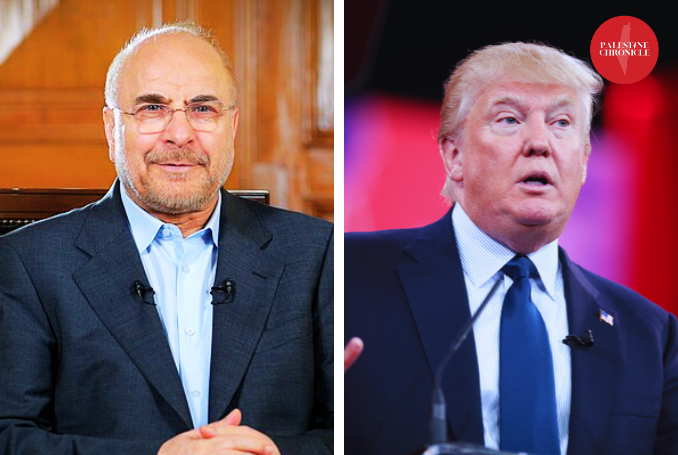
Meanwhile, Iranian Parliament Speaker Mohammad Baqer Qalibaf stressed that there is “no alternative” to recognizing the rights of the Iranian people as outlined in Tehran’s proposed 14-point framework.
In a statement published on X, Qalibaf said any approach that ignores Iran’s national rights “will be entirely futile and lead only to failure after failure.”
He warned that continued hesitation and delays by Washington would ultimately impose heavier costs on American taxpayers.
Earlier Monday, Qalibaf also stressed that Iran’s armed forces remain fully prepared to respond forcefully to any future aggression.
“The armed forces are ready to deliver a disciplinary response to any aggression,” he said, adding that “wrong strategies and decisions always lead to wrong results.”
‘Disappointed’: Trump Blames Kurds for Failure to Arm Protesters against Tehran
Fragile Truce
The United States and Israel launched attacks against Iran on February 28, triggering Iranian retaliation against Israeli targets as well as US allies in the Gulf region.
The confrontation also led to the closure of the Strait of Hormuz, severely disrupting global shipping and energy markets.
A temporary ceasefire brokered through Pakistan took effect on April 8, though negotiations held in Islamabad failed to produce a permanent settlement.
Iranian officials continue to insist that recognition of Tehran’s sovereign rights — including its nuclear activities, maritime security demands, and regional interests — remains essential for any lasting agreement.
(PC, Anadolu, Al Mayadeen)