
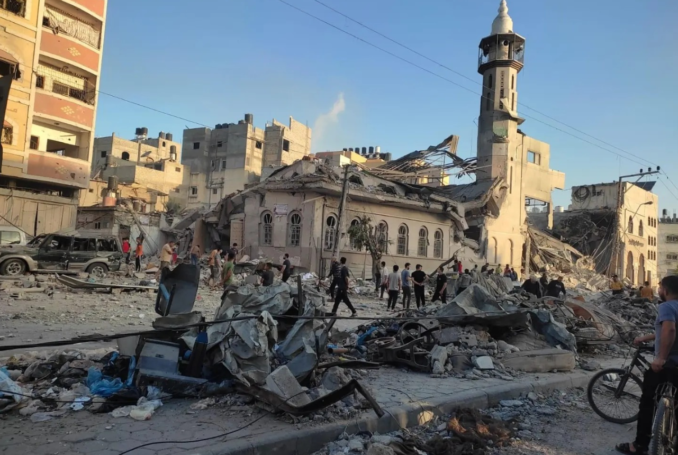
Abu Shadi was a dedicated Hajj guide. He asks for one thing: the chance to heal. The chance to walk again. The chance to speak to his children. The chance to live, not just survive.
For the past 14 years, Mohammed Abd Al-Bari – affectionately known in his community as Abu Shadi served as the imam of a mosque near his home in Gaza. He was widely beloved for his humble presence and the warmth of his voice, which resonated deeply with worshippers of all ages. His recitation of the Quran was not only spiritually uplifting but also emotionally stirring, drawing people to prayer and reflection.
Abu Shadi was a gifted speaker—articulate, eloquent, and commanding. His voice was powerful, yet deeply reverent and warm. It carried a spiritual weight that calmed hearts and brought comfort to those who heard him. Whether delivering sermons or reciting the Quran, he had a presence that filled the room and touched souls.
From a young age, Mohammed showed remarkable potential. At just ten years old, his mother noticed his unique gift: a soulful, confident voice and a natural ability to connect with others through speech. She nurtured his talent, encouraging him to develop it with dedication. Years later, her support paid off—Mohammed grew into one of the most respected and recognizable religious figures in his community.
Even Survival Is Resistance: Life and Loss under Genocide in Northern Gaza
In addition to his role as a preacher and imam, Abu Shadi had been a dedicated Hajj guide and media coordinator for over 17 years. Every year, he accompanied groups of pilgrims to Mecca, offering spiritual guidance and logistical support throughout their sacred journey. His deep knowledge, patience, and gentle demeanor made him indispensable to many families during their pilgrimage.
But everything changed with the war.
In December 2023, like many in Gaza, Abu Shadi was forced to evacuate his home following Israeli warnings of incoming airstrikes. He sought refuge in his sister’s house in the Al-Amal neighborhood of Khan Yunis, along with nearly 45 members of his extended family: men, women, and children. That night, he led them in the Isha prayer, a moment of solace and unity amidst the terror of war.
After the prayer, they all went to bed. Only ten minutes later, Israeli warplanes struck the house with two missiles, obliterating it in an instant.
Abu Shadi awoke beneath the rubble, surrounded by the lifeless bodies of his family. His pregnant wife lay dead beside him, her womb torn open by the blast. His ten-year-old son, Shadi, and six-year-old daughter, Ghalia, had been flung from the fourth floor into the street by the force of the explosion. He heard their cries for help, but he could not move. Trapped under the wreckage, bleeding and broken, all he could do was wait for help.
Dreams in the Rubble: A Generation in Gaza Resists through Education
“I could hear them crying, screaming,” he later said. “But I couldn’t reach them. I couldn’t protect them.”
The bombing killed 36 members of his extended family in one night—his mother, three brothers and their families, his sister, her husband, and their child. Only a handful survived: Abu Shadi’s injured children, his father, and his sister’s family.
He himself was critically wounded. A shrapnel wound to the head left him unconscious and bleeding for nearly 30 minutes before an ambulance could arrive. The injury caused severe neurological damage, robbing him of both his memory and his ability to speak. Multiple surgeries were performed, but his voice did not return. He now suffers partial paralysis, chronic pain, and deep trauma. Doctors say he urgently needs an advanced operation on his head and leg, as well as electrical stimulation therapy, to have any chance of recovering his speech.
While his children were eventually transferred to Egypt for treatment in 2024, accompanied by their aunt, Abu Shadi was denied permission to leave. Trapped in Gaza, he continues to suffer without access to the care he desperately needs.
My Right to Joy: The 7-Year-Old Determined to Celebrate Eid in Gaza
“I cannot hug or kiss my children to comfort them after losing their mother,” he wrote, with assistance. “I cannot talk to them. I cannot listen to their stories or answer their questions. I send them kisses through the air, hoping they know how much I love and miss them.”
Today, Mohammed lives in a tent with his elderly father and surviving sister. He is voiceless, homeless, jobless, and in pain. The war took everything from him – his wife, his home, his livelihood, his health, and his voice. Once a symbol of spiritual strength and community service, Abu Shadi is now a man silenced by war, appealing to the world, not for charity, but for humanity.
He asks for one thing: the chance to heal. The chance to walk again. The chance to speak to his children. The chance to live – not just survive.
(The Palestine Chronicle)
– Noor Alyacoubi is a Gaza-based writer. She studied English language and literature at al-Azhar university in Gaza City. She is part of the Gaza-based writers’ collective We Are Not Numbers. She contributed this article to The Palestine Chronicle.

The Israeli Jewish Nazis are the scum of the Earth. The people of Gaza, Palestine, et al; are the strongest, most resilient people ever born. The JewZis can never win.
To hell with Wasrael.
FTRTTSPWBF!
” Make Israel Palestine Again “