
By Shaimaa Eid
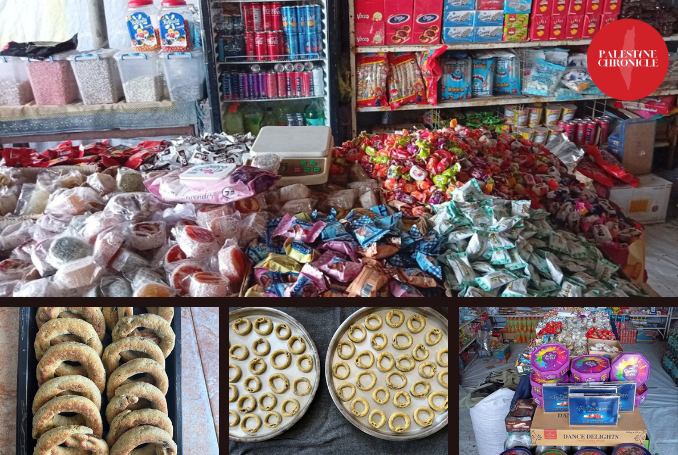
Despite the hardship, the smell of cakes brings back a sense of joy lost over the past two years and reminds people of their lives before the war.
In the Al-Mawasi area, south of the Gaza Strip, signs of Eid are appearing differently this year. For the first time in two years, Eid passes without the sounds of explosions and airstrikes that have accompanied the lives of residents throughout the months of war.
Inside worn-out tents—weathered by the cold of winter and the heat of summer—steadfast Palestinian mothers try to make ‘Eid cakes’ using primitive means, hoping to bring joy to their children.
We brought the ingredients for traditional Palestinian cakes, and my mother began making them for us with love.
As she kneaded the dough and shaped the cakes, her hands brought back the scent of our old home, which was destroyed in an Israeli airstrike.
It was not just a dessert, but an attempt by my mother to mend our souls, worn down by pain.
Rami and Iman’s Promise to Jana – Gaza Couple Fosters Baby Who Lost Entire Family
My mother remembers with nostalgia: “The last time we all gathered to make cakes was two years ago, in our spacious kitchen, with laughter filling the place. Today, the war has separated us, and we are left with nothing but these primitive clay ovens,” she told the Palestine Chronicle.
Although the task is extremely difficult—cooking gas is almost impossible to obtain and modern ovens have become a thing of the past—my mother’s insistence on baking over a wood fire and in clay ovens is stronger than the exhaustion.
“We are cooking joy for our children, so they can see in our eyes that life continues despite all this hardship,” she said.
Clay Ovens: A Forced Alternative
Here in Gaza, reaching the final stage of making cakes is not easy in the absence of basic necessities. With ongoing power outages and no access to cooking gas or modern ovens, residents have been forced since the beginning of the war to return to traditional clay ovens.
The baking process requires double the effort from women, who spend hours gathering firewood and tending the fire amid thick smoke inside the camps.
Despite the hardship, the smell of cakes brings back a sense of joy lost over the past two years and reminds people of their lives before the war.
Between Life and Death: An Unknown Fate Haunts the Families of the Missing in Gaza
In a neighboring tent, Hajja Salwa Al-Khalidi sits with her grandchildren. Salwa, who lost her eldest son, Karam, in the war, now faces the responsibility of caring for his orphaned children.
“Children have the right to experience Eid and its details, even if they are simple,” Salwa told the Palestine Chronicle. “I bought some sweets and clothes for my martyred son’s daughters, and I made the cakes with my own hands, because I want to see the smiles on their faces.”
Salwa knows that nothing can replace their father, but she is trying, as much as possible, to ease the pain of their loss.
Markets: High Prices and Weak Activity
At the commercial level, markets in the Gaza Strip are experiencing clear stagnation. The sharp rise in the prices of clothes and ready-made Eid sweets has placed them out of reach for most families, many of whom have lost their sources of income due to the war.
Tariq Abu Hubais, a sweets shop owner, explained that demand for ready-made sweets this year is “very weak” compared to pre-war years, he told the Palestine Chronicle.
He emphasized that this is due to the deterioration of the economic situation, as residents now struggle to secure their daily livelihood.
At the same time, Abu Hubais noted increased demand for cake ingredients—such as flour, date paste, and semolina—as most families turn to making them by hand inside their tents to reduce costs and ensure they can offer something to their children during Eid.
In the Yafa displacement camp in Mawasi al-Qarara, Youssef Abdel Wahab, the person in charge of the camp, said they are working to set up a tent within two days and decorate it so that Eid prayers and takbeerat can be held, he told the Palestine Chronicle.
He added that young people in the camp have volunteered to gather ropes, decorations, and simple toys for children.
“Although we have lost our mosques and homes, we will not lose our ability to celebrate our rituals,” he said.
Youssef believes their mission is to create moments of calm from within suffering.
“Eid prayer in this tent will be a message to the world that we are a people who love life and joy,” he said. “The pain of displacement will not prevent us from standing together, smiling, and reciting the Eid takbeerat despite our loss.”
It must be remembered that residents of the Gaza Strip are still living under unprecedented economic pressure. After two years of war, and with many people losing their livelihoods and businesses, reliance on humanitarian aid has become inevitable.
As a result, making cakes inside displacement centers has shifted from a social tradition into an economic necessity—while also serving as a way to escape the pressures of daily life.
Eid in Gaza remains different this year. It is an Eid burdened with memories of destroyed homes and the disappearance of places where children once found joy. Yet it also reflects a determination to continue life with the limited means available, and a search for small moments of happiness in the midst of pain and suffering.
(The Palestine Chronicle)
– Shaimaa Eid is a Gaza-based writer. She contributed this article to the Palestine Chronicle.




Thank you Shaimaa for this insight in the lives of the people in Gaza at this time. They are just unbeatable and I am glad to know they have not lost their sweet tooth.
THIS IS what the ACCURSED zionists have DONE to PALESTINIAN HUMAN BEINGS!!….THROUGHOUT THE WORLD, zionists SHOULD BE ARRESTED AND PROSECUTED FOR GENOCIDE, AS SHOULD EVERY SINGLE PERSON WHO ENABLED OR TRIES TO JUSTIFY THE GENOCIDE IN GAZA!!…..THIS PURIFICATION IS NECESSARY IF HUMAN BEINGS EVER HOPE TO RETRIEVE THEIR HUMANITY AGAIN…..IF IT IS NOT DONE, THAN WE NO LONGER HAVE THE RIGHT TO CALL OURSELVES CIVILIZED!!