By Shaimaa Eid
As Israel refuses to withdraw, Palestinians living near the Yellow Line describe a ceasefire that exists only in name.
After months of waiting for the second phase of the ceasefire in the Gaza Strip, many Palestinians had hoped it would finally allow them to return to what remains of their homes—particularly those located within or near what has come to be known as the so-called Yellow Line. Instead, those expectations were met with deep frustration.
Despite public announcements, including statements by US President Donald Trump declaring the start of the second phase, Israel has refused to withdraw from the same areas it continues to occupy. For residents displaced from their neighborhoods, the promise of return has once again proven hollow.
Mohammed al-Qadi, a resident of Rafah, remains confined to a displacement center. Like thousands of others, he has been waiting for any sign that returning home would become possible.
‘We Sail So Our Children Don’t Go Hungry’: Gaza’s Fishermen Risk Their Lives at Sea
“Since we were forcibly displaced from Rafah, we have lived in anticipation of the moment when our return would be announced,” al-Qadi told The Palestine Chronicle. “When the war was said to have ended, our relief was incomplete. Yes, the killing stopped—for a moment—but being unable to return to Rafah left us with a deep sense of loss and bitterness.”
He explained that uncertainty has defined daily life since then.
“Every day, we hear new plans for Rafah,” he said. “One day, it’s supposed to become a so-called humanitarian city where people are concentrated. Another day, we’re told we’ll be screened at checkpoints before being allowed back. None of this feels like a real return.”
For al-Qadi, Israel’s conduct has stripped these announcements of any credibility.
“Israel does not honor its promises or commitments,” he said. “Trump announced the second phase, which was supposed to include a withdrawal from the Yellow Line. Yet we are still here, living in displacement centers, enduring conditions that are harsh, humiliating, and far from safe.”
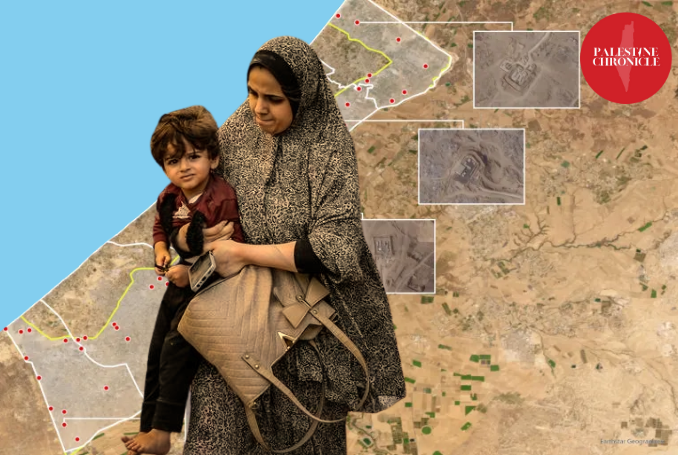
The Yellow Line stretches from south of northern Gaza, cutting through central areas and extending toward the outskirts of Rafah in the south. Along and beyond it, Israeli forces remain stationed in eastern Gaza City—particularly in Sheja’iyya, Al-Tuffah, and Al-Zaytoun—as well as in Beit Hanoun, Beit Lahia, eastern Khan Yunis, and large parts of Rafah.
Gazans’ New Year Wishes: A Life of Dignity after Annihilation
For those living near the line, the war has never truly ended.
Zina Kolab, a 28-year-old resident of the Beit Lahia project area, lives just one street away from the Yellow Line. She describes her life as a constant negotiation with fear.
“As evening approaches, everything comes to a halt,” Kolab told The Palestine Chronicle. “By five o’clock, once it starts getting dark, no one dares to step outside. It feels as though an undeclared curfew has been imposed on us.”
Nighttime, she explained, is even worse.
“Quadcopter drones hover over our homes, explosions echo through the area, and demolition operations continue without pause,” she said. “Every sound brings back memories of the war. Fear settles in our chests, and sleep becomes impossible.”
Any talk of a postwar reality feels detached from what residents like Kolab are experiencing.
“We returned because we had no other option,” she said. “Our house is damaged and barely standing. We repaired what we could with scraps and plastic, just to protect ourselves from the winter cold and rain. But this is not a return to life—it’s survival under constant threat.”
Hollow Promises and a Redefined ‘Ceasefire’
While residents struggle with an unfinished war on the ground, political analysts warn that Israel has systematically undermined the substance of the ceasefire agreement itself.
Firewood, Smoke, and Survival: Life Without Cooking Gas in Gaza
Political analyst Salah Abdel Ati told The Palestine Chronicle that Israel has been “deliberately hollowing out the first phase of its commitments,” while attempting to do the same with the second.
“Even after announcing the second phase, Israel is trying to strip it of any real content,” Abdel Ati said. “At the same time, it is promoting a US–Israeli narrative that claims Israel fulfilled its obligations in the first phase—something that is completely detached from reality.”
He pointed to the scale of violations since the ceasefire came into effect.
“Israeli violations exceed 1,300 incidents,” he explained, “resulting in the killing of at least 526 Palestinians and the injury of more than 1,300 others. Most of those injured were shot while approaching areas near the Yellow Line.”
According to Abdel Ati, Israel has worked to impose the Yellow Line as a permanent reality on the ground.
“It has done so by targeting schools and civilian facilities, establishing military positions, and gradually expanding the area,” he said. “This raises the real possibility that Israel intends to remain inside the Gaza Strip and effectively divide it.”
He argued that the motives behind this policy are clear.
“These violations are enabled by unwavering US support and the absence of any serious international pressure,” Abdel Ati said. “Israel now claims that the second phase is limited solely to the disarmament of Palestinian factions, while it ignores its own obligations under the agreement.”
This, he added, reflects a unilateral reinterpretation of the ceasefire.
“Israel is redefining its commitments to suit its interests—backing away from withdrawal, refusing to fully open crossings, restricting humanitarian aid, delaying temporary housing solutions, and undermining any real pathway toward reconstruction.”
Abdel Ati stressed that reversing this trajectory requires more than statements.
“What is needed is genuine pressure from mediators and the international community to force Israel to adhere to the ceasefire agreement and to implement UN Security Council Resolution 2803 in full.”
‘The War Never Stopped’
For journalists reporting from inside Gaza, the gap between political declarations and lived reality is stark.
Nema al-Astal, a young journalist from eastern Khan Yunis, says that claims of the war’s end have little to do with what people continue to experience daily.
“Talking about the war being over feels almost surreal,” al-Astal told The Palestine Chronicle. “What we live through every day tells a completely different story.”
Daily Thirst amid Tents and Ruins: A ‘Rough and Sandy Path’ for Gaza’s Displaced
She accused Israel of deliberately misleading international audiences.
“Israel presents announcements to the world, but on the ground, the sounds of explosions, demolitions, and shelling never stop—especially in areas classified within the Yellow Line,” she said.
The danger, she explained, is not limited to noise alone.
“People are still being killed,” al-Astal said. “There are nights when we don’t sleep at all. In Al-Mawasi, we lie awake as the explosions east of Khan Yunis shake the air. Their echoes reach us clearly, carrying fear with them.”
For al-Astal, the continuation of this reality underscores the failure of the current phase.
“This is not a ceasefire that protects lives,” she said. “It is a fragile pause that allows violence to continue in different forms.”
She concluded with a direct appeal to those who claim to mediate the process.
“I call on the mediating countries and on US President Donald Trump to intervene urgently,” al-Astal said. “What is happening must stop. Israel must be compelled to implement the agreements it announced, without further violations that continue to claim Palestinian lives.”
(The Palestine Chronicle)

– Shaimaa Eid is a Gaza-based writer. She contributed this article to the Palestine Chronicle.