
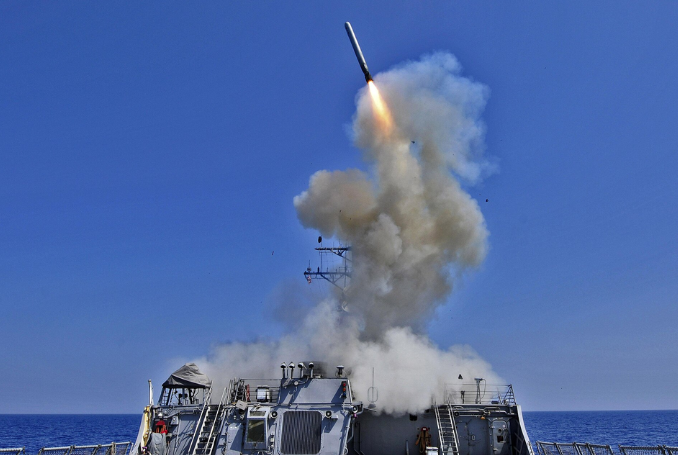

US expends hundreds of Tomahawks as war intensifies, while NYT reports widespread damage has made key regional bases increasingly uninhabitable.
Key Takeaways
- US fired over 850 Tomahawk missiles in four weeks, raising concerns about depletion.
- Pentagon officials warn of “alarmingly low” stockpiles in the region.
- NYT reports multiple US bases damaged, with troops relocated as facilities become difficult to sustain.
Washington Post: Missile Use Raises Supply Concerns
The United States has fired more than 850 Tomahawk cruise missiles in less than four weeks of war against Iran, according to a detailed report by the Washington Post, raising concerns inside the Pentagon about the sustainability of current operations.
The missiles, long considered a cornerstone of US long-range strike capability, are being used at a pace that some officials described as unsustainable. One official said remaining stocks in the Middle East are “alarmingly low,” while another warned that forces are approaching “Winchester”—military slang for running out of ammunition.
Tomahawks, which can travel more than 1,000 miles and are launched from naval platforms, are produced in limited numbers, with only a few hundred manufactured annually. Each missile can cost up to $3.6 million and take up to two years to build, making rapid replenishment difficult.
The heavy reliance on these weapons has prompted internal discussions about diverting missiles from other theaters, including the Indo-Pacific, and accelerating production through defense contractors.
The report also notes that the US military has fired more than 1,000 air-defense interceptor missiles in response to Iranian counterattacks, further straining inventories of high-end systems such as Patriot and THAAD.
Analysts cited in the report warned that the current burn rate could significantly affect US readiness in other regions.
“That would be about a quarter of the total inventory and would leave a large gap for a conflict in the Western Pacific,” said Mark Cancian of the Center for Strategic and International Studies.
Despite these concerns, US officials have publicly rejected claims of shortages. A Pentagon spokesperson said the military “has everything it needs to execute any mission,” while senior officials insisted stockpiles remain sufficient.
At the same time, the Trump administration has begun engaging defense manufacturers to increase production, with discussions reportedly focused on expanding output of advanced munitions.
NYT: Bases No Longer Sustainable
A separate report by the New York Times suggests that the strain is not limited to weapons stockpiles but extends to the physical viability of US military infrastructure across the region.
According to the report, repeated Iranian missile and drone attacks have rendered many US bases “all but uninhabitable,” forcing troops to disperse into makeshift locations, including hotels and office buildings.
The shift has effectively transformed parts of the US military presence into a fragmented and improvised network. While operations continue, officials acknowledge that such conditions reduce efficiency and degrade operational capability.
“You’re absolutely going to lose capability,” said retired Air Force specialist Wes J. Bryant, noting that critical equipment cannot be fully deployed in temporary or civilian settings.
Several key installations have sustained direct damage. In Kuwait, strikes on Port Shuaiba destroyed an Army tactical operations center, killing six service members, while other bases saw damage to aircraft structures, fuel facilities, and maintenance infrastructure.
In Qatar, Iran struck Al Udeid Air Base, damaging an early-warning radar system, while in Bahrain and Saudi Arabia, attacks targeted communications equipment and refueling assets.
The cumulative effect, according to military officials cited in the report, is a regional network of bases that can no longer reliably support sustained operations under current conditions.
(PC, Washington Post, NYT)







Be the first to comment