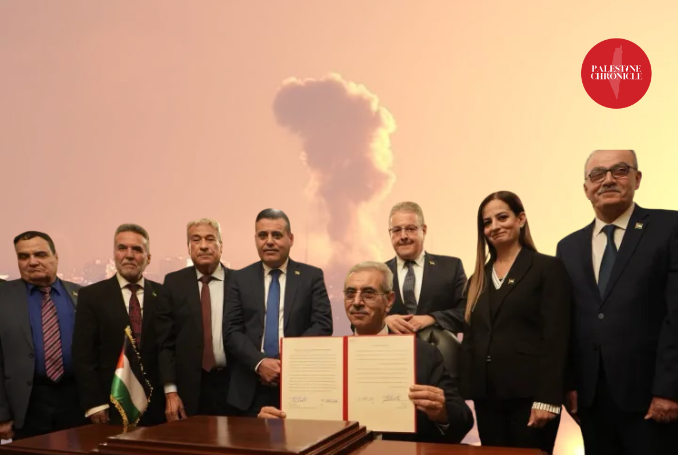

Ali Shaath signed the first official document of Gaza’s new administration, as Palestinians weigh hopes for relief against concerns over US-led oversight and postwar governance.
Ali Shaath, head of the newly formed National Committee for the Administration of Gaza, signed the committee’s mission statement on Sunday, marking his first official act since assuming the role amid intense debate over Gaza’s postwar governance.
In a statement published on social media, Shaath said the signing was intended to formally define the committee’s mandate, principles, and responsibilities during the transitional phase following Israel’s war on the Gaza Strip.
“As my first official act, I adopted and signed the mission statement of the National Committee for the Administration of Gaza,” Shaath wrote. “This affirms our governing mandate and defines our operating principles and responsibilities.”
Civil Engineer, Ali Shaath, to Head Gaza Technocratic Committee – Who is He?
‘International Decisions’
Shaath said the committee’s work is authorized under UN Security Council Resolution 2803 and the 20-point plan announced by US President Donald Trump, which underpins the second phase of the Gaza ceasefire agreement.
He described the committee’s mission as transforming the transitional period into “a solid foundation for sustainable Palestinian prosperity,” adding that the work would proceed under the supervision of the US-led Board of Peace and with support from Gaza’s High Representative, Nikolai Mladenov.
According to Shaath, the committee’s priorities include restoring security, rebuilding essential services such as electricity, water, healthcare, and education, and reviving Gaza’s economy through transparency, integrity, and job creation.
“Our mission is not only to rebuild infrastructure,” he said, “but to revive Gaza’s social fabric and restore hope for the future.”
Shaath also emphasized that peace, in his view, is “the only path to securing legitimate Palestinian rights and preparing the way toward self-determination and a future based on justice and stability.”
Israel Voices Concern as US Pushes Ahead with Gaza ‘Executive Committee’ and Board of Peace
Following the announcement, US Secretary of State Marco Rubio welcomed Shaath’s move, saying he looked forward to working with the committee to “build a better future for Gaza and the wider region.”
Jared Kushner, Trump’s envoy and a member of the Board of Peace’s executive body, echoed Shaath’s remarks on restoring security and services, commenting that “the serious work begins now.”
The White House confirmed on Friday that the Gaza governance framework consists of four parallel bodies: the Board of Peace, the Gaza Executive Board, the National Committee for the Administration of Gaza, and an International Stabilization Force.
Palestinian Debate and Unease
While the signing of the mission statement was presented as a procedural step toward governance and relief, the broader framework has generated widespread debate among Palestinians.
Activists and analysts have expressed concern that the Board of Peace—chaired by Trump and populated by US, Israeli, and international figures—places Gaza under a form of external oversight that risks sidelining Palestinian political agency.
Critics argue that the timing and composition of the board, announced after a genocide that destroyed much of Gaza and displaced most of its population, raise questions about whether the initiative prioritizes justice, accountability, and an end to Israeli aggression, or merely seeks to manage the consequences of devastation.
Others note the paradox that Gaza, where the vast majority of residents are living in tents and emergency shelters, is now set to be overseen by international bodies tasked with demilitarization and governance restructuring, while core political issues remain unresolved.
At the same time, some Palestinian voices express cautious hope that the committee’s work could alleviate immediate suffering, prevent mass displacement, and open pathways for reconstruction—if it leads to real relief on the ground.
White House Unveils Gaza ‘Board of Peace’ — Who Will Control Gaza’s Next Phase?
A Fragile Beginning
Shaath announced on Friday that the committee had officially begun its work from Cairo and would later relocate to Gaza to implement an urgent relief plan.
The administration’s first steps come as Gaza remains under siege, Israeli ceasefire violations continue, and the humanitarian crisis deepens. More than 71,000 Palestinians have been killed since October 2023, with large parts of the Strip reduced to rubble.
As Gaza’s new governing structures take shape, Palestinians are left navigating a complex reality—balancing the urgent need for relief and reconstruction against profound concerns over sovereignty, accountability, and who ultimately controls Gaza’s future.
(PC, Anadolu, QNN)