
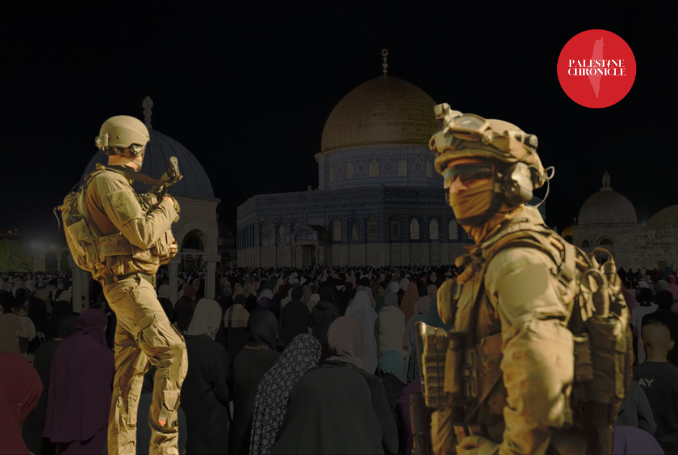

Detentions at Al-Aqsa, a West Bank killing, land seizures, and military escalation converge before Ramadan across occupied Palestine.
Key Developments
- Israel detained and banned Al-Aqsa imam Sheikh Muhammad Ali Abbasi for one week inside the compound.
- Occupation authorities blocked Ramadan preparations and issued more than 250 exclusion orders from the mosque.
- Israeli forces killed an 18-year-old Palestinian near Qalqilya amid expanding raids across the West Bank.
- UN and Jordan warned Israeli land registration policies amount to annexation and destabilization.
- Israeli media reported troop reinforcements, worker bans, and strict limits on Palestinian access to Jerusalem.
- Army chief declared 2026 a year of intensified multi-front operations across the region.
Al-Aqsa Ban
Israeli police detained Sheikh Muhammad Ali Abbasi inside the Al-Aqsa Mosque compound and issued an expulsion order banning him from entering the site for one week, according to the Jerusalem Governorate and Palestinian officials.
The ban came days before the holy month of Ramadan, when hundreds of thousands of Palestinians traditionally seek to pray at the mosque.
At the same time, Israeli occupation authorities prevented Islamic Waqf administrators from carrying out logistical preparations, including installing shade structures, medical points and organizational arrangements for worshippers.
Ben-Gvir Stepped on Prisoners’ Heads during Ofer Prison Raid — What Happened in Section 26
Palestinian sources reported more than 250 exclusion orders from Al-Aqsa since the beginning of the year and the removal of about 25 Waqf employees, alongside arrests of others.
Israeli occupation authorities are also expected to impose strict demographic limitations on entry, allowing only older Palestinians limited access while restricting most West Bank residents.
Meanwhile, settler groups announced longer morning incursions into the compound under police protection and called for expanded Jewish access during Ramadan, deepening fears of confrontation in Jerusalem’s Old City.
Youth Killed
Hours after the Jerusalem developments, Israeli forces shot and killed an 18-year-old Palestinian near the separation wall – known among Palestinians as the Apartheid Wall – west of Qalqilya. He was transferred to the hospital but died of his wounds, according to official Palestinian sources.
The killing occurred amid an intensified campaign across the West Bank involving raids, arrests, and armed incursions. Since October 2023, more than 1,100 Palestinians have been killed and nearly 11,500 injured in Israeli operations across the territory.
Israeli media reported additional troop deployments ahead of Ramadan, including reinforcement battalions and expanded arrest operations.
Restrictions also remain in place on roughly 140,000 Palestinian workers barred from entering Israel since the Gaza war, a measure security officials themselves warned may increase instability.
Jerusalem officials say Israeli authorities have issued a one-week ban, renewable, against Al-Aqsa imam Mohammad Ali al-Abbasi after detaining him inside the compound.#AlAqsa #Jerusalem #Palestine pic.twitter.com/21lLR9gnkg
— Al-Estiklal English (@alestiklalen) February 16, 2026
Land Registration
In related news, UN Secretary-General António Guterres condemned Israel’s decision to resume land registration procedures in the occupied West Bank, warning the move could lead to large-scale confiscation of Palestinian property and consolidation of settlement control.
The measure concerns Area C — roughly 61% of the West Bank — which remains under full Israeli civil and military authority under the Oslo framework.
Registration had been frozen since 1967; restarting it allows Israeli authorities to classify vast tracts as “state land,” a legal mechanism historically used to allocate territory to illegal settlements and block Palestinian construction.
Through the process, land records are re-examined, Ottoman- and Jordanian-era ownership claims can be invalidated, and control shifts to the Israeli Civil Administration.
The UN said such actions are unlawful and reiterated that all settlements in the occupied Palestinian territory, including East Jerusalem, “have no legal validity.” It warned that the policy accelerates de facto annexation and undermines prospects for any political resolution, urging Israel to reverse the decision.
Jordan’s King Abdullah II issued a parallel warning during meetings in London with British officials and parliamentarians. According to the Royal Court, the king said Israeli steps to impose sovereignty over Palestinian land threaten regional stability and sabotage de-escalation efforts.
He emphasized that expanding settlement control while restricting Palestinian access — particularly ahead of Ramadan — risks igniting wider unrest and called for international pressure to halt the measures and protect the legal and historical status of the occupied territories.
Israel’s Land Registration and Jerusalem Expansion Explained – All You Need to Know
Zamir: ‘Year of Decision’
Israeli Chief of Staff Lt. Gen. Eyal Zamir declared that 2026 would be a “year of decision,” saying the army is preparing for intensified combat across multiple fronts while continuing operations in Gaza, the West Bank and the wider region.
According to the Israeli army statement, Zamir told reserve brigade commanders the military is expanding its ground maneuver capability, increasing offensive capacity, improving operational mobility and developing robotic combat systems. He also ordered higher readiness of reserve stockpiles and emergency logistics infrastructure.
Zamir described the situation as a “multi-arena war,” adding that Israel intends to maintain a high operational tempo to “weaken threats” and achieve decisive outcomes along confrontation lines.
His remarks come amid ongoing violations of ceasefire arrangements in Gaza and continued military raids across the West Bank.
The timing is also linked to regional tensions. Israeli officials increasingly frame the confrontation as extending beyond Gaza to Lebanon, Syria, and Iran, with the occupation army preparing for simultaneous escalation scenarios.
(PC, Anadolu, QNN, AJA, Palestinian Media)



Zamir, you are the weak one, as weak as a spider’s web