
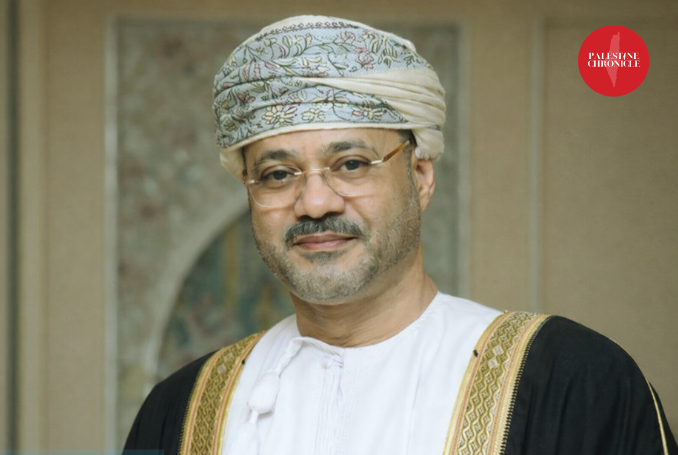

Oman’s foreign minister has issued a stark warning against military and economic coercion as Muscat struggles to broker an agreement over the Strait of Hormuz.
Key Takeaways
- Omani Foreign Minister Sayyid Badr al-Busaidi warned against both “gunboat diplomacy” and using economic power to “bully entire populations into submission.”
- He linked such coercion to attempts at “regime change” and the installation of a “compliant proxy administration.”
- Oman said negotiations over reopening the Strait of Hormuz had not yet succeeded but declared: “We are not walking away.”
Omani Foreign Minister Sayyid Badr al-Busaidi has issued a striking condemnation of military intimidation, economic warfare and regime-change policies as his country continues its efforts to negotiate an agreement over the Strait of Hormuz.
Writing in the Financial Times in an article published by the Oman Observer on Friday, al-Busaidi presented the current international crisis as the product of something far larger than a breakdown in negotiations.
He argued that the world is witnessing the erosion of international law alongside the revival of methods historically associated with imperial power: military coercion, collective economic pressure and efforts to impose compliant governments on weaker states.
His intervention comes as Oman remains deeply involved in efforts to negotiate an agreement restoring freedom of navigation through the Strait of Hormuz amid the continuing confrontation involving Iran and the United States.
“A solution has not yet been reached,” al-Busaidi wrote. “But we are not walking away.”
‘Gunboat Diplomacy’
Al-Busaidi identified two developments that he said were transforming international politics.
The first, he wrote, is a growing disregard for international law.
He pointed to the consolidation of occupations, assassinations and abductions used as instruments of policy, attacks on civilians and growing contempt for the United Nations, the International Court of Justice and the International Criminal Court.
The consequence, he warned, could be a return to an era when powerful states operated with impunity — only now in a world possessing weapons of mass destruction.
His second warning was even more explicit.
Al-Busaidi criticized political leaders who bypass professional diplomats and attempt to conduct international relations themselves.
Once diplomatic tools have been discarded, he argued, leaders discover that their remaining options are overwhelmingly coercive.
“They are forced to resort either to the traditional 19th-century imperial method of ‘gunboat diplomacy’,” he wrote, “or to the more refined but equally destructive modern equivalent of using economic power to bully entire populations into submission.”
The objective of such economic pressure, he continued, is frequently “regime change” and the establishment of a “compliant proxy administration.”
Economic Warfare
Al-Busaidi did not name the United States in the passage criticizing “gunboat diplomacy” and economic coercion.
The timing of his intervention, however, places the argument directly within the escalating confrontation surrounding Iran and Hormuz.
Washington has increasingly emphasized economic pressure against Tehran alongside its military attacks.
US Treasury Secretary Scott Bessent has threatened an intensified campaign against Iran and countries continuing to trade with it, portraying economic pressure as another means of forcing Tehran to change course.
Al-Busaidi’s article presents a fundamentally different diagnosis. Rather than treating military and economic pressure as alternatives to unsuccessful diplomacy, he describes both as symptoms of diplomacy being abandoned.
For smaller states, he argues, the answer to powerful countries ignoring established rules cannot be to abandon those rules themselves.
Instead, they must insist repeatedly on international law, even when doing so appears ineffective.
“Repeated invocations of international law may be dismissed as tedious by those whose instincts are to move fast and break things,” he wrote.
“But they are there to protect the vast majority of the global population.”
‘We Are Not Walking Away’
The argument then turns directly to Iran and the Strait of Hormuz.
Al-Busaidi said one of Oman’s principal diplomatic priorities in recent months has been securing an agreement that would restore freedom of navigation through the strategic waterway.
He described the negotiations as exceptionally difficult and taking place under the “ever-present threat of war.”
The stakes extend far beyond Iran, the United States or Oman.
The strait remains one of the world’s most strategically important energy corridors, meaning its continued closure has consequences for energy markets and the wider global economy.
Yet al-Busaidi made clear that Muscat does not regard the failure to secure an immediate agreement as justification for abandoning negotiations.
“A solution has not yet been reached,” he wrote. “But we are not walking away.”
There is, he argued, more at stake than the immediate dispute itself.
“The very process of negotiation — the idea that nations can resolve differences through dialogue — is also at stake.”
Oman’s Three Objectives
Al-Busaidi outlined three objectives behind Oman’s continued mediation.
The first is protecting Omani sovereignty, particularly because the situation surrounding Hormuz threatens the security of the country’s territorial waters.
The second is protecting the wider international community from the consequences of continued disruption to the strait, with al-Busaidi warning that the most vulnerable populations will ultimately bear the greatest cost.
The third is defending international law itself by continuing to operate within its framework even when more powerful actors disregard it.
For Oman, he explained, these principles form part of what Muscat calls “constructive neutrality.”
But al-Busaidi insisted that neutrality does not mean passivity. It means maintaining dialogue and attempting to construct a system of mutual commitments capable of restraining the exercise of raw power, he wrote.
A Warning from the Mediator
Al-Busaidi’s intervention ultimately presents the Hormuz negotiations as a test of a much larger question: whether international disputes will continue to be governed by diplomacy and law or increasingly settled through military and economic power.
His references to Palestine, Iran, Yemen, Sudan, Lebanon, and Ukraine place the current crisis within what he sees as a broader deterioration of the international system.
For smaller countries, he argued, international law is not an abstract principle. It is one of the few protections available against states powerful enough to act without restraint.
And as Oman attempts to prevent the confrontation over Hormuz from escalating further, al-Busaidi’s prescription is deliberately at odds with the logic of escalating pressure.
Where others increasingly turn to military force, economic strangulation and threats of regime change, Oman says it will continue negotiating.
“The challenge is not to walk away,” al-Busaidi wrote.
Terror Lists to Shield the Gangster Capitalism of a Lunatic State: From ICE Raids to Palestine
(PC, Oman Observer)




Be the first to comment