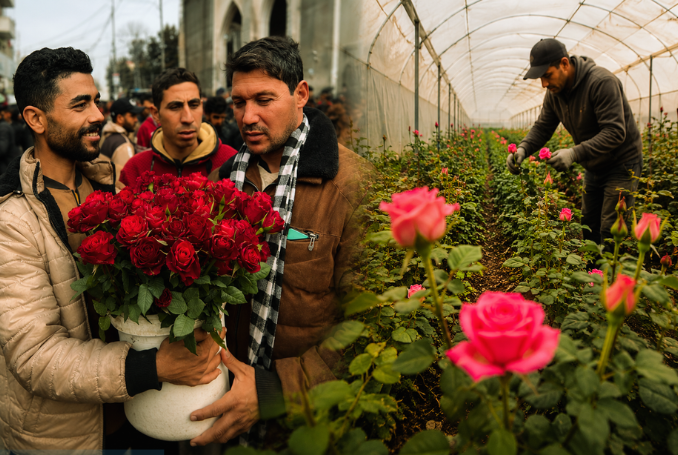

After Israel barred thousands of Palestinian workers from their jobs, a Jenin flower nursery became a source of livelihoods, resilience and steadfastness.
Key Takeaways
- Israel’s closure of its labor market following October 2023 left tens of thousands of Palestinian workers across the occupied West Bank unemployed.
- A flower nursery established in Jenin has provided new employment opportunities while promoting Palestinian agricultural production and reducing reliance on Israeli imports.
- Despite settler violence, movement restrictions and import barriers, the project continues expanding, illustrating how Palestinian entrepreneurship has become a form of economic resilience.
Cultivating Resistance
When Israel closed its labor market to Palestinian workers following the outbreak of its war on Gaza in October 2023, Ali lost far more than a paycheck.
Like tens of thousands of laborers across the occupied West Bank, he suddenly found himself without a steady income, uncertain how he would continue supporting his family after years of working inside Israel.
For years, Ali’s daily routine had been familiar to countless Palestinians: Before dawn, he would leave home in search of work across the Green Line, earning a salary that allowed him to provide for his family and build a measure of financial stability.
That routine ended almost overnight after October 7, when Israel revoked work permits for Palestinian laborers, severing one of the West Bank’s most important sources of employment.
Determined to recover what he had lost, Ali attempted to return to work inside Israel.
Instead, he was arrested.
His experience reflected the uncertainty confronting thousands of Palestinian workers who suddenly found themselves excluded from jobs they had depended on for years.
With few alternatives available and his responsibilities at home unchanged, Ali began searching for any opportunity that would allow him to earn a living.
That search led him somewhere unexpected: a flower nursery on the outskirts of Jenin.
The salary is significantly lower than what he once earned. Yet for Ali, the job represents something that had become increasingly scarce since the war began—stability.
It also allows him to return home to his family every evening, rather than spending extended periods away as his previous work often required.
Ali’s story is not unique. It reflects a broader transformation taking place across the occupied West Bank, where Israel’s restrictions have forced Palestinians to rethink how they earn a living and how local economies can survive under occupation.
Rebuilding What Was Lost
The nursery where Ali found work was itself born from another moment of crisis.
Years before the current war and genocide, during the COVID-19 pandemic, Farah Brahameh and her husband, Maan Sadaqa, faced their own economic uncertainty after Sadaqa, a mechatronics engineer, lost his job in Ramallah.
Rather than waiting for another employer, the couple began exploring the possibility of creating a business of their own. After studying the Palestinian market, they identified an unexpected opportunity: cultivating Damask roses.
The decision was driven by careful research as much as ambition.
According to figures from the Palestinian Ministry of Agriculture, Palestine’s annual rose market is valued at roughly 10 million shekels. Before the current war, much of that demand had been supplied either through flowers grown in Gaza or imports entering via Israel.
Brahameh and Sadaqa believed local production could help meet that demand while reducing dependence on outside suppliers.
The project began modestly, supported by early grants and funding before gradually becoming self-sustaining through reinvestment of its own revenues.
Brahameh credits the Palestinian Ministry of Agriculture with helping the nursery survive its difficult beginnings, describing the ministry’s support as crucial in enabling the project to grow.
The financial hurdles, however, proved to be only the beginning.
Many flower shop owners initially declined to purchase locally grown roses, preferring to maintain established commercial relationships with Israeli suppliers.
Others questioned whether a newly established Palestinian producer could consistently deliver flowers of sufficient quality.
Instead of abandoning the project, the couple continued cultivating roses, improving production methods and building relationships with retailers.
Gradually, perceptions changed. Shop owners who had once rejected their flowers began contacting the nursery themselves after recognizing the quality of its products.
What began as a small family business gradually developed into a successful Palestinian agricultural enterprise.
Farming Under Occupation
Success, however, has never insulated the nursery from the realities of occupation.
One of the project’s most persistent challenges lies in obtaining rose seedlings.
Commercial varieties are sourced primarily from the Netherlands, but Israeli control over Palestinian borders and imports makes the process expensive, unpredictable and fraught with risk. If seedlings arrive damaged or diseased, growers often have little recourse, exposing small businesses to potentially devastating losses.
The nursery’s location presents even greater challenges.
Situated in Area C of the occupied West Bank near an Israeli settlement, the project operates under the constant shadow of Israeli settler violence.
According to Brahameh, settlers no longer simply pass near the farm. They increasingly approach the greenhouses themselves, creating a daily sense of insecurity for workers and threatening the continuity of production.
Israeli movement restrictions present another obstacle.
Road closures and village lockdowns frequently prevent employees from reaching the nursery, disrupting harvesting schedules and routine maintenance essential to cultivating roses.
During periods of heightened tension, some workers have even spent nights inside the nursery to protect the greenhouses and safeguard months of painstaking work.
In such circumstances, Brahameh says, the relationship between the project and its employees has evolved beyond that of employer and worker.
The people employed there have become partners in protecting not only a business but also a shared investment in their community’s future.
Providing employment, she says, is about much more than paying salaries. It offers families a measure of stability, dignity and belonging at a time when all three have become increasingly difficult to secure.
Cultivating More Than Flowers
For Brahameh, projects like the nursery deserve greater institutional support through financing, technical assistance and protection. Strengthening productive sectors, she argues, helps create employment opportunities while reinforcing Palestinians’ ability to remain rooted on their land.
Her appeal reflects a much broader reality unfolding across the occupied West Bank.
The economic shock created by Israel’s post-October 2023 restrictions has extended far beyond individual workers, forcing communities to search for new models of survival as long-standing sources of employment disappeared.
Across Palestine, small agricultural and manufacturing initiatives have increasingly sought to fill that gap, despite operating under military occupation, movement restrictions, land confiscation and growing settler violence.
The Jenin nursery cannot replace the tens of thousands of jobs that were lost.
Nor can rows of carefully cultivated roses resolve the structural economic challenges imposed by decades of occupation.
What they can do is offer an alternative.
Each flower harvested represents not only a product destined for the Palestinian market but also another small step toward economic self-reliance. Every worker employed represents a family that has regained a measure of security after seeing its livelihood abruptly disappear.
In Jenin, the roses growing inside these greenhouses have come to symbolize something far greater than commercial success. They stand as quiet evidence that, even as Israeli occupation seeks to undermine Palestinian livelihoods and deepen economic dependence, communities continue searching for ways to rebuild from within.
In that sense, this nursery is cultivating more than flowers. It is cultivating resilience, preserving livelihoods, and helping Palestinians remain rooted in the land they continue to call home.
Women of Atara: How Settler Expansion is Erasing a Generations-Old Way of Life
(Quds News Network)