
Qalibaf links Hormuz tensions to US fuel prices, warning of compounded economic fallout through a calculated formula.
A Formula to Explain Escalation
Iranian Parliament Speaker Mohammad Baqer Qalibaf warned that US policy toward Iran would directly impact fuel prices in the United States, framing the confrontation in economic terms rather than military ones.
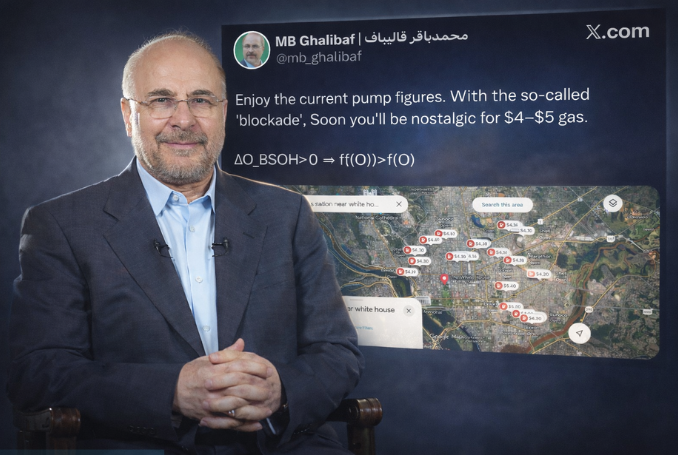
In a post addressed to Americans on Monday, he wrote: “Enjoy the current pump figures. With the so-called ‘blockade’, Soon you’ll be nostalgic for $4–$5 gas.”
The message coincided with escalating tensions over the Strait of Hormuz, a key global energy route, and US moves toward restricting maritime access.
Qalibaf accompanied his message with a mathematical expression:
ΔO_BSOH > 0 ⇒ f(f(O)) > f(O)
The formula outlines a sequence of economic effects tied to a potential disruption in the Strait of Hormuz.
The first part indicates that any blockade or disruption leads to an increase in oil prices. The second part defines how that increase evolves.
The initial impact, represented as f(O), refers to rising fuel costs. The second term, f(f(O)), refers to the broader economic consequences that follow.
The inequality shows that the second wave of impact exceeds the first.
Enjoy the current pump figures. With the so-called 'blockade', Soon you'll be nostalgic for $4–$5 gas.
ΔO_BSOH>0 ⇒ f(f(O))>f(O) pic.twitter.com/rVxlC6vFWG
— محمدباقر قالیباف | MB Ghalibaf (@mb_ghalibaf) April 12, 2026
From Oil Shock to Economic Chain Reaction
The model reflects a chain reaction. Rising oil prices increase transportation costs, which in turn raise the price of goods and services. This feeds into inflation, affecting multiple sectors beyond energy.
The result is a compounding effect in which the economic consequences expand over time rather than stabilizing after the initial shock.
Qalibaf’s formulation suggests that the real impact of escalation lies in this second phase, not in the immediate increase in oil prices.
Fuel costs are a central economic indicator, with direct implications for inflation and public sentiment.
Trump Orders Blockade
US President Donald Trump announced on Sunday that Washington would immediately begin blockading the Strait of Hormuz, stating that US forces would intercept any ship that pays transit fees to Iran.
In a post on Truth Social, Trump said the US Navy would “seek and interdict every vessel in international waters that has paid toll to Iran”, adding that such vessels will not have “safe passage”.
He also claimed that US forces would begin removing mines planted by Iran, warning that “any Iranian who fires at us, or at peaceful vessels, will be BLOWN TO HELL”.
Trump said other countries would participate in the blockade, though he did not name them, and accused Iran of failing to uphold commitments to reopen the strait.
He added that US forces would be placed on full combat readiness and warned that Washington could “finish up the little that is left or Iran!”
‘Security for All or None’ – Iran Signals Gulf-Wide Consequences as US Escalates
The Iranian Response
Iran’s Revolutionary Guard issued a direct warning that any attempt by military vessels to cross the Strait of Hormuz would be met with force.
“The IRGC Naval Force powerfully has full smart control over the Strait of Hormuz,” the Guard said in a statement.
It added that “only civilian vessels are allowed to pass through the strait under specific conditions,” stressing that “any attempt by military vessels to pass through will be dealt with severely and decisively.”
Iranian officials emphasized that navigation in the strait is subject to Iranian monitoring and regulation, and that passage requires prior coordination.
(The Palestine Chronicle)


Be the first to comment