
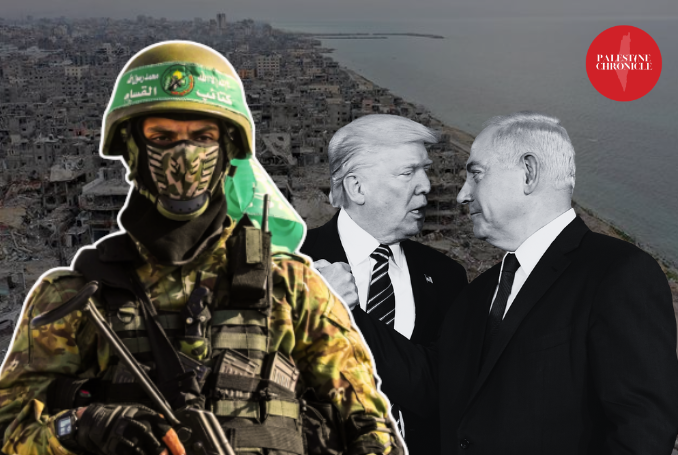

A draft US-backed framework for Gaza proposes the phased disarmament of Palestinian resistance groups in exchange for reconstruction and a new governing structure. Presented internationally as a stabilization initiative, the plan effectively conditions political progress and Israeli withdrawal on the dismantling of armed resistance — placing security arrangements before sovereignty.
Key Developments
- The United States demands Hamas surrender weapons capable of striking Israel while initially retaining small arms.
- Israeli troop withdrawal depends on full demilitarization of Gaza factions.
- An international force and technocratic Palestinian administration would govern the enclave.
- Reconstruction and normalization would follow compliance with the security framework.
- Hamas rejected unconditional disarmament and linked the issue of weapons to the continuation of occupation.
Security Plan before Political Settlement
The New York Times reported that mediators drafted a proposal requiring the Palestinian Resistance movement Hamas to surrender strategic weapons during an interim political arrangement.
“The United States is demanding that Hamas surrender all weapons that are capable of striking Israel, but will allow the group to keep some small arms, at least initially,” officials familiar with the proposal reportedly said.
The plan, according to the report, outlines a staged process: ceasefire stabilization, disarmament, international supervision, and only afterward reconstruction and political transition.
Washington framed the objective as building “a durable security framework that supports long-term stability in the region and prosperity for Gaza.”
Israel’s withdrawal is directly tied to this sequence. The report noted that Israel is “unlikely to withdraw its troops from the enclave before Hamas and other militant groups lay down their arms.”
Analysts cited in the report emphasized the centrality of the demand. “Demilitarization is the linchpin of everything,” said Shira Efron, chair of Israel policy at the RAND Corporation.
Qassam Spokesman Abu Obeida Warns Collaborators as Israel Reports Rafah Tunnel Killings
Governance without Sovereignty
The proposal envisions Gaza administered by a Palestinian technocratic committee backed by an international stabilization force.
Large-scale reconstruction would begin only after security arrangements are implemented, and authority over weapons collection remains undefined.
Al-Jazeera reported that the framework leaves unresolved who would ultimately control security in Gaza or manage surrendered arms — raising concerns the territory could shift from siege to externally supervised administration rather than self-rule.
The absence of elections, national representation, or clear sovereignty mechanisms suggests a governance model focused on management rather than liberation.
Israeli Withdrawal Conditional on Disarmament
The plan aligns closely with Israel’s conditions for ending its genocidal war in Gaza.
Tel Aviv has reportedly refused to accept any arrangement short of full demilitarization and views Hamas’ underground tunnel network as part of its military infrastructure.
Why Deterrence Failed and the Second ‘Flood’ is Coming as Israeli Arrogance Persists
Under the framework, Israeli troop withdrawal would occur only after disarmament is completed rather than in parallel with it.
This sequencing places Palestinian obligations ahead of binding political guarantees, effectively making progress in negotiations contingent upon prior security concessions.
Hamas: Resistance Linked to Occupation
Hamas has not formally accepted the proposal but signaled openness to long-term calm under guarantees.
However, its leadership rejected unconditional disarmament. “As long as there’s an occupation, there’s resistance,” senior Hamas official Khaled Meshal said in Doha, The New York Times reported, citing remarks at a public event in Qatar.
The movement has repeatedly rejected the premise of surrendering weapons as a precondition for political progress, with discussions conveyed through mediators including Qatar, Egypt and Türkiye.
(PC, New York Times, Anadolu, Al-Jazeera)



In the relatively recent history that Israel keeps harking back to, namely the Second world War, I do not think anyone asked the local Resistance forces in Nazi-Occupied Europe to disarm before the Wehrmacht – the army accused of committing atrocities agaisnt the civilian population – disarmed and left. Ergo, if Israel is to keep harking back to WW2, then it is incumbent on Israel to disarm completely before Hamas or Hizbullah or any other such group, disarms. This should be raised as often as possible, to remind people of the historical context Israel so often abuses.