
By Jeremy Salt
Like Gallipoli, again, any attempt to control the Strait of Hormuz from land or sea or actually launch a ground invasion of Iran from the sea would seem doomed to defeat and humiliation.
In an article for Consortium News, Alfred McCoy has drawn a parallel between the current blockade of the Strait of Hormuz and the Suez War of 1956, when Egypt’s President Nasser blocked the Suez Canal with sunken ships.
Where this might have led, we don’t know because President Eisenhower, furious at being deceived by Britain, France and Israel, intervened and forced an end to the war 10 days after it had been launched.
Threatened with financial sanctions, Britain and France withdrew immediately. Israel refused to leave occupied Sinai until pressure from the US worked in 1957.
Thus, while the sunken ships would have threatened the global economy, the blockade lasted only until Eisenhower brought the war to an end.
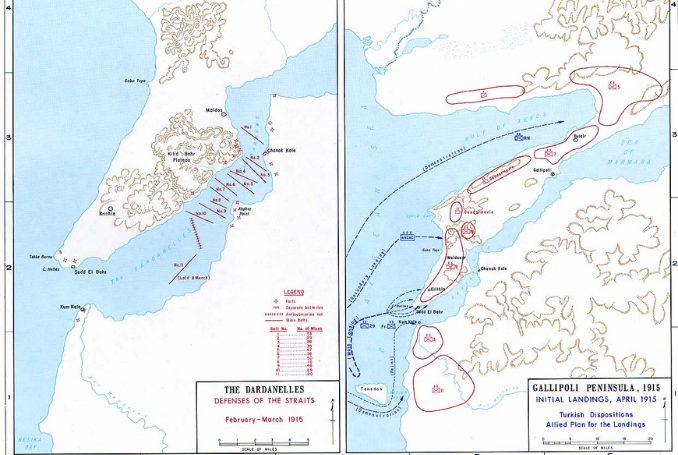
A closer parallel to the situation in the Strait of Hormuz might be Gallipoli in 1915. The Bosporus Strait or ‘throat’ (bogaz) connects the Black Sea to the Sea of Marmara, which then debouches into the Aegean Sea through the Canakkale Strait, better known in the west since antiquity as the Dardanelles. The Gallipoli peninsula separates the Sea of Marmara from the Aegean.
The strait, a major global trade route in the 19th century, like the Strait of Hormuz now, was always vulnerable to wartime pressure. This was demonstrated anew after Italy invaded Libya, then an Ottoman sovereign possession, in 1911.
Italian claims of disorder and threats to Christians in Libya were lies, but accepted by the British government as justification for the invasion. The bottom line was that the imperial powers were carving up Africa, and a new member of the club, Italy, was entitled to its share.
The Libyan coast was quickly occupied, but the Italians were blocked from penetrating the interior by the joint resistance of the tribes and a small Ottoman force. Frustrated, the Italians began looking for targets around the Aegean and eastern Mediterranean to put pressure on the sultan and his government.
In May, Italy occupied Rhodes and subsequently all islands in the Dodecanese (southern Aegean) except Kastellorizo.
In November, Italian warships shelled the Yemeni coast. In January, ‘Aqaba and the Ottoman garrison at Qunfidha, also on the Red Sea coast, were bombarded.
As this did not force the Ottomans to submit, a flotilla was sent to Beirut in February 1912. When the Ottomans refused to surrender, a destroyer, the Italian flagship, the Garibaldi, sent a torpedo into the side of a coastal vessel, killing eight officers and 55 men.
It then went on to sink the destroyer and bomb the city, killing 66 people, wounding hundreds of others, and severely damaging government buildings and banks. As again, this did not break Ottoman resistance, the Italians turned their attention to the Canakkale straits.
In April, a flotilla of 14 ships was sent to the entrance of the Canakkale Strait. Ottoman telegraph communications were cut with the islands of Imroz (Gokceada), Tenedos (Bozcaada), and Lemnos (Limni), as well as Selanik (Salonica) and towns down the Aegean coast.
The forts lining the strait were then bombarded. The Ottoman government responded by closing the strait and mining the Gulf of Izmir. The US-flagged steamer Texas hit one of the mines and sank, with the loss of 70 lives.
By April 30, about 150 ships carrying grain, corn, petroleum (from Romania), iron ore, timber, coal, naptha, and other goods, including perishables such as maize, were trapped between the Canakkale strait and the Black Sea. This threat to trade was the real crisis for British and European governments, not Italy’s war of aggression against Libya
The British response was the suggestion to Russia that Italy be asked not to bomb the strait or other targets nearby, to which the Russian foreign secretary responded that Russia wanted to keep on the friendliest terms with Italy as it was “a valuable counterpoise to Austria in the Balkans.”
Under European pressure, the strait was finally opened. The Ottoman defence of Libya was soon brought to an abrupt end in October when four Balkan states (Serbia, Bulgaria, Greece, and Montenegro) attacked the Ottoman Empire in Macedonia and Thrace. Libya had to be abandoned in the defence of the near homeland.
Commenting on the final settlement (the Treaty of Lausanne) between the Ottoman and Italian governments, the British Foreign Secretary said that “We should have no political objection to recognise the full and entire sovereignty of Italy over Libya.” With Britain invading and colonizing other countries itself, Italy was allowed to seize Libya as long as British commercial interests were not damaged.
In 1915, the Gallipoli campaign began with a failed attempt in March by French and British warships to force the Canakkale Strait and sail through the Sea of Marmara all the way to Istanbul. As the city had been promised to Russia in the wartime agreements, what would have happened if they had succeeded in overthrowing the Ottoman government in its capital has to remain a moot point.
In the event, apart from the batteries on the coast, mines had been laid in the strait. They were far more dangerous. The British and French thought they knew where they were, but their intelligence was outdated.
New mines had been laid, and the French and British warships sailed straight into them. A French battleship was destroyed, two British ships sank, and others were abandoned. Hundreds of lives were lost. For Britain, the loss of ships was the greatest since the Battle of Trafalgar in 1805.
It was then decided to launch a land campaign, which is where another comparison with the Strait of Hormuz begins. The Strait of Hormuz is more than 160 kms in length and is bounded on the Iranian side by rugged cliffs. The Gallipoli peninsula is about 60 kms long and bounded for much of its length on the Aegean side by steep hills and cliffs set back from the beach.
With the Turks commanding the high ground – as Iran would against any invading force entering the Strait of Hormuz – the allied land campaign began to fail at the start. Soldiers were shot as they jumped from the landing craft. The Ottomans repelled repeated attempts to scale the heights, leaving the invaders trapped below. This went on for months. In December, the retreat of the allied forces was ordered, and by early 1916, all had gone.
It was a great triumph for the Ottomans, to be repeated in 1916 when the siege of Kut in Iraq ended with the surrender of the British-Indian army. 13,000 soldiers were captured. The commanding officer, Charles Townshend, was treated with respect and sent to the island of Heybeliada, where he spent the rest of the war in comfort, even inviting his wife to join him.
Britain tried to put the best propaganda face on Gallipoli by turning defeat into some kind of victory, because it had been effected without the Turks knowing. This was nonsense. The Turks could see from the heights that the allied forces were leaving and were just glad to get rid of them.
The Gallipoli parallel indicates the even worse dangers facing any expeditionary force sent to the Strait of Hormuz. In such a narrow stretch of water, its ships would be immediately under threat from Iranian missiles. On land, the whole Iranian coastline has been seeded with a network of defensive installations, many deep underground and difficult, if not impossible, to destroy.
While there are beaches, the terrain is generally very rugged, with cliffs ranging in height from 75 to 2040 meters. The challenge would be infinitely greater than Gallipoli if any attacking force attempted to scale these heights.
Like Gallipoli, again, any attempt to control the Strait of Hormuz from land or sea or actually launch a ground invasion of Iran from the sea would seem doomed to defeat and humiliation, as US military planners and strategists must realize, even if Donald Trump and the cohort around him don’t.

– Jeremy Salt taught at the University of Melbourne, at Bosporus University in Istanbul and Bilkent University in Ankara for many years, specializing in the modern history of the Middle East. Among his recent publications is his 2008 book, The Unmaking of the Middle East. A History of Western Disorder in Arab Lands (University of California Press) and The Last Ottoman Wars. The Human Cost 1877-1923 (University of Utah Press, 2019). He contributed this article to The Palestine Chronicle.





Excellent analysis!