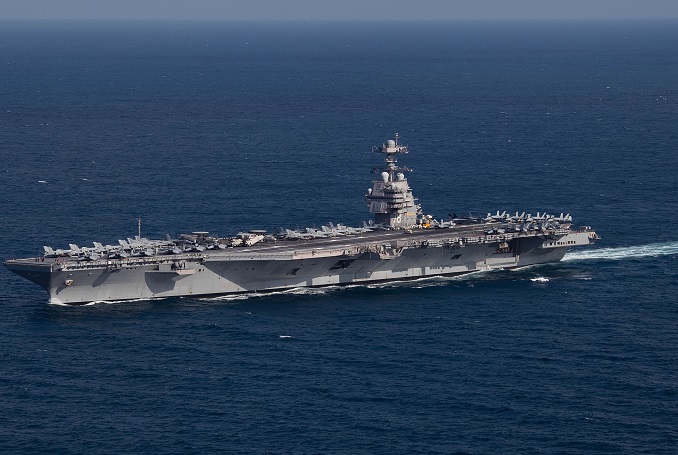

USS Gerald Ford withdrew from Iran war after onboard fire, exposing deeper operational flaws in America’s most expensive warship, Bloomberg reported.
Key Takeaways
Pentagon report finds “insufficient data” to assess the carrier’s combat effectiveness nearly a decade after delivery.
Key systems—including launch, radar, and weapons elevators—remain unreliable under realistic wartime conditions.
Parallel reliance on older carriers like USS Abraham Lincoln underscores strain across US naval deployments in ongoing regional war.
Broader Problems
The USS Gerald R. Ford, the most expensive warship ever built by the United States, has withdrawn from operations in the Middle East after a fire broke out onboard, but a Bloomberg report on Tuesday indicates the incident reflects deeper structural issues.
The aircraft carrier, deployed as part of US operations linked to the war on Iran, was forced to leave the region and dock in Crete after the fire in a laundry area led to more than 200 sailors being treated for smoke inhalation.
However, according to a Pentagon testing office assessment cited by Bloomberg, the vessel’s challenges extend far beyond this incident.
Despite being delivered in 2017 at a cost of $13.2 billion, the ship’s combat readiness remains uncertain.
Outlasting the Superpower: The Reasons Why Iran is Beating uhe US and Israel
The Pentagon report states that “insufficient data are available at this time” to determine the Ford-class carrier’s operational effectiveness, even nine years after delivery.
This lack of clarity stems from incomplete realistic combat testing, raising questions about how the vessel would perform in a sustained war scenario.
The report highlights ongoing concerns with several core systems, including the aircraft launch and recovery system, radar, and weapons elevators.
It remains unclear whether the carrier could sustain operations under enemy fire or manage the intense pace of continuous sorties expected in wartime.
As noted in the assessment, there is insufficient data to evaluate the ship’s “operational suitability”, particularly under real combat conditions.
Despite unresolved issues, the USS Gerald R. Ford was deployed for extended operations, including missions linked to Venezuela, before being redirected to the Middle East.
According to the report, the carrier has been at sea for roughly nine months—well beyond the standard deployment cycle—placing additional strain on both equipment and crew.
USS Abraham Lincoln also Withdraws
The Ford’s exit comes alongside reports that the USS Abraham Lincoln, another US aircraft carrier deployed to the region earlier this year, has also withdrawn from operational areas amid escalating tensions.
The Lincoln had been sent to the Middle East in January as part of Washington’s military buildup ahead of strikes on Iran, forming a core component of US naval pressure in the region.
Iran Targets USS Abraham Lincoln as USS Ford Fire Exposes US Naval Strain
However, reports indicate it later pulled back from waters near the Strait of Hormuz following heightened confrontation risks, including encounters involving Iranian drones, though US officials have not publicly detailed the circumstances of its repositioning.
Taken together, the departure of both carriers—one following a technical incident and the other amid operational tensions—points to growing strain on US naval deployments as the war on Iran enters a more prolonged and volatile phase.
Unresolved Fixes and Funding Gaps
According to Bloomberg, the Pentagon testing office also found that some identified system flaws on the Ford have yet to be resolved.
Fixes developed for combat systems remain largely unfunded, according to the report, raising further concerns about readiness.
In addition, logistical issues such as insufficient berthing capacity—requiring at least 159 additional bunks—highlight ongoing operational constraints.
“These berthing shortfalls will affect quality of life onboard,” the testing office warned.
The Pentagon’s findings point to a widening gap between the projected capabilities of advanced US military systems and their tested performance in real-world conditions.
As Washington continues to depend on carrier strike groups to sustain pressure on Iran, both the limitations of next-generation platforms like the Ford and the aging profile of vessels like the Lincoln may shape operational outcomes.
In a prolonged conflict, these structural constraints could become increasingly significant, affecting both military effectiveness and strategic planning.
(PC, Bloomberg, Reuters)