
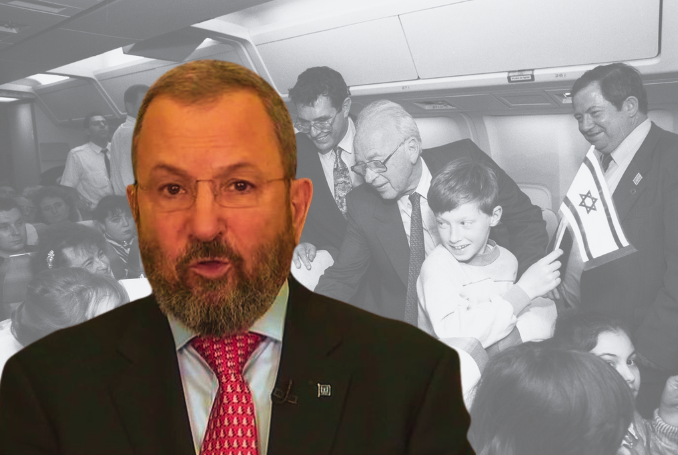

New Epstein files include an audio recording of Ehud Barak discussing selective mass immigration to Israel.
Key Takeaways
- An Epstein files audio captures a conversation between Ehud Barak and Jeffrey Epstein on immigration to Israel.
- Barak said Israel could “easily absorb another million” immigrants from Russian-speaking countries.
- He argued authorities can now be “selective” compared to earlier immigration waves.
- Barak linked immigration to demographic, economic, and cultural change.
- He said “social pressure” could accelerate integration of new arrivals.
- The recording has renewed scrutiny of Epstein’s ties to Israeli political figures.
Epstein Files Release Includes Barak Recording
A newly released audio recording from the Epstein files has drawn attention to a private conversation between former Israeli Prime Minister Ehud Barak and convicted sex offender Jeffrey Epstein, in which Barak discusses large-scale immigration to Israel and how it could be managed under current conditions.
The undated recording was released as part of millions of documents made public by the US Department of Justice under the Epstein Files Transparency Act. It forms part of a broader disclosure examining Epstein’s relationships with political and business figures across several countries.
In the audio, Barak outlines what he presents as Israel’s capacity to absorb a significant number of immigrants from Russian-speaking countries and describes how immigration policy could be adjusted compared to earlier periods.
Mapping Epstein’s Israel Connections: What the Documents Show
“Easily Absorb Another Million”
During the conversation, Barak states that Israel could “easily absorb another million” immigrants. He contrasts present conditions with earlier immigration waves, which he describes as driven primarily by humanitarian urgency.
“They took whatever came just to save people. Now we can be selective,” Barak says.
He adds that Israeli authorities could better “control the quality” of new arrivals and suggests that integration could be accelerated through social mechanisms. “Social pressure” would help newcomers adapt, he argues.
Immigration as Demographic Change
Barak links mass immigration to broader structural change inside Israel. He describes the arrival of an additional one million immigrants as capable of producing what he calls a “dramatic” transformation, extending beyond population figures to economic and cultural life.
He refers to the post-Soviet immigration wave of the 1990s, during which approximately one million Russian-speaking immigrants arrived in Israel, a period widely credited with reshaping the country’s labor market, military composition, and political alignments. Many of the new arrivals also populated the illegal settlements throughout the West Bank, thus directly contributing to the slow ethnic cleansing of the Palestinains.
In the recording, Barak recalls telling Russian President Vladimir Putin that Israel needed “not just one more million,” referencing the scale of change produced by that earlier wave.
Blair, Epstein, and Israel: How Tony Blair’s Israel Networks Returned at a Critical Juncture
Identity, Eligibility, and Integration
The recording also addresses questions of eligibility and belonging. Barak suggests that necessity can create “flexibility” in how criteria are applied and argues that Israel can now afford to be more “tolerant” in defining who qualifies for immigration.
He references religious narratives when discussing broader inclusion and indicates that integration could proceed quickly, even joking about hybrid Russian-Israeli names appearing in military units as an example of how newcomers would assimilate.
The recording adds to existing scrutiny of Epstein’s relationships with Israeli political figures. Barak met Epstein several times in 2015 and 2016, years after Epstein’s 2008 conviction, and was photographed entering Epstein’s Manhattan residence.
The Epstein Files: Israel, Trump, and What Mainstream Media Leaves Out
Immigration Policy and the Question of Return
Israel’s immigration system is governed primarily by the Law of Return, enacted in 1950, which grants Jews from anywhere in the world the right to immigrate to Israel and obtain citizenship. Over the decades, this framework has enabled millions of Jewish immigrants—from Europe, the former Soviet Union, the Middle East, Africa, and the Americas—to settle in Israel.
At the same time, Palestinians ethnically cleansed during the 1948 Nakba and the 1967 war, along with their descendants, remain denied the right to return to their homes. The Palestinian right of return is affirmed in international law, including UN General Assembly Resolution 194, which states that refugees wishing to return to their homes and live in peace should be permitted to do so.
Israel rejects the applicability of this right, citing demographic and political considerations. As a result, while immigration pathways remain open to Jews globally, Palestinian refugees—numbering in the millions—continue to be barred from returning to towns and villages from which they were displaced.
(AJA, Israeli Media, PC)





Be the first to comment