

Hezbollah announced multiple operations on Monday as Israeli media reported increasing concern over the movement’s expanding drone attacks.
Coordinated Series of Operations
The Lebanese resistance movement Hezbollah announced on Monday a series of military operations targeting Israeli occupation soldiers, military vehicles and positions in southern Lebanon and northern occupied Palestine, amid continuing confrontations following repeated violations of the ceasefire agreement reached on April 18.
According to statements issued by the movement, operations began in the morning and continued throughout the day, targeting Israeli forces in multiple locations.
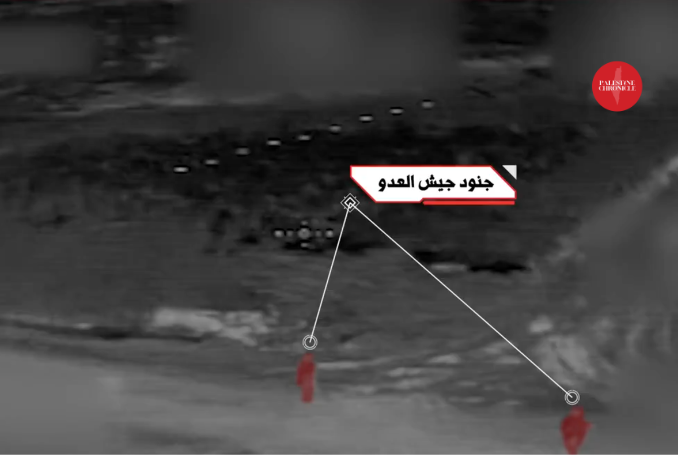
At 10:45 AM., resistance fighters said they targeted a gathering of Israeli soldiers at a newly established military site in Jal al-Hammar, south of Adaysah, using a swarm of attack drones.
Shortly afterward, at 11:10 AM, Hezbollah announced that fighters targeted a Merkava tank in the town of Dibil using an Ababil attack helicopter, stating that a direct hit had been achieved.
🇱🇧 First footage of Hezbollah's night-vision fiber-optic FPV drone being used against IDF personnel in the El-Bayada area of southern Lebanon. pic.twitter.com/WPOjtVZXo7
— DD Geopolitics (@DD_Geopolitics) May 25, 2026
The movement later announced additional strikes against a second Merkava tank and an Israeli artillery emplacement in Adaysah, also using Ababil aerial units.
Afternoon operations expanded further, according to the statement.
Hezbollah said it launched rocket barrages targeting Israeli soldiers and vehicles in Al-Qouzah, Rashaf and the newly established Balat military site. It also announced an aerial attack targeting Israeli forces in the Misgav Am settlement.
The movement said the operations came in defense of Lebanon and in response to what it described as continuing Israeli violations of the ceasefire agreement and attacks targeting villages in southern Lebanon that resulted in civilian casualties and injuries.
Israeli Media Reports Growing Concern
The operations coincided with reports in Israeli media pointing to increasing concern regarding Hezbollah’s expanding use of drones.
Israeli newspaper Maariv reported hours of drone and aerial attacks across northern areas, citing military correspondent Avi Ashkenazi, who said Hezbollah’s explosive aerial vehicles had increasingly become “a kind of precision missile launcher.”
Israeli media also reported explosions involving explosive drones in the Misgav Am area and said a house in the Shomera settlement area sustained a direct hit.
Additional reports claimed that injuries, fires and structural damage had occurred during attacks and alleged that evacuation efforts had become increasingly difficult.
⚡️Hezbollah:
Targeting an Israeli army military fuel tanker in the city of Bint Jbeil, southern Lebanon, with an Ababil drone on 14-05-2026. pic.twitter.com/QbaxaoTXSj
— Warfare Analysis (@warfareanalysis) May 25, 2026
Israel’s Channel 12 reported that Hezbollah had significantly increased the use of suicide drones in addition to its existing surveillance capabilities.
The channel said dozens of drone incidents had been recorded overnight, many targeting settlements near the Lebanese border, while also reporting that the range of Hezbollah attacks had expanded beyond previous operational patterns.
‘Strategic Threat’
Israeli newspaper Yedioth Ahronoth described Hezbollah’s drone capabilities as evolving beyond a tactical battlefield challenge into what it called a “strategic threat.”
According to the newspaper, Hezbollah increasingly gathers intelligence regarding Israeli troop deployments before concentrating attacks on specific operational areas.
The report said the movement launches multiple drones either simultaneously or in successive waves, allowing attacks to create continuing pressure on forces operating in the field.
Yedioth Ahronoth also reported that Hezbollah has continued improving explosive devices and described the confrontation as a growing “battle of attrition.”
The newspaper stated that the drone threat has begun producing operational changes on the Israeli side.
According to the report, engineering equipment was recently withdrawn from some operational areas due to drone threats, while contractors reportedly received instructions that much of their work should take place during nighttime hours.
The newspaper added that the resulting conditions slowed demolition and construction activity.
Israeli media further suggested that political leaders had not anticipated developments taking this course or the current battlefield environment created under the ceasefire arrangement.
The reports noted growing uncertainty regarding the future direction of operations in the north as confrontations continue along the Lebanese border.
(PC, Al Mayadeen, Hezbollah military media)




“political leaders had not anticipated developments taking this course” — bad intel in, bad “courses” out